
Key Takeaways
Wati’s real monthly bill is driven by hidden markups, chatbot overages, and extra user seats—not the advertised base price.
As conversations, automation, and agents scale, Wati costs often 3–5x the headline plan, especially for growing Shopify brands.
Flowcart removes message markups, user limits, and chatbot caps, using revenue-based WhatsApp commerce pricing that stays predictable at scale.
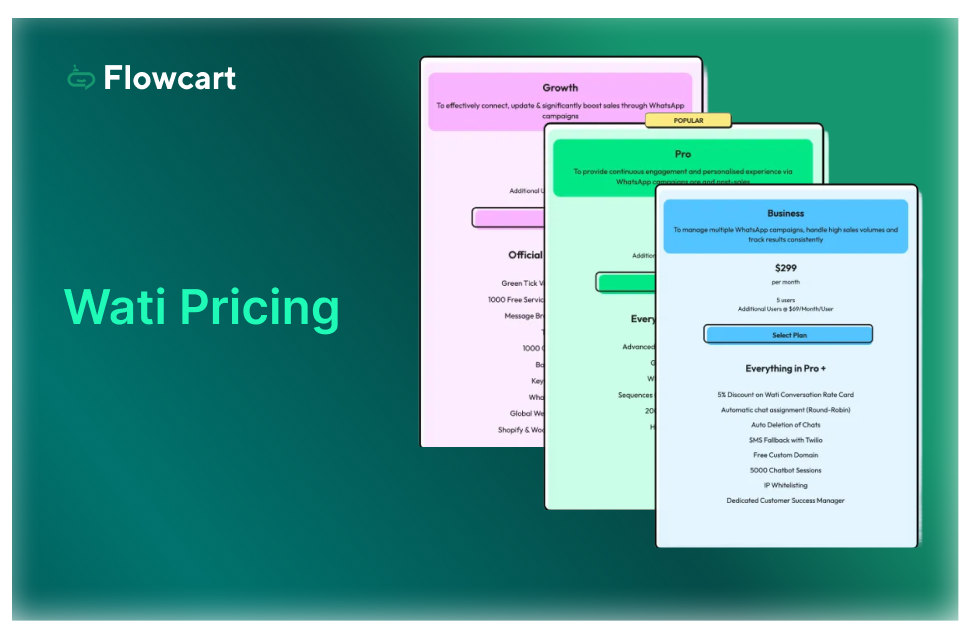
Wati advertises plans starting at $49 or ₹2,499 per month, but this headline price rarely reflects what teams actually pay each month.
Real pricing depends on message volume, automation usage, and team size—factors that aren't immediately obvious upfront.
This guide covers:
- How Wati pricing actually works
- Where costs increase unexpectedly
- When teams start looking at alternatives like Flowcart
This analysis is written from Flowcart's perspective, focused on helping teams make informed decisions about WhatsApp platform costs.
What Is Wati and Who Is It Built For?
Wati is a WhatsApp Business API management platform that enables businesses to send bulk messaging, automate conversations via chatbots, and manage multi-agent support.
Typical customers include e-commerce brands, D2C retailers, SaaS companies, and service businesses with 2-50+ support or sales agents.
Teams commonly use Wati for broadcast campaigns, FAQ automation, multi-agent customer support, order confirmations, abandoned cart recovery, and lead qualification workflows.
How Wati's Pricing Structure Actually Works
The base subscription fee covers access to the platform and a set number of users, chatbot sessions, and integrations, but not message delivery costs.
Pricing scales based on message volume, chatbot automation triggers, extra user seats, and premium integrations or features.
Every Wati bill includes three components:
- Subscription fee (fixed monthly or annual cost for Growth, Pro, or Business plan tier)
- Per-message charges (Meta rate plus Wati's markup on marketing, utility, and authentication messages)
- Add-ons (extra users, chatbot session top-ups, Shopify integration, AI features, Green Tick verification)
Most teams underestimate their real monthly spend because message markup fees and chatbot overages only appear after sending.
Wati Pricing Plans Explained (2026)
1. Growth Plan
Who This Plan Is For
- Startups and small e-commerce teams handling 1-3K conversations monthly with 2-3 agents
- New WhatsApp automation initiatives testing viability before scaling up to larger volumes
Base Price
The Growth plan costs $49 monthly with annual billing, $69 monthly, or ₹2,499 monthly in India.
What's Included
- 3-5 user seats with shared team inbox for multi-agent support
- 1,000 chatbot sessions per month for automation triggers and flows
- 1,000 free service messages monthly for customer replies within 24-hour window
- 2 integrations with limited CRM or Shopify access
- Basic broadcast and campaign tools with Click-to-WhatsApp (CTWA) analytics
- 24x5 email support for technical assistance and troubleshooting
Where This Plan Starts Breaking Down
- Scaling beyond 1-2K conversations monthly triggers compounding per-message markup fees of ₹1,000-2,000 monthly
- Adding a 4th or 5th agent costs ₹1,299 per user monthly, effectively doubling the base plan cost
2. Pro Plan
Who This Plan Is For
- Growing e-commerce brands managing 5-20K conversations monthly with multi-agent teams
- Mid-market SaaS companies needing customer support automation with advanced chatbot workflows and integrations
Base Price
The Pro plan costs $99 monthly with annual billing, $149 monthly, or ₹5,999 monthly in India.
What's Included
- 5 user seats with advanced chatbot builder supporting 200+ nodes per flow
- 2,000 chatbot sessions monthly, double the Growth tier automation capacity
- 1,000 free service messages monthly for inbound customer replies
- 5 integrations including HubSpot, Zapier, advanced Shopify, and Google Sheets workflows
- WhatsApp Forms for lead capture with message sequence automation
- 250 AI Support Agent responses monthly for automated reply assistance
- 24x7 email and chat support with improved service level agreements
Where This Plan Starts Breaking Down
- User seat ceiling at 5 included; adding 6th-10th users costs ₹1,299 each totaling ₹6,495 extra monthly
- High-volume campaigns consuming 5-10K chatbot sessions monthly require $90-$270 add-ons beyond included 2K sessions
3. Business Plan
Who This Plan Is For
- Large e-commerce or multi-location retail handling 50K-500K conversations monthly with distributed teams
- Enterprise SaaS with 15-50+ support agents integrating WhatsApp into revenue workflows like checkout and payments
Base Price
The Business plan costs $279 monthly with annual billing, $349 monthly, or ₹16,999 monthly in India.
What's Included
- 5 user seats with round-robin chat assignment auto-distributing to next available agent
- 5,000 chatbot sessions monthly for high-volume automation workflows
- 1,000 AI Support Agent responses monthly, four times the Pro tier capacity
- Unlimited integrations with advanced API access supporting 10K calls monthly
- IP whitelisting for security with custom branded domain option and free setup
- 24x7 priority support with dedicated success manager for enterprise accounts
Where This Plan Starts Breaking Down
- Still capped at 5 users; enterprises with 20+ support staff pay ₹99,950 monthly for extra seats alone
- 5K chatbot session limit insufficient for high-volume seasons hitting 15K+ sessions requiring $270 monthly add-ons
Wati Pricing at a Glance
What Actually Drives Your Monthly Cost on Wati
1. Message Volume & Markup Fees
Every marketing, utility, or authentication message consumes credits at Meta's official rate plus Wati's 20% markup, scaling unpredictably with volume spikes.
One successful campaign generating 5-10x normal volume creates bill jumps of 5-10x that month, with Black Friday or seasonal peaks adding ₹20K-50K in message charges. On 100K conversations, the 20% markup penalty equals an extra ₹15,612 monthly compared to Meta's official ₹0.7846 per marketing message rate.
2. Chatbot Sessions & Automation
Every chatbot rule or automation trigger fires consuming one session from your monthly allotment, with overages requiring $30-1,590 monthly top-ups.
Growing teams hitting 10K triggers monthly pay $270 monthly add-ons—54% of Pro plan's base cost—because each chatbot rule multiplied by customer count creates multiplicative consumption.
3. User Seats & Team Growth
Support or sales team members assigned to the Wati inbox count as users, with only 5 included per plan tier.
A 10-person support team on Growth pays ₹2,499 base plus ₹6,495 for 5 extra users—a 260% increase—while Business tier teams adding 5 users pay ₹36,994 total monthly.
4. Integrations & Premium Features
Connecting Wati to Shopify costs $4.99 monthly, WhatsApp Green Tick verification costs $50 per country, and dedicated account managers cost $200 monthly.
A Pro plan team adding Shopify integration, keyword automation, and AI agent upgrades pays ₹16,000+ monthly before message or user overages compound further.
Real-World Wati Pricing Examples
Example 1: Small Team / Low Usage
Business Profile
Niche e-commerce brand selling handmade goods handles 1,000 conversations monthly with 2 full-time customer service agents running limited automation.
Cost Breakdown
- Growth plan: ₹2,499/month
- Message costs: 1,000 marketing messages @ ₹0.94/message = ₹940
- Chatbot overage: 500 sessions used (under 1K limit) = ₹0
- Integrations: None = ₹0
Actual Monthly Cost: ₹3,439
On paper Growth costs ₹2,499; actual spend reaches ₹3,439—38% higher with ₹940 message markup invisible until billing.
Example 2: Growing Brand
Business Profile
D2C Shopify brand scaling to 7-figure revenue handles 15,000 conversations monthly with 4 agents running moderate automation and abandoned cart recovery.
Cost Breakdown
Advertised cost shows ₹5,999; actual reaches ₹26,524—342% higher with chatbot and message overages invisible until teams scale.
Example 3: High-Volume / Seasonal Business
Business Profile
Large e-commerce platform handles 40K conversations monthly off-season with 8 agents, spiking to 100K conversations with 12 agents during holiday peaks.
Off-Season Cost: Business plan (₹16,999) + 3 extra users (₹11,997) + 40K messages (₹37,600) + 3K chatbot overage (₹6,000) + AI support (₹5,100) = ₹77,696/month
Peak Season Cost: Base + users (₹28,996) + 100K messages (₹94,000) + 10K chatbot overage (₹22,950) + integrations (₹5,100) = ₹151,046/month
Seasonal variance equals +97% from off-season to peak, with scaling non-linear and highest volume periods not delivering best unit economics.
Where Wati Pricing Falls Short as You Scale
Pricing pain usually shows up during growth phases when message volume, automation usage, and team expansion hit simultaneously rather than at initial signup.
Teams face three critical scaling issues:
- Cost visibility opacity: 20% message markup, chatbot overages, and user seat limits hidden across support articles until invoices arrive
- Message markup at scale: 20% penalty on 100K conversations equals ₹15,600 monthly hidden tax compared to zero-markup alternatives like Flowcart
- User seat bottleneck: Scaling from 5 to 10 agents adds ₹6,495-12,990 monthly with per-seat costs rising faster than revenue
Businesses typically outgrow Wati when monthly bills exceed ₹12,000-15,000 from accumulated overages or when alternative platforms' total ownership costs drop below Wati's per-unit economics.
How Flowcart Approaches Pricing Differently
Flowcart is a WhatsApp-first commerce and revenue platform with pricing reflecting a revenue-based fee model instead of per-user and per-message costs.
Key differences include:
- Zero message markup: Passes through Meta rates only vs Wati's 20% markup penalty
- Unlimited agents and chatbot sessions: No per-seat costs or automation caps vs Wati's 5-user ceiling
- Transaction-based fees: 0.5-1.5% per transaction tied to revenue growth vs Wati's linear per-message scaling
Teams typically switch from Wati to Flowcart when revenue focus shifts to in-chat commerce, chatbot costs exceed ₹15K monthly, or team scaling hits the 8-10 agent ceiling where unlimited seats become economically attractive.
Wati vs Flowcart: Which Is the Better Fit?
The choice depends on whether your priority is cost-efficient support or revenue-focused commerce with unlimited scaling.
When Wati Makes Sense (And When Flowcart Is a Better Choice)
Wati Makes Sense If…
- Primary use case is customer support or lead qualification requiring 24x5 multi-agent inbox rather than in-chat commerce
- Team size stays at 2-5 agents where per-user pricing hasn't become a burden on monthly budgets
- Message volume remains under 10K monthly keeping markup fees under ₹10K as a minor cost driver
Flowcart Is a Better Fit If…
- Revenue goal centers on in-chat sales and checkout with abandoned cart recovery and product discovery as core strategy
- Team includes 8+ agents or is growing fast where unlimited seats eliminate per-user cost bloat entirely
- Message volume is predictable or seasonal where transaction-based fees scale with actual revenue instead of message count
Frequently Asked Questions About Wati Pricing
Does Wati have hidden costs?
Yes. Wati's advertised pricing omits per-message markups (20%), chatbot session overages, extra user seat costs, and integration fees.
The headline ₹2,499/month Growth plan doesn't reflect typical real spend. A small team sending 5K conversations monthly with 3 agents pays ₹7,000-9,000 when all costs are included. Markup fees alone equal ₹3,000-5,000 monthly beyond the base subscription fee.
Why is my Wati bill higher than expected?
Hidden costs materialize post-signup: message markup fees (₹0.14 extra per message), exceeded chatbot limits (₹2,000-14,400 add-ons), or more agents than planned.
Teams often mistake "unlimited conversations" (unlimited volume) with "unlimited included costs." Each conversation triggers per-message charges and potential chatbot session consumption. One campaign doubling your monthly volume means your bill doubles. Preview costs using Wati's pricing calculator before scaling.
Can I predict my monthly cost on Wati?
Partially. Your base subscription fee is fixed, but per-message costs and add-on overages are unpredictable without detailed usage audits.
To predict costs: (1) Estimate monthly conversation volume → multiply by message type distribution (70% marketing @ ₹0.94, 20% utility @ ₹0.14, 10% auth @ ₹0.14). (2) Estimate chatbot triggers; (3) count actual agents needed. Budget 30-50% buffer for overages. Flowcart's pricing transaction model is more predictable if revenue is stable.
When should I switch from Wati to Flowcart?
Switch when monthly Wati costs exceed ₹12,000-15,000, your team grows beyond 5 agents, or in-chat commerce becomes a strategic priority.
If your business is scaling D2C e-commerce on Shopify and WhatsApp is a top sales channel, Flowcart's unlimited agents plus abandoned cart recovery plus transaction-based pricing typically cost 20-40% less than Wati at scale while offering commerce-specific features Wati lacks entirely.
Is Flowcart more expensive than Wati?
Not typically at scale. Flowcart starts at ₹6,250/month vs Wati's ₹2,499, but Wati's hidden markups and add-ons often exceed Flowcart's fees.
Break-even comparison: Wati small team (₹2,499 base + ₹940 messages + ₹4,000 users + ₹2,000 chatbots) = ₹9,439/month. Flowcart Starter (₹6,250 + 1% transaction on ₹300K/month sales = ₹3,000) = ₹9,250/month. Identical cost, but Flowcart provides unlimited agents while Wati caps at 5. For revenue-focused businesses, Flowcart's ROI is superior. Book a demo to compare your specific usage scenario.




%201.webp)




.png)