

Key Takeaways
- Cart Flow vs. Checkout Flow: Cart Flow needs manual handling; Checkout Flow automates shipping, payment, and confirmation via API. Checkout Flow scales faster and cuts drop-off risk.
- Proven Conversion Lift: In-chat checkout delivers 35% higher conversion rates and 23% fewer abandoned carts. Automated recovery converts 18-25% of abandoned sessions within 30 minutes.
- Infrastructure, Not Just Messaging: WhatsApp works best when integrated with CRM, payments, and inventory as a full transaction system. AI cart creation and automation turn conversations into scalable revenue.
- Speed Wins Purchases: Sub-60-second responses and no-redirect checkout compress buying decisions from hours to minutes. Keeping everything in one thread eliminates friction and preserves intent.
Most ecommerce brands still treat WhatsApp like a support channel. That's a mistake. The platform has evolved into a full e-commerce funnel where customers browse products, ask questions, negotiate options, and complete purchases without switching apps.
Two systems power this shift:
- Cart Flow
- Checkout Flow
Cart Flow relies on manual order handling after a customer adds items. Checkout Flow automates everything from shipping capture to payment processing using the WhatsApp Business API. The first works for small operations. The second scales revenue.
Brands using in-chat checkout see 35% higher conversion rates and 5× return on ad spend. This guide explains how both flows work, when to use each, and how Flowcart turns WhatsApp into a revenue engine.
What Are WhatsApp Cart & Checkout Flows?
Cart Flow is the basic setup. Customers browse your catalog inside WhatsApp and add items to a cart. Then they send an order message. From there, your team
- manually confirms availability
- collects shipping details
- arranges payment (usually via link or COD)
- processes everything outside the chat.
It works for testing demand or handling personalized sales, but every manual step creates drop-off risk.
Checkout Flow runs differently. Built on WhatsApp Business API, it automates the post-cart journey:
- Captures shipping details
- Calculates totals with tax and shipping
- Processes payment via Razorpay, Stripe, PayPal, or COD in-chat
- Confirms the order instantly
No waiting. No payment links in separate tabs. No confusion about order status.
Cart Flow is a conversation. Checkout Flow is a transaction system. Brands start with Cart Flow while building volume, then move to Checkout Flow when conversion speed and cart recovery automation become critical.
Why WhatsApp Commerce Matters in 2026?
Customer tolerance for multi-step checkout journeys is collapsing.
People expect instant replies and the ability to buy without switching apps. WhatsApp delivers this because
- Discovery
- Decision-making
- In-chat purchase
happen in one continuous conversation.
There's no redirect friction. No session timeout. No loss of context. 98% open rates and sub-60-second response times create conversion conditions that email and web checkout can't match.
When a customer asks "Do you have this in blue?" and gets an answer with an updated cart in 30 seconds, the purchase decision time compresses.
WhatsApp Business API messaging is forecasted to hit 3.57 trillion messages between 2024 and 2027. The channel isn't emerging anymore. It's load-bearing for brands that understand speed matters as much as traffic volume.
Where WhatsApp Cart & Checkout Flows Drive Results?
Conversational Commerce: Browse, Chat, Buy
Traditional e-commerce assumes customers will navigate websites independently. Conversational commerce inverts this.
The customer states intent ("running shoes under $100"),
- system responds with curated options
- answers questions
- adjusts recommendations
- moves to checkout.
The entire buying journey collapses into a 2-5 minute conversation.
Lead Capture With Automated Follow-Up
When someone engages via a Click-to-WhatsApp Ad but doesn't buy immediately, the thread becomes a persistent lead asset.
Automated flows
- capture phone numbers
- product interest
- then trigger follow-ups based on time elapsed or inventory changes.
WhatsApp remarketing campaigns convert 45-60% of engaged users, far outperforming email sequences.
AI-Powered Product Recommendations
AI-generated carts don't just speed up checkout, they introduce intelligent discovery that static catalogs can't deliver.
When a customer describes a need in natural language,
- the system parses intent
- cross-references inventory
- assembles relevant bundles.
This works especially well for complex catalogs like skincare routines or supplement stacks.
In-Chat Payment Integration
Redirecting customers to external checkout leaks intent at every step.
- In-chat checkout with UPI, wallets, cards, or COD keeps transactions inside the thread.
- Merchants using this approach report 23% fewer abandoned carts.
Post-Purchase Engagement
The conversation doesn't end at checkout. WhatsApp becomes the hub for everything that follows:
- Order tracking and delivery updates arrive in the same thread
- Return initiations happen through simple messages, not portal logins
- Customers reopen existing chats instead of digging through email
- This continuity reduces support load while creating natural upsell moments
High-Impact Broadcast Campaigns
Email open rates hover around 15-25%. WhatsApp sits near 98%. But open rates aren't the real story.
- Broadcast recipients can reply immediately and ask questions
- Product launch announcements become two-way sales conversations at scale
- Single broadcast can trigger hundreds of individual buying threads
- Response quality beats email by orders of magnitude, not just percentages
What Are The Benefits of WhatsApp Checkout Systems?
- Faster purchase decisions: Sub-60-second response times eliminate hesitation. Buying decisions happen in minutes instead of hours.
- Fewer drop-offs: Every redirect introduces friction. Keeping journeys inside WhatsApp preserves intent through checkout.
- Dynamic personalization: Conversational context enables real-time product recommendations based on customer queries and past behavior.
- Frictionless payments: Payment method flexibility (UPI, cards, wallets, COD) combined with single-tap checkout creates conditions web funnels can't match.
- Stronger relationships: Direct communication builds trust faster than faceless ecommerce sites, increasing repeat purchase rates.
- Richer behavioral data: Every interaction and conversion path is trackable, informing AI segmentation and campaign optimization.
How to Set Up WhatsApp Cart & Checkout Flows?
1. Choose a Business Solution Provider
WhatsApp Business API requires an approved provider. You can't access it directly:
- Platforms like Flowcart, Zoko, and Interakt offer API access bundled with catalog sync, payment integration, and automation tools
- Choose based on which orchestration layer matches your operational model
- Consider factors like pricing structure, integration capabilities, and support quality
2. Verify Your Number and Configure API Access
Setup involves business verification and technical configuration:
- Complete business verification with WhatsApp
- Link a dedicated phone number (can't be used with regular WhatsApp)
- Configure message templates for automated notifications
- Typical timeline: 3-7 days depending on verification speed
3. Sync Your Product Catalog
Your catalog needs to live inside WhatsApp, not just link to external sites:
- Most providers integrate directly with Shopify, WooCommerce, or custom APIs
- Product details, pricing, and inventory sync in real time
- Updates on your store automatically reflect in WhatsApp conversations
- Customers browse actual products within the chat interface
4. Build Automated Flows
Configure WhatsApp Flows that run continuously without manual intervention:
- Welcome messages for new contacts
- Order confirmations immediately after purchase
- Shipping notifications with tracking details
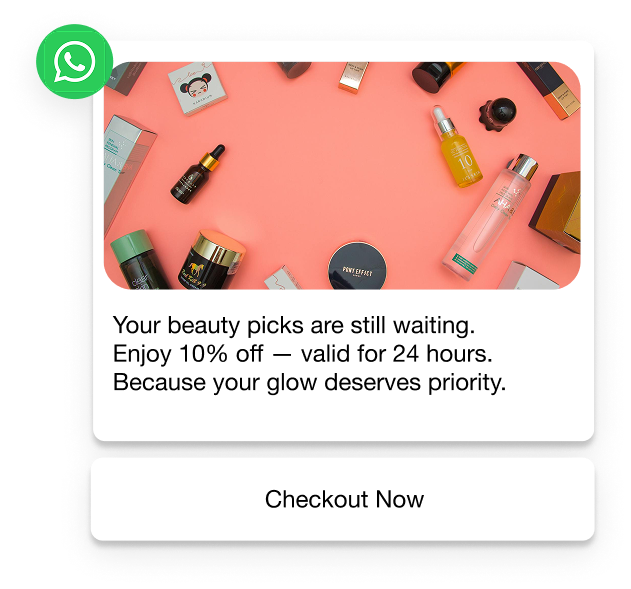
- Cart recovery triggers for abandoned conversations
- Post-delivery follow-ups and review requests
5. Create Opt-In Lists
WhatsApp requires explicit opt-in—no cold outreach allowed:
- Build lists via Click-to-WhatsApp Ads on Facebook and Instagram
- Add website widgets that let visitors start conversations
- Use in-store QR codes for offline-to-online capture
- Once opted in, customers receive targeted broadcasts without email deliverability issues
6. Track Performance Metrics
Monitor key metrics to optimize your flows:
- Click-through rates on broadcasts and product shares
- Response times (both automated and human agent)
- Checkout completion rates within WhatsApp
- Drop-off points in the conversation funnel
- Platforms with built-in analytics surface these metrics in real time for continuous iteration
How Flowcart Powers WhatsApp Commerce at Scale?
Flowcart combines AI cart assembly, native checkout, ERP, and CRM automation into one platform. No need to patch together separate tools for ads, payments, inventory and recovery.
- AI-generated carts convert natural language queries into ready-to-pay bundles in seconds
- Integrated checkout with 50+ payment gateways (Razorpay, Stripe, PayPal, UPI, wallets, COD)
- Automated cart recovery re-engages abandoned sessions within 30 minutes, recovering 18-25% of lost sales
- Custom flow builder for purchase journeys, loyalty programs, and post-purchase engagement
- Real-time analytics for message performance, conversion rates, and revenue attribution
Explore Flowcart's in-chat checkout or book a demo to see it in action.
What Are The Best Practices for WhatsApp Shopping Journeys?
Segment your audience:
- Use behavioral data to send relevant recommendations. Generic broadcasts underperform.
- AI segmentation lets you target high-intent users, lapsed customers, or first-time browsers.
Automate smartly:
- Handle repetitive tasks automatically (order confirmations, FAQs, cart reminders) but keep the tone conversational.
- Use dynamic personalization and clear handoff points to live agents when needed.
Leverage rich media:
- Product images and demo videos make messages more engaging than plain text
- Interactive CTAs drive higher engagement rates when combined with visual content
Respect opt-in rules:
- Never message users who haven't explicitly consented.
- Violating this results in account bans. Maintain transparent opt-out mechanisms.
Optimize continuously:
- Track where customers drop off in the conversation such as after catalog share, during shipping details, or at payment
- Iterate on flow design based on actual behavior patterns rather than assumptions
Turn WhatsApp Into Revenue Infrastructure
WhatsApp Cart and Checkout Flows give brands a direct path to revenue inside the world's most-used messaging app. For mobile-first commerce, the question isn't whether to adopt these systems but how quickly you can operationalize them.
Customer behavior has already shifted toward chat-first experiences. The brands that win will treat WhatsApp as commercial infrastructure: integrated with CRM and payment systems, powered by AI for discovery and recovery, optimized for conversion velocity.
Try Flowcart or book a demo to turn WhatsApp into a high-performing sales channel.
FAQs
1. What's the difference between Cart Flow and Checkout Flow?
Cart Flow requires manual order handling after customers add items. Checkout Flow automates shipping capture, payment processing, and order confirmation inside WhatsApp using API integration.
2. Do I need the API to accept payments inside WhatsApp?
Yes. In-chat payment processing requires WhatsApp Business API and gateway integration. The free Business App only supports catalog sharing and manual coordination.
3. What payment methods work with WhatsApp Checkout?
UPI, credit/debit cards, digital wallets (Paytm, PhonePe, Google Pay), PayPal, and cash-on-delivery. Options depend on your market and gateway provider. Flowcart connects to 50+ gateways.
4. Can these flows reduce cart abandonment?
Yes. Merchants using in-chat checkout see 23% fewer abandoned carts. Automated recovery within 30 minutes converts 18-25% of abandoned sessions.
5. Are automated order confirmations supported?
Yes. Once configured, order confirmations, shipping notifications, and delivery updates run automatically based on backend system triggers (Shopify, WooCommerce, ERP).






%201.webp)



.png)