
.png)
Key Takeaways
WhatsApp beats email and SMS for real conversations that drive engagement, loyalty, and repeat revenue.
Flowcart automates WhatsApp campaigns with segmentation, personalization, and timing to recover carts and boost lifecycle conversions.
Real-time analytics and ROI tracking help brands prove WhatsApp’s impact on sales, retention, and customer satisfaction.
You've tried using email to engage your customers, but realized they weren't lying about its 31% open rate. You've also tried SMS but noticed it doesn't give you the flexibility to use rich media, has a 160-character limit, and most of its messages are one-way. That’s okay for promotions and order updates, but what about building two-way interactive customer relationships?
WhatsApp does this. Not only does it have a whopping 98% read rate, it's also where your customers live and interact on a personal level, making it ideal to engage customers in a way that feels personal and memorable.
Paired with the right automation tool, you can turn WhatsApp into a revenue loop, driving retention through loyalty from engaged customers. This guide explores the top strategies for customer engagement on WhatsApp and how FlowCart can help businesses achieve exponential results by automating the process.
What is WhatsApp Customer Engagement?
Customer engagement is the continuous process of building meaningful, two-way relationships between your brand and its customers — not just at one point, but across every stage of their journey.
On WhatsApp, that journey starts from the very first “Hey, I saw your ad” to “I’d like to pay for this item” and finally “I’ve received my order.” At every stage of the journey, the goal is to curate personalized experiences, the kind that make customers feel seen, valued, and part of your brand. A few examples include:
- Gathering feedback by asking questions through surveys that allow them to feel heard.
- Creating fun moments with games, spin-the-wheel, or scratch cards.
- Rewarding loyalty with exclusive offers and programs.
- Sending contextual promotions and helpful updates that match their needs.
- Engaging them in conversations that help them make a buying decision.
- Using FAQ bots to answer their questions like they’re speaking with a personalized shopping assistant.
By engaging customers on WhatsApp where they already spend their time, and turning what used to be one-sided interactions (like SMS blasts or email promos) into real conversations, customers can talk to your brand the same way they talk to friends. This humanises your business, makes engagement feel natural, and builds brand loyalty and ultimately customer retention.
Top 5 WhatsApp Engagement Strategies to Consider in 2025
E1. Personalize messages
Addressing customers by their first names isn’t personalization. Which product did they buy last? What was the last enquiry they made? What’s sitting in their cart? What was the last complaint they made? Anyone can shout offers, but using all that data to curate personalized messages makes all the difference between a brand adding to the noise and a brand that actually listens to their customers.
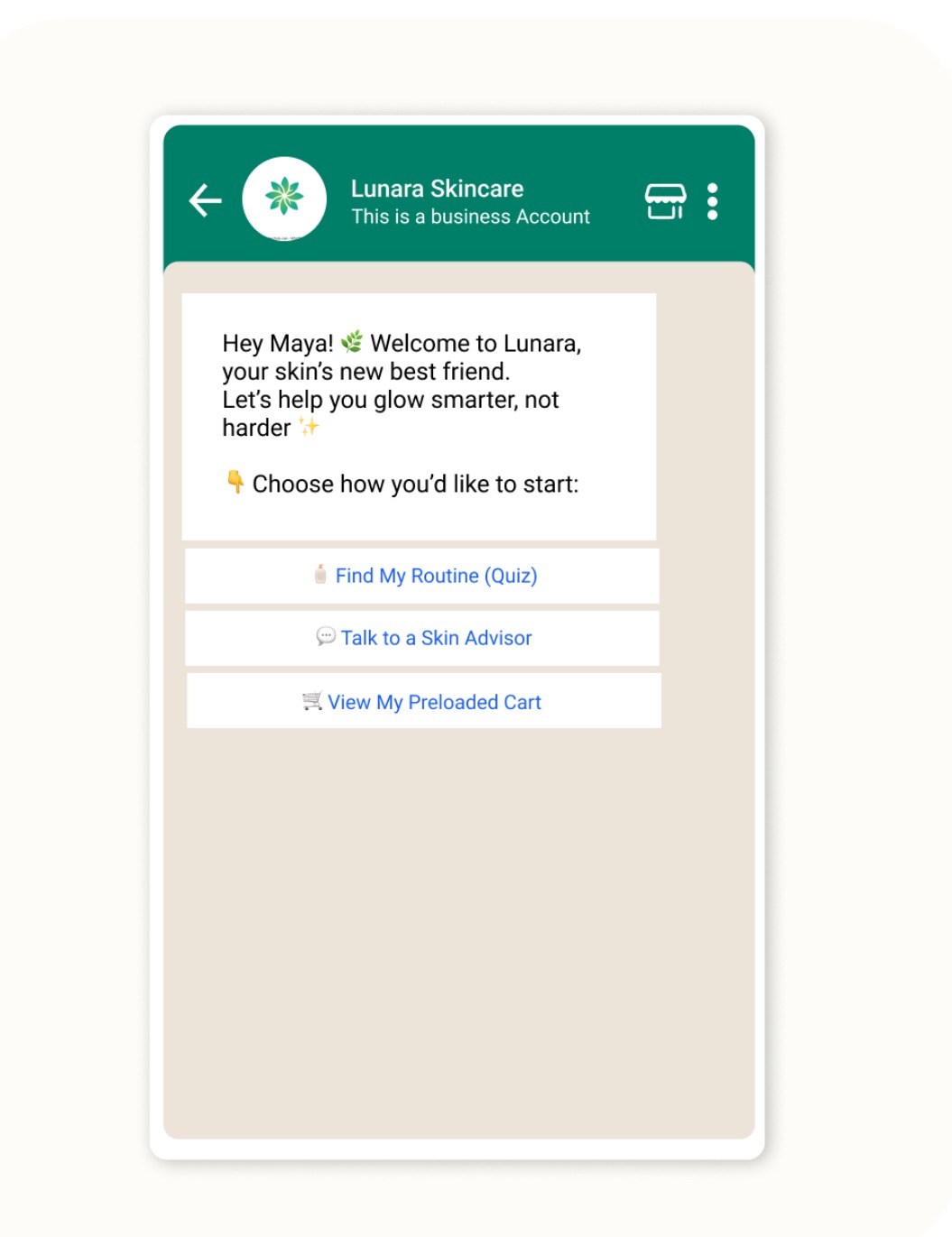
A personalized WhatsApp message welcoming a first time customer
Why it works: When customers receive messages that reflect their behaviour, they’re more likely to respond, engage, and buy again. It taps into basic psychology: people pay attention to what feels personally relevant.
Uncover Beauty understands this, and that's why they were able to 3x their revenue on WhatsApp with Flowcart through personalization. Sneha Mehta, their CEO, expresses:
“With Flowcart’s Smart Broadcasts, we turned WhatsApp into a revenue channel. Every message we send now has ROI built in. We send over 10,000 personalized messages a month and drive 3X more revenue than email.”
Here’s how you can do the same for your business:
- Integrate your e-commerce platform (like Shopify or WooCommerce) with WhatsApp so you can pull customers’ data.
- Use placeholders like {first_name} or {last product viewed} that automatically fill in with customer-specific details.
- Build automated workflows that trigger messages when a prospect or customer performs specific actions like abandoned cart, wishlist add, new sign-up, or product view.
💡Pro Tip: Don’t just set up a system and forget about it. Track the performance of your messages and tweak the tone to see what resonates best with your customers.
2. Automate chat flows while maintaining a human tone
Chat automation allows your brand to answer customers' queries 24/7. But it really doesn't have to sound like “Automation”.
The key is to keep automated messages friendly and natural, not robotic. Create flows that sound like a person talking, not like an automated phone menu asking you to “press 1 for this”.
It’s also not set-and-forget; some questions need a human touch, so create triggers that notify human support to step in whenever a customer hits a wall.
Why it works: Customers can smell a bot a mile away, and knowing that alone keeps them from fully expressing their needs. Talk like a human, and it feels like a shop assistant speaking to them in real time.
How to implement:
- Integrate your CRM and e-commerce shop data with WhatsApp.
- Decide the moments that should trigger a chat flow, eg, when a customer asks if a specific product is available.
- Create flows to cover any possible question a customer might ask during the conversation.
- Set up trigger points within the conversation that a human can be notified to take over, and launch.
💡Pro Tip: Don’t rely only on plain blocks of text when automating chat flows. Use Flowcart’s interactive elements like quick replies, lists, and buttons to make the conversations frictionless and easy for customers to interact with.
3. Optimize timing
Your sent messages on WhatsApp are only as effective as the time they're sent out. Send at the wrong time and they're dead on arrival. Send at the right time when customers are most active to engage, and you'll score good points.
Not all customers are active at the same time. By tracking the peak engagement times of each customer and sending messages accordingly, you ensure your messages land right in front of them and not buried under a pile of notifications.
Good timing helped Jaza recover abandoned carts:
“We used to lose a lot of carts, especially on weekends. Now, Flowcart brings them back with better timing and smarter messages than we ever could manually.” Willy Kimani, CEO & Founder
To Implement this:
- Track when customers are most active using opens and clicks, browsing history, and engagement with messages.
- Segment them into multiple groups based on their peak hours and days.
- Schedule messages to be sent during those times.
💡Pro Tip: Use Flowcart’s Smart Broadcast feature to send different versions of the same update tailored to different audience segments, at different times. This way, messages don’t just land when customers are most likely to respond; they also speak directly to what each group cares about most when they do.
4. Segment your audience by lifecycle stage
Segmenting your WhatsApp audience by lifecycle stage — new, active, or dormant, allows you to run targeted flows and campaigns that match their intent. Think welcome series for newcomers, restock alerts for loyal buyers, and win-back messages for those fading out.
When your messages match where customers are in their journey, every conversation moves them forward. A warm welcome plus the right product recommendation can turn a prospect into a buyer. A clever reactivation message can turn a dormant customer back into a repeat one.
Here’s how you can make this work:
- Use the data from your customers' interactions to segment them into new, repeat, and dormant groups.
- Create campaigns tailored to each group’s current stage.
- Use customer’s behavior to personalize the messages being sent out.
💡Pro tip: Use Flowcart’s Smart Segmentation to group customers by more than just lifecycle. Think smaller moves; people who clicked a WhatsApp link in the past 7 days, browsed products but didn’t check out, or engaged with a campaign but didn’t convert. By segmenting this way, you guide customers down the funnel through a series of micro-actions instead of waiting for one big leap.
5. Integrate WhatsApp with overall retention strategy
Don’t treat WhatsApp like a separate island. When it comes to retention campaigns, the whole point is to get customers engaging with your loyalty programs, reward offers, and reactivation offers. What other way to achieve that than using a platform that lives and breathes interaction?
Why it works: Using WhatsApp, a platform where customers actually hang out and chat with significantly more interaction compared to email and SMS, makes it easier for customers to engage and click on your offer links.
Flowcart helped Bundles and Snuggles implement this strategy and here’s what they had to say after:
“Our loyalty program used to be hidden on a webpage. Now it lives where our customers live on WhatsApp. We’ve seen a major bump in reorders since launching it with Flowcart.”
To put this into action for your business:
- Craft a clear message based on your retention goal and attach the right offer accordingly.
- Use loyalty points or rewards for returning customers, and reactivation offers for dormant ones.
- Add the product URL with a strong CTA.
- For loyalty points, include the minimum redeemable points and its conversion rate (the equivalent in any currency of your choice)
💡Pro Tip: Go beyond just giving loyalty points after every purchase. Use them to incentivize prospects to check out abandoned carts, reward survey participation, and product feedback.
Top Use Cases for WhatsApp Customer Engagement
When it comes to using WhatsApp for customer engagement, businesses are really only limited by their imagination and the immediate needs of their customers. That being said, these are a few of its use cases.
Welcome & onboarding sequences
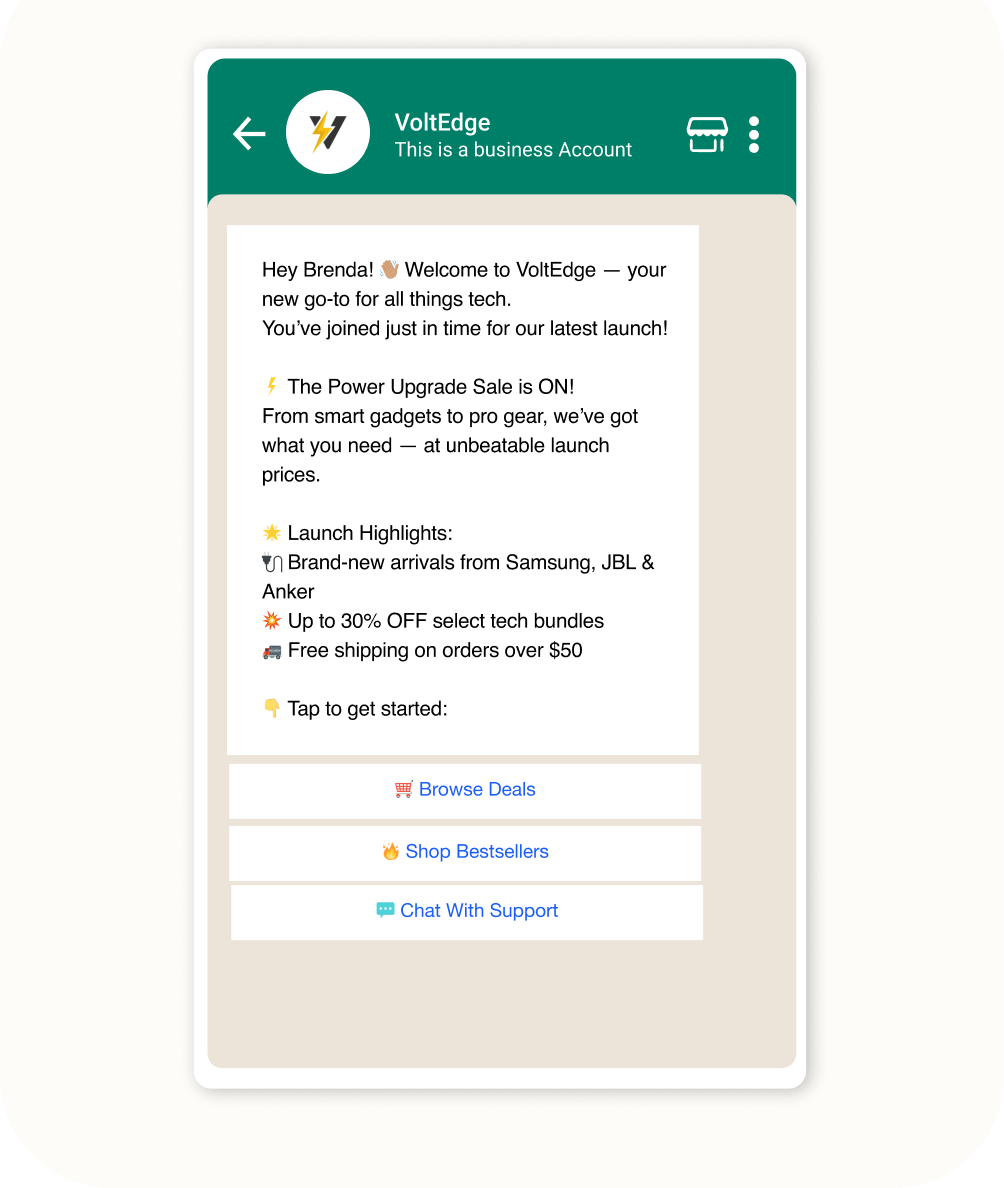
Image caption: A Flowcart onboarding template being used to welcome a new customer.
Alt text: WhatsApp Business message showing a warm welcome message that details ongoing 30% discount sales, two CTA buttons, and a link to customer support.
As shown in the image above, brands are using WhatsApp to make customers feel valued and seen right away. Once a customer signs up or contacts you directly on WhatsApp, they receive a friendly welcome message followed by tips on how to get the most from your brand and curated product recommendations or links to helpful resources to help them get started.
Order tracking and live updates
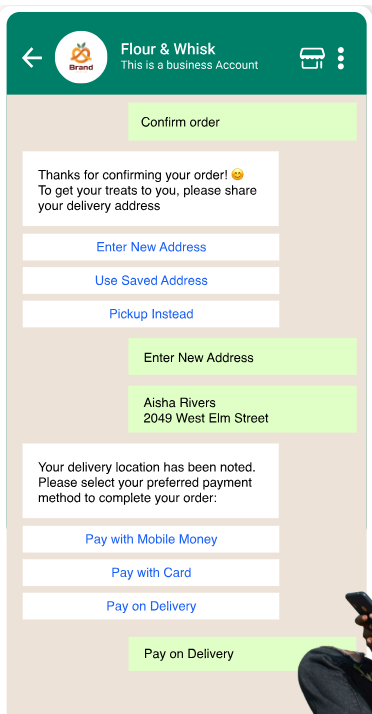
Image caption: An automated order tracking flow by Flowcart, allowing a confectionery brand to ask for delivery details with buttons to payment options.
Alt text: A WhatsApp Business message from Flour & Whisk showing messages enquiring about delivery details and payment options.
No one likes waiting in silence, especially if their bank account just read a minus because they made a purchase online. Many brands know this, that's why they’re using WhatsApp to make customers feel safe by keeping them in the loop with real-time delivery updates and tracking.
Abandoned cart & retargeting reminders
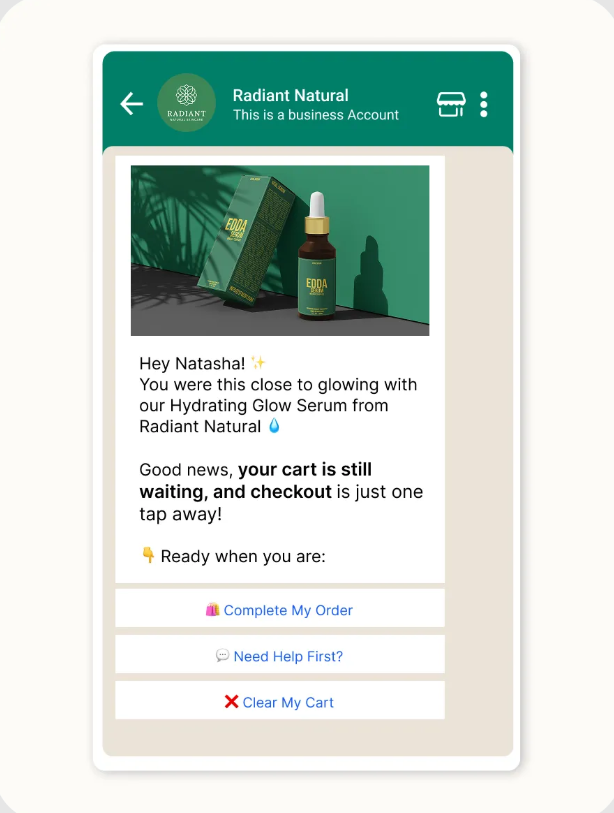
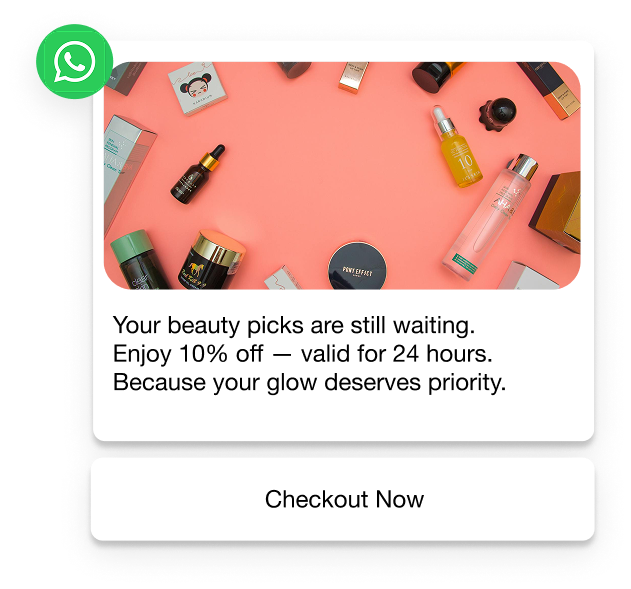
Image caption: A skincare brand using Flowcart’s abandoned cart recovery feature to remind a prospect to check out.
Alt text: A cart abandonment message on WhatsApp business from Radiant Natural, showing the image of a product abandoned in a customer’s cart with links to complete the order.
Abandoned cart reminders are not left out. Brands are using it to bring shoppers back before they slowly drift away. Instead of sending yet another email that ends up buried under a pile of others, businesses now send quick, friendly pings on WhatsApp that show right in front of customers.
Product recommendations & cross-sells
Businesses are turning WhatsApp into profit loops by identifying post-purchase moments with powerful upsell opportunities, and sending personalized product recommendations to customers while the opportunity is still hot. A beauty brand, for instance, might follow up post-purchase on WhatsApp with:
“Hey, since you grabbed a vitamin C serum, you'll love the result when paired with our brightening moisturizer. It completes your glow routine”.
SaaS brands are doing it too, nudging users to upgrade or try a new feature after they hit a milestone. For example:
“Congrats! You’ve just completed 10 projects this month with our Basic Analytics dashboard. You might find our Premium Analytics pack more useful. It gives you deeper insights and custom reports”.
Feedback collection & surveys
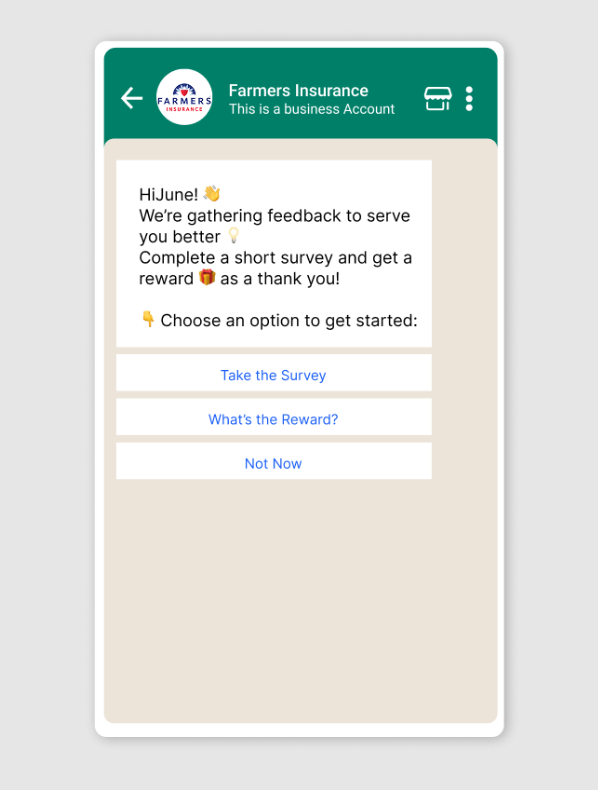
Image caption: An insurance company using Flowcart’s loyalty program/reward feature to incentivise customers to participate in a survey.
Alt text: A WhatsApp business message from Farmers Insurance, asking customers to take a survey and earn a reward, with multiple buttons and a CTA to get started with any of them.
At any stage of the customer journey prospects and buyers are, WhatsApp is being used by brands as a command center to choreograph the collection of feedback, through surveys and product trials, easily providing them with the insights they need to improve their products and services and curate unique experiences for each customer.
Loyalty programs, reward campaigns, and reactivation campaigns
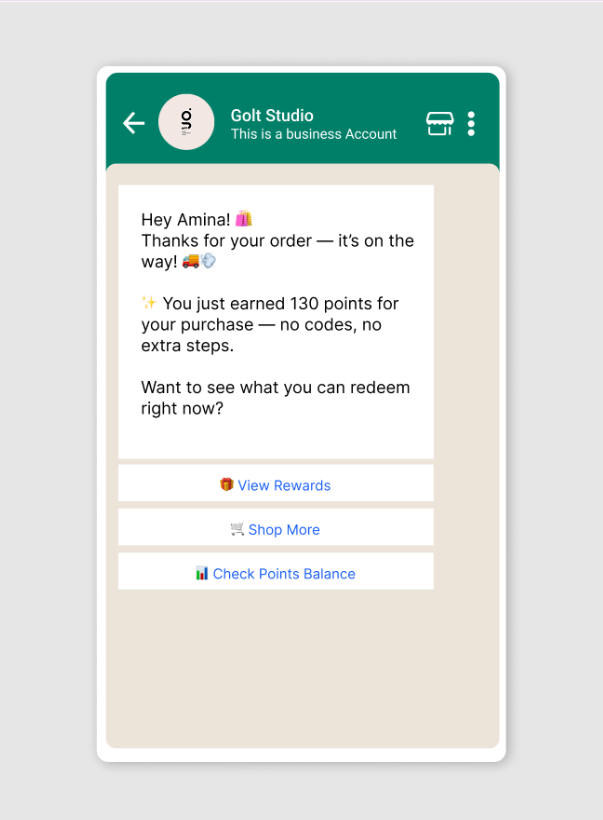
Image caption: Flowcart’s Loyalty Program feature allowing a brand to send a “Thank you for ordering” message with reward points.
Alt text: A WhatsApp business message from Gulf Studio thanking a customer post-purchase, rewarding them with redeemable points, with a CTA to click button links to next steps.
This image clearly illustrates how brands are driving retention on WhatsApp using loyalty points, reward offers, and reactivation campaigns. Whether it’s a repeat buyer or someone who’s gone quiet, they’re using WhatsApp to promote incentives that encourage new prospects to buy and repeat customers to keep coming back. Here’s how Flowcart helped the brand achieve measurable results using this strategy:
How Darling Hair drove sales by 300% and increased customer engagement
Darling Hair, a hair manufacturer and distributor in Kenya, grew tremendously — breaking recorded sales by 300% and almost 7X-ing unique customer accounts. The Flowcart platform and loyalty program were key drivers of growth.
By automating their loyalty program, their customers were able to easily track and redeem points while they captured customer data during the interactions. This data enabled them to tailor and send targeted broadcast messages subsequently.
The result? 300% Increase in Sales, and an almost 7x increase in customer base, from 2,000 unique accounts to 13,500 unique accounts.
Customer support & FAQ automation
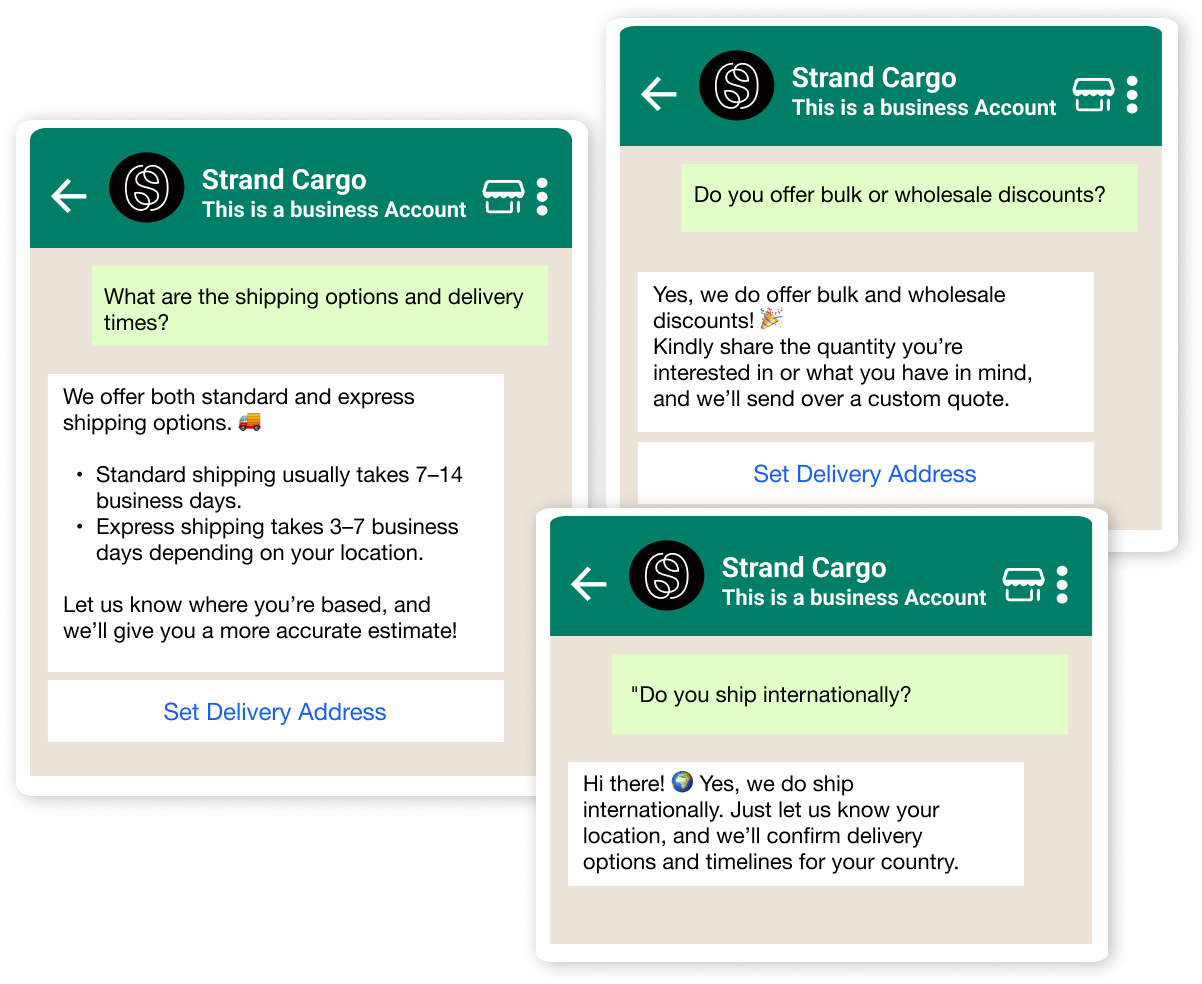
Image caption: Flowcart’s FAQ bot feature in action, answering the questions customers ask on a regular basis 24/7.
Alt text: Multiple WhatsApp Business messages showing Strands Cargo’s custom FAQ bot by Flowcart, answering questions about shipping, delivery, bulk orders, and wholesale discounts.
This is one of WhatsApp’s most popular use cases, and for good reason. Since customers already use it for everyday chats, brands that use FAQ bots to handle common questions around the clock are winning big on customer experience and positive brand sentiment.
Best practices to drive higher engagement on WhatsApp
1. Maintain a conversational, human tone
Tone makes all the difference between messages that get read and ones that are left unread. In every update, talk like a real person, so customers don’t feel like they’re either talking to a bot or just part of some broadcast list.
2. Control message frequency
Too many messages can wear people out fast. Find a steady rhythm that keeps your brand top of mind without becoming a notification they dread. Anything more than two messages per week can begin to feel spammy.
3. Follow WhatsApp policies and opt-in rules
Always follow WhatsApp’s opt-in and messaging rules. Use Braze’s in-app, in-browser, or SMS methods to collect clear WhatsApp opt-ins. Also, keep your phone number quality rating high by giving users easy ways to opt out and avoid being blocked.
4. Regularly test and optimize flows
Keep an eye on your engagement metrics. Test different message flows, timings, or CTAs to see what clicks. Then double down on what drives the best responses and conversions.
How to Measure WhatsApp Engagement Success
Customer engagement on WhatsApp requires many touchpoints, so proving its success can be tricky. To make sure you can clearly justify your return on investment, track the following metrics.
1. Delivery Rate
Delivery directly measures the percentage of messages sent out that successfully land in your WhatsApp audience's inbox.
What it reveals about engagement
A low delivery rate could indicate that:
- Your contact list contains invalid or inactive numbers
- Some customers haven't opted in to receiving promotional messages from you,
- Or your messaging template isn't approved or has been flagged by Meta.
2. Open Rates
Use this metric to track the percentage of your delivered messages being opened and read by customers. WhatsApp open rates can range any where between 58% and 98% with 58% being the lowest, so regularly compare your average open rate against the benchmark to see how well yours is doing. Although WhatsApp does not provide read rates, blue ticks can also be used to estimate engagement.
What it reveals about engagement
A low open/read rate can indicate:
- Poor personalization and segmentation,
- Bad timing and frequency
- Weak hooks.
3. Response rates
Response rates measure the percentage of recipients that reply to your sent messages. It’s a direct measure of customer engagement.
What it reveals about engagement
Low response rate could indicate:
- Poorly personalized content
- A generic content that offers no value.
- A fatigued audience from too many messages.
- Timing issues
4. Click-through rate
This metric is a measure of the percentage of people who open your messages and click the links within your message.
What it reveals about engagement
A low click-through rate could indicate:
- A weak or unclear CTA that offers no value,
- Poor image or video choice,
- Messages that are poorly personalized or communicated.
5. Conversion uplift and retention improvement
Conversion Uplift is the increase in the number of people who took a desired action (predefined by you), like making a purchase or signing up for your WhatsApp newsletter broadcast, after engaging with your WhatsApp campaign messages.
Conversion uplift is compared side by side with your previous conversion rates before a new campaign was launched to see how much impact the new campaign made and how improvements can be made.
Retention improvement, on the other hand, measures the percentage of customers that keep making purchases after a new retention campaign has been launched, compared to the percentage before the launch.
What they reveal about engagement
These metrics give a bird’s-eye view of how well your engagement campaigns are driving conversion and retention.
6. Sentiment Analysis
Sentiment analysis measures Customer Satisfaction (CSAT) Score and Net Promoter (NPS) Score.
CSAT measures the percentage of customers who are happy with your product or service.
NPS measures the percentage of customers who would recommend your product or service to others.
Both metrics combined are used to gauge how positively or negatively your audiences perceive your brand on WhatsApp.
What they reveal about engagement
A negative brand sentiment could indicate:
- A dissatisfaction or negative experience with a product or service
- A disconnect between customer support and customers, or a lack of timely or helpful customer support to resolve those issues.
7. ROI tracking through analytics dashboards
To get a 360° view of your WhatsApp engagement metrics, you need to combine all the key metrics mentioned above into an analytics dashboard. Regular WhatsApp Business doesn’t provide one, so you need the WhatsApp Business API to connect your WhatsApp Business account to a third-party WhatsApp automation tool like Flowcart. This setup lets you fully track engagement, attribute results, and prove your ROI.
How Flowcart Helps Brands Boost WhatsApp Engagement
With Flowcart’s Smart Broadcast feature, brands can send automated messages that reach thousands of customers in seconds while driving conversion. Every WhatsApp campaign is designed to push audiences from “Hey, I saw your ad” to “I want to pay for this”. Here’s how they’re doing it:
Advanced audience segmentation and retargeting workflows
With AI-powered segmentation, Flowcart groups your audiences into either new, repeat and dormant, or purchase history, cart size /value, engagement activity, product interest, and geography.
This makes it easy to set up automated flows that target different groups all within the same campaign.
For example, an e-commerce brand running a cart recovery campaign can use Flowcart to target customers who haven’t purchased in 90 days. They can segment by last purchase value and product categories they liked, and their location.
They can send:
- Personalized reminders with loyalty points to buyers with high purchase value.
- Personalized reminders with built-in urgency offers for regular buyers
- And location-based deals to local shoppers.
AI-powered personalization and product recommendations
From product drops and restock alerts to targeted recovery messages, Flowcart uses segmentation data to make every message feel like it’s speaking directly to each customer, no matter what stage they are in their journey. This personalization also seeps into how products are recommended for customers.
A clothing brand, for example, can use Flowcart to recommend different variations of a T-shirt after a customer browses their T-shirt section or makes a purchase for a particular type of T-shirt.
Another variation of this would be using Flowchart's FAQ bot to answer a customer’s questions about a particular product, then triggering in-chat catalogs that shows the customer the exact products they are asking about, with links to checkout the product.
Real-time analytics for engagement and ROI
Flowcart’s comprehensive tracking feature is built to give businesses a deeper view into what’s happening with customer engagement. From open rates to click-through rates and conversion rates, its analytics dashboard allows businesses to see what’s working in real time and make smarter decisions to boost engagement and performance
Explore these features and start engaging today
Next Steps
WhatsApp lets your business reach customers where they already spend their time, and turn chats into meaningful conversations that drive conversions. But real, measurable results happen only when you pair it with the right tool. Flowcart is built for that, scaling engagement with smart segmentation, AI-powered WhatsApp
personalization, and automation. It's only right that it's your tool of choice to boost customer engagement on WhatsApp. Book a Demo to get started
Frequently Asked Questions
1. What is WhatsApp Customer Engagement?
It’s how brands build two-way relationships with customers on WhatsApp. It’s not just about sending promos; it’s about curating personal experiences through personalized interactive content.
2. Why should brands focus on WhatsApp for engagement?
Because it’s where your customers already live. With a 98% read rate (compared to email’s 31%), WhatsApp makes it easier for brands to cut through the noise and have actual conversations, not one-way broadcasts.
3. How can small businesses use WhatsApp to retain customers?
Small businesses can retain customers on WhatsApp by running loyalty programs that reward every purchase with points and reactivation campaigns that win back dormant customers with special offers or bonus points.
4. What tools help improve engagement on WhatsApp?
Tools like Flowcart make engaging on WhatsApp easier by automating chat flows, segmenting audiences, and allowing businesses to send highly personalized broadcast messages to thousands of customers in seconds.
5. How to measure engagement success on WhatsApp?
To measure engagement success, track delivery rates, open rates, response rates, click-throughs, conversion uplift, and retention improvement. Combine all these in an analytics dashboard (via WhatsApp Business API and Flowcart) to get a 360° view of how your campaigns perform. Also, monitor CSAT and NPS scores to gauge how happy and loyal your customers actually feel about your brand.




%201.webp)



.png)