.png)
.png)

.png)
Key Takeaways
Physical grocery stores and supermarket businesses have a structural communication cap. Every in-store promotion reaches only one group: the people who walk into the building while that offer is live. Shelf signs, counter flyers, and employee mentions all stop when a shopper leaves.
This bottleneck hampers your grocery sales growth. Customers shop on a weekly cycle, but store promotions change daily. For example, a Tuesday offer will reach Tuesday's shoppers. Weekend regulars will miss it unless you put a flyer in advance. Loyal buyers who skip a week will miss it regardless.
To fix this, you need to move your communication outside the physical storefront. Turn walk-in foot traffic into an owned WhatsApp customer list. Then, send offers, product arrivals, and reorder reminders directly to those phones between store visits.
This way, the weekend shopper will see Tuesday's deal on their phone. While the customer who hasn’t visited in a month also gets a smart reminder. Reach stops resetting.
This guide explains how to build that WhatsApp grocery store sales system. You will see how Flowcart turns walk-in traffic into an owned digital audience and converts message broadcasts into recurring revenue.
The Invisible Customer Problem Behind Every Sales Plateau
Supermarkets grow through a familiar set of levers:
- Running weekend offers.
- Handing out loyalty cards.
- Stacking promotions during festive seasons.
These work for a while, until they stop.
The reason is simple. Your transactions are growing, but your relationships are not. A regular customer who shops every week looks identical to a first-time visitor at the billing counter. Neither can you tell them apart, nor can you reach either of them once they leave the store.
When a competitor opens nearby, or a delivery app runs a steep discount, the habitual loyalty you assumed you had disappears. Nothing structural was holding it in place. You were relying on proximity and routine, both of which any new entrant can disrupt.
This is where the economics get interesting. Most of your existing revenue is leaking out of gaps you cannot see.
- Customers who almost bought and left.
- Customers who bought once and never came back.
- Customers who shifted to a competitor three weeks ago without you noticing.
A WhatsApp commerce platform, like Flowcart, built for retail, closes these gaps directly, and the revenue lift shows up faster than most merchants expect.
Nectar Beauty, a Nigerian beauty wholesaler supplying 38 retail outlets, recovers 24.49% of its abandoned carts on Flowcart, compared to an industry average of 3 to 5%. That single layer now drives 60% of their WhatsApp revenue. In fact, 40% of their WhatsApp orders come from buyers returning a second, third, or fourth time, even without a loyalty program in place.
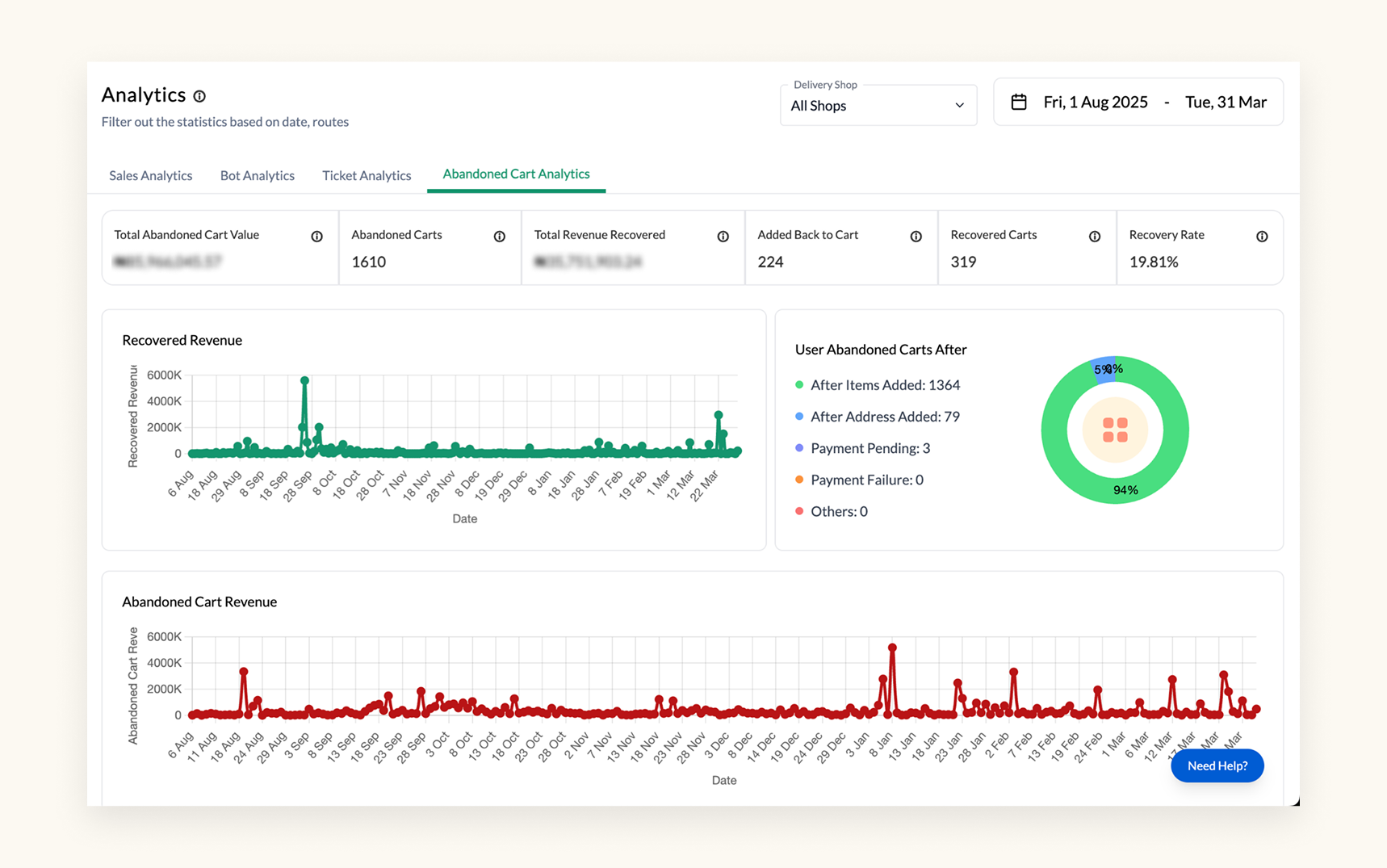
Analytics of Nectar Beauty after working with Flowcart
The same recovery logic, designed by Flowcart's customer success team for Black Camels, took their cart recovery from 7.8% to 25.47% inside 30 days. The system itself did the work without new traffic, a bigger team, or a website redesign.
The pattern repeats across retail categories. Merchants moving to Flowcart routinely see digital revenue grow 40 to 50% within the first few months. Some triple it. The growth in each case comes from closing the revenue leaks in the existing customer journey. There is no pressure to focus on finding new traffic.
The rest of this article shows you how that closure works, stage by stage.
Stage 1: Turn store footfall into an owned WhatsApp audience using QR codes
The first job is ingestion. You need a way to move people from your store into a channel you control.
- Email signup forms get ignored at the billing counter.
- Loyalty card applications add three minutes to a queue that is already moving slowly.
- App downloads ask for a level of commitment most customers will not make in the moment.
Flowcart uses QR codes placed at the touchpoints where customers already pause.
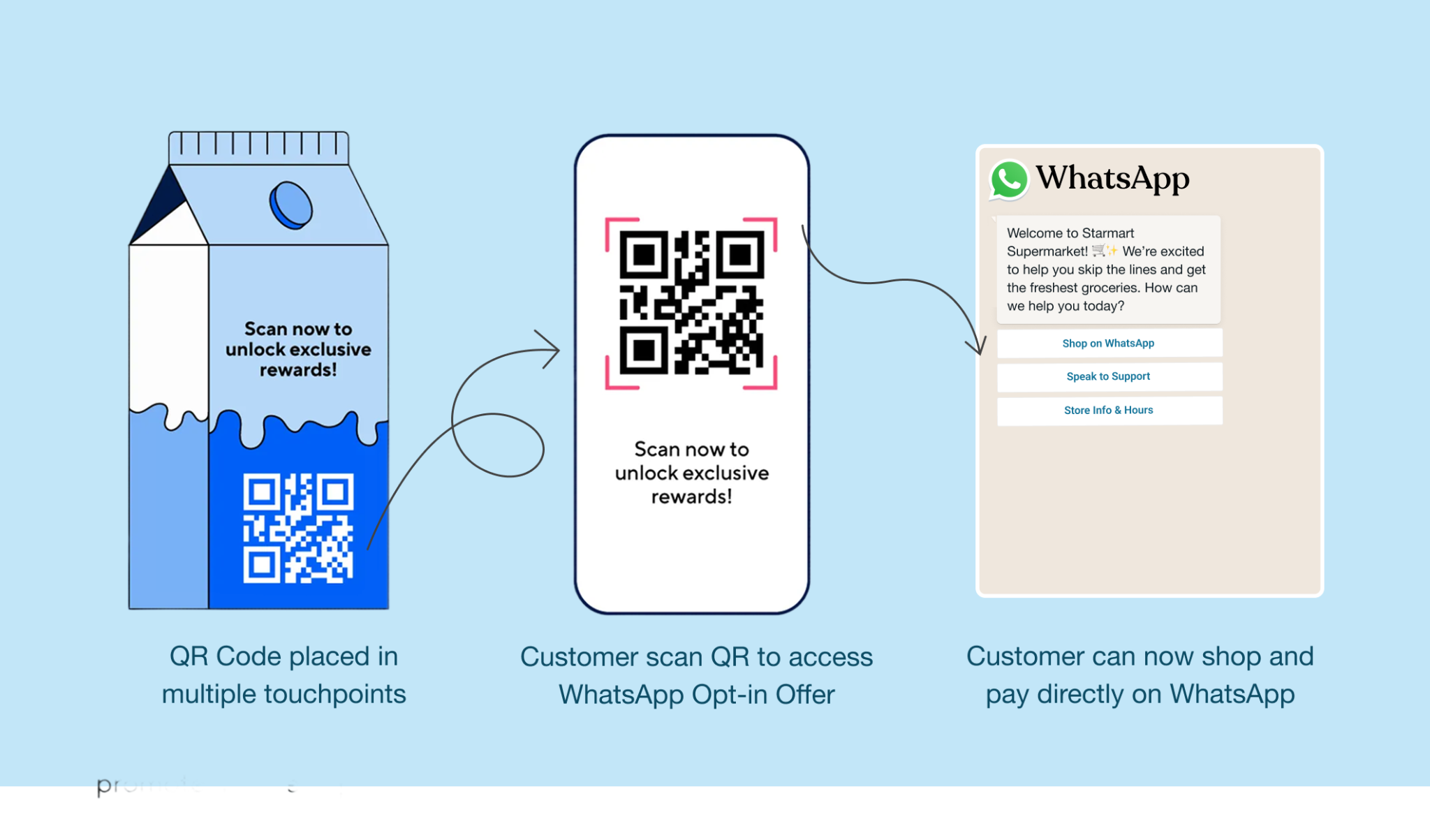
You can put a code at the billing counter, where a single scan delivers the digital receipt and completes the WhatsApp opt-in in a single step. The best part? You can place one at the store entrance, tied to that week's live offers as the immediate incentive to scan.
You can also print codes on physical receipts so customers can opt in after they leave. Similarly, consider adding shelf talkers next to high-frequency products. It captures intent right at the moment of consideration.
Every customer who scans enters your owned WhatsApp audience straight away. You can now reach them for offers, order prompts, and retention messages without a third-party delivery platform sitting between you and the relationship.
Loyalty points act as the natural opt-in incentive. Scan to earn your first points, redeem them later on an order you were going to place anyway. The friction is close to zero, and the customer gets immediate value.
Alfamart, which runs more than 18,000 stores across Indonesia, ran exactly this play. Loyalty registration used to take three to five minutes at the counter. After they moved to WhatsApp-based QR opt-in, registration dropped to 30 seconds. The channel now moves an average of IDR 2 billion in digital vouchers every month. That is the kind of operational shift a properly built ingestion layer creates.
Stage 2: Build a WhatsApp ordering system that reads what customers send
Once a customer is in your audience, the next question is how to place an order. The mistake WhatsApp commerce setups make is asking the customer to do the work. For example, they send a catalog link, asking the customer to scroll, search, and figure out variants on their own. Immediately, the conversation that started naturally turns into a chore.
Flowcart uses a different approach. The customer sends a grocery list as they would to a family member, and the system handles the rest.
Here is what the flow looks like from the customer side:
→ The customer types a message in plain language. Something like "I need eggs, atta, tissues, and milk." There is no special format or instructions to memorize.
↓
Flowcart reads the message and matches each item to your store's live catalog.
↓
Within seconds, the customer receives a link inside the same WhatsApp chat.
↓
The link opens a structured cart page right inside WhatsApp, with no app to download and no browser tab to switch to. Basically, it uses WhatsApp WebView. It is a web page that loads within the WhatsApp app, so the customer never feels like they have left the conversation.
↓
Inside the cart, the customer sees each item with its full variant options.
- Eggs are available in free-range, farm, and organic options.
- Atta shows up in 1kg, 5kg, and 10kg weights.
- Tissues display brand and pack size.
The customer taps to select what they want and sets the quantities they need.
↓
A review screen then shows the complete order before payment. The customer can see every variant and the quantity. Once selected, they can also adjust anything before they commit.
This sequence solves the operational mess that many stores face today.
What changes:
- Stop receiving vague messages that need three follow-up replies to clarify.
- No more losing orders because someone forgot to mention a quantity.
- Every cart that reaches the review stage is structured, complete, and ready to be paid for.
Stage 3: Connect your ERP so the ordering system reflects real inventory and pricing
A WhatsApp cart is only useful if the data inside it is accurate. If a customer orders 5kg of atta and it turns out to be unavailable, you have created a worse experience than if you had no system at all.
This is why Flowcart integrates directly with the ERP systems grocery retailers already run on. NetSuite, Odoo, SAP, and Prana all connect to Flowcart as the source of truth. Your product catalog, variant options, inventory levels, pricing, and active discounts all flow from the ERP into the WhatsApp ordering layer in real time.
When a customer opens their cart, they see what is actually on your shelves at the price you charge. When they complete the order, the confirmed transaction is automatically imported into the ERP. Your fulfillment team picks it up in the same workflow they use for every other order. Plus, your finance team sees the revenue in the same reports they already review.
Thanks to this system, the store's existing operations stay intact.
The Spar Oman rollout shows what this looks like at a multi-branch scale. Before Flowcart, Spar operated six supermarket branches across Muscat, each with its own personal WhatsApp number and no catalog integration with store inventory.
A customer near one branch had no easy way to know which number to message. And every order required a manual back-and-forth between the shopper and a staff member.
Flowcart unified all six branches into a single WhatsApp Business account and connected each branch to its own inventory and pricing in Prana ERP.
When a customer messages Spar today, Flowcart's geomapping detects their location and automatically routes the order to the nearest branch. The catalog the customer sees reflects what that specific branch has in stock, at that branch's price, with that branch's active discounts. One number for the customer, branch-level precision behind it.
Stage 4: Use in-chat checkout to remove the last point of drop-off
The biggest revenue leak for WhatsApp commerce setups is the same step. The customer has selected items, reviewed the cart, and is ready to pay. Then the system sends them a payment link.
Your customer opens a browser, copies their account details into another app, and finds themselves three screens away from the chat they started in. The majority of them will never complete that purchase.
Cash on delivery introduces a different problem. The order ships before payment is confirmed, so disputes get harder to resolve. The store ends up carrying the cost of delivery on orders that may never get paid for.
Flowcart's in-chat checkout closes both gaps. When the customer taps to pay, the payment gateway opens inside the same WhatsApp WebView that carried the cart. Your customers don’t have to face a redirect to a new tab or comply wth instructions to complete payment somewhere else.
The Flowcart payment method connects to whatever is standard in your market. Hence, keeping the checkout experience identical regardless of which method the customer uses.
Two operational outcomes follow from this:
- First, conversion improves because you have removed the last point where customers abandon. A customer who has already selected variants and reviewed the cart is now one tap away from a paid order.
- Second, every order in your dashboard is a paid order. There are no pending transactions sitting in a holding queue, and no deliveries going out on the assumption of payment.
Stores running Flowcart see checkout times drop by around 70% and recoveries from abandoned carts rise sharply when in-chat payment is paired with automated follow-up.
Stage 5: Retarget your existing customers to increase recurring revenue
By this point in the system, you have a WhatsApp audience built from your physical footfall. You also have an ordering flow that converts messages into paid orders, and an ERP that keeps data clean across all branches.
However, what should you do with that audience between visits? The answer is the same offer plan you already run, executed against the customers most likely to act on it.
Flowcart turns each of your weekly promotions into a retargeting message segmented by purchase history. The cooking oil promotion goes to customers who bought cooking oil from you in the last six weeks. The festive bundle goes to customers who shopped during last year's festive cycle. You are not designing new offers for this layer. You are routing existing offers to customers whose data already indicates they will respond.
Segmentation runs on three axes: purchase history, product category, and recency. A customer who shopped last weekend gets a different message from one who has not visited in four weeks. Those who buy premium see a different price point than those who buy value. Each message lands with customers who have a structural reason to act on it, which is why the conversion economics here look nothing like a generic promotion.
Customers act on the message inside the same chat. They can reply to a poll, tap a quick-reply button, or open a one-tap cart directly from the message. Each interaction can increase their loyalty points, so the offer doubles as an entry point back into a purchase cycle rather than a one-way notification.
The same layer also keeps you present between hard offers. New product announcements, seasonal polls, recipe ideas, or category updates go out to the same segmented audience. The goal here is engagement, not conversion. You stay visible to customers who are not ready to buy this week without becoming the brand they mute.
The dashboard closes the loop. Opens, clicks, replies, and revenue impact all show up in real time, mapped to the specific offer that drove them. You stop running promotions on instinct. You see which segment converted, on which message, at which value, and you build the next week's plan from data.
Stage 6: Automate retention with reorder reminders, subscriptions, and winback flows
The first order is the start. What you do after it decides whether you have a customer or a one-time transaction.
Grocery is a category built on repetition. Customers buy the same cooking oil, the same atta, the same vegetables on a cycle that hardly changes. Flowcart tracks each customer's purchase pattern and learns when they typically restock.
Reorder reminders
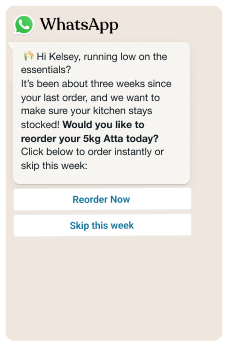
Reorder reminders go out right when your consumer is about to exhaust their stock. For example, a customer who buys 5kg of atta every three weeks receives a WhatsApp message at the start of week three with a one-tap link to reorder.
The message references what they bought. If the customer wants to skip a week, they can. If they want to reorder, they can do it without leaving the chat.
Subscriptions
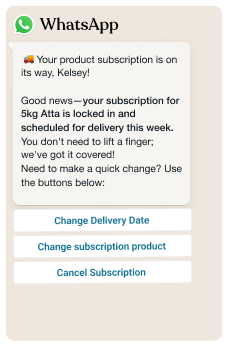
Subscriptions take this further for items the customer wants on a fixed cycle. The customer sets it up once in WhatsApp, and the order runs automatically from then on. You secure repeat revenue before the week begins, so the customer no longer has to remember.
Winback flows
Winback flows handle the customers who go quiet. Without a system, you have no way to tell the difference between a regular who is busy this week and one who has shifted to a competitor.
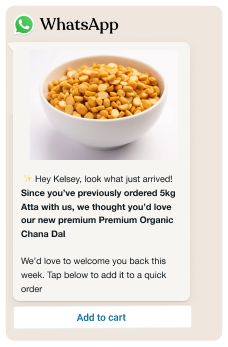
Flowcart identifies the drop-off and triggers an automated message. The content adapts to what the customer ordered previously, with a relevant prompt that makes returning easy. You can surface a points balance that they have not redeemed. Or highlight a new product in a category they have previously bought from.
Each of these flows runs automatically. Your team does not write the messages. The system does the work, and you see the recovered revenue in the dashboard.
Stage 7: Build loyalty that creates repeat behavior instead of discount dependency
The hardest problem with discounts is what they teach. When customers learn that a sale is always around the corner, they stop buying at full price. Your margin erodes, and the loyalty you were trying to build never fully forms.
Flowcart's loyalty program works differently. Customers earn points on every order, check their balance inside WhatsApp, and redeem them against future purchases without leaving the chat. Points are also awarded for surveys, product feedback, and referrals, which means you can shape behavior beyond the transaction itself.
Personalized discounts then build on the data you already have.
- A customer who consistently buys premium products gets an offer that reflects what they actually purchase.
- A customer who buys staples in bulk gets a different offer.
You stop running uniform promotions that train everyone to wait for the same discount, and you start running offers that convert because they fit the customer.
This is what measurable retention looks like in practice. You can see loyal customers and lapsing customers simultaneously in your dashboard. It makes it easier to tackle both for maximum ROI.
The Infrastructure Behind Repeat Grocery Store Sales
Grocery retail does not have a demand problem. Your customers walk in every week. They buy from you on a cycle you can already predict. The gap sits between the existing demand and a system that can reach those customers between visits.
Flowcart closes that gap end-to-end. Footfall converts into an owned WhatsApp audience through a single scan. Your existing weekly offers go out as retargeted messages to the customers most likely to act on them. Reorder reminders, subscriptions, and winback flows run automatically against each customer's purchase pattern. Loyalty points build a structural reason to keep choosing your store over the alternatives.
The supermarkets winning on recurring revenue right now are not designing cleverer promotions. They are running the same promotions against the right audience, between visits, on the channel their customers already use.
Book a demo with Flowcart to see how the full system runs in your store.
.png)




%201.webp)



.png)