
Key Takeaways
Connecting WhatsApp with your CRM gives agents full customer context, cutting response times and improving resolution quality.
Integrated WhatsApp journeys unlock personalized campaigns, abandoned cart recovery, and measurable revenue from every customer conversation.
Choosing the right BSP and setup process lets you scale automation without losing the human touch in key chats.
Most e-commerce businesses run two separate conversations with their customers.
- One happens on WhatsApp, where messages get 98% open rates and responses come within minutes?
- The other happens through their CRM [which offers email, database, and analytics], where they track engagement, purchase history, preferences, and performance.
But these systems don't talk to each other.
So your support team answers WhatsApp questions without seeing last week's email complaint. Your sales team spots a hot lead in the CRM but misses the WhatsApp message saying "I'm ready to buy." You send cart abandonment emails while the customer asks about shipping on WhatsApp.
WhatsApp <> CRM integration fixes this.
WhatsApp CRM integration connects these conversations. Every WhatsApp message flows into your CRM automatically. When customers reach out, your team sees their complete history; past orders, support tickets, browsing behavior; and responds with context instead of guessing. You can finally measure which WhatsApp conversations actually drive revenue.
In Africa, the Middle East, India and APAC, where WhatsApp is how people communicate and do business, this integration isn't optional. It's table stakes.
Here's what WhatsApp CRM integration actually is and how to set it up properly.
What Is WhatsApp CRM Integration?
WhatsApp CRM integration connects your WhatsApp Business account directly to your customer database. When someone messages your business on WhatsApp, that conversation [along with their contact details and interaction history] saves automatically in your CRM.
Your team sees everything in one place: WhatsApp chats alongside email threads, purchase records, and support tickets.
How the WhatsApp <> CRM integration work
You don't connect WhatsApp directly to your CRM. Instead, you use the WhatsApp Business API through a Business Solution Provider (BSP) platforms like Flowcart, Wati, AiSensy, or Respond.io.
These providers act as the bridge. When a customer messages you, WhatsApp sends that data to your BSP, which translates it into a format your CRM understands and delivers it to the right place. The reverse happens when you send messages from your CRM.
Two integration approaches:
Example CRM WhatsApp Integration Use cases
- For customer support: A customer messages "Where's my order?" on WhatsApp. Your support agent sees the message in your CRM alongside the customer's order history, past support tickets, and shipping status. They respond with specific tracking information without asking the customer to repeat their order number.
- For sales: A lead fills out a form on your website asking about pricing. Your sales rep sees this lead in the CRM and can immediately start a WhatsApp conversation—no need to switch apps. The conversation history saves automatically, so anyone on your team can pick up where the last person left off.
- For marketing: You launch a flash sale. Instead of sending generic emails, you segment customers in your CRM by past purchase behavior and send personalized WhatsApp messages: "Hi Priya, those sneakers you viewed last week just went on sale—30% off for the next 6 hours." When customers click through and buy, that revenue attributes directly to the WhatsApp campaign in your CRM.
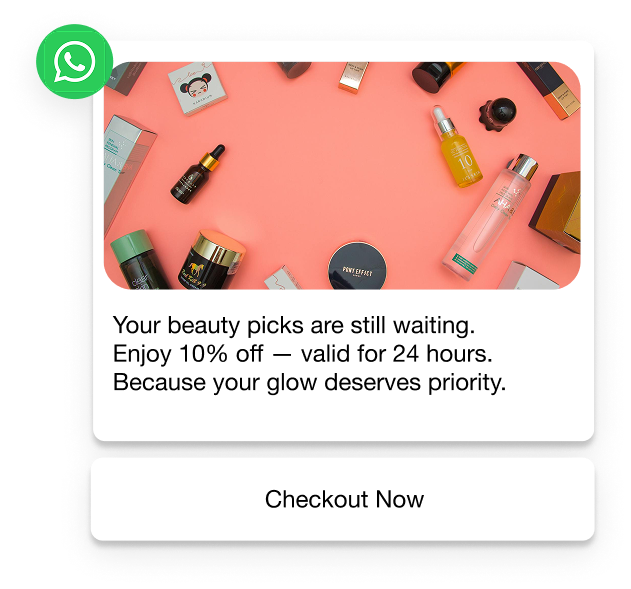
- For abandoned cart recovery: A customer adds items to their cart but doesn't complete checkout. Your system automatically sends a WhatsApp message 2 hours later: "Hey Raj, you left these items in your cart. Need help completing your order?" If they respond with questions, your team sees the cart contents right in the CRM and can address specific concerns.
Why Integrate WhatsApp With Your CRM: Top 5 Benefits
1. Respond Faster With Complete Context
Without integration, your team plays detective. A customer messages on WhatsApp asking about a delayed shipment. Your agent asks for their order number, searches the system, discovers the customer already complained via email yesterday, then scrambles to piece together what happened.
With integration, the context loads instantly. Your agent sees the WhatsApp message in the CRM alongside the email complaint, the order details, the shipping delay reason, and the compensation already offered.
2. Stop Losing Leads Between Channels
You run Facebook ads with "Click to WhatsApp" buttons. Leads message you expressing interest. But those conversations live in WhatsApp while your sales pipeline lives in your CRM. Your sales team follows up on web form leads but misses hot WhatsApp prospects who are already asking "How much?" and "Can I order today?"
Integration captures every WhatsApp lead automatically in your CRM with full conversation history. Your sales team sees all prospects in one view, prioritizes based on intent signals ("ready to buy" vs "just browsing"), and no high-value lead slips through the cracks.
3. Personalize at Scale Without Manual Work
Generic messaging gets ignored. "Dear Customer, we have an offer for you" achieves less engagement versus personalized messaging "Hi Priya, those Nike sneakers you viewed are now 30% off".
Without integration, personalization requires manual lookups. Your marketing team wants to send targeted WhatsApp campaigns but can't efficiently segment by purchase history, cart contents, or browsing behavior because that data sits in the CRM while WhatsApp lives elsewhere.
4. Measure What Actually Drives Revenue
Most businesses treat WhatsApp as a black box. They know customers message them. They know some conversations lead to sales. But they can't track which WhatsApp campaigns generated revenue, which messages converted leads, or what their WhatsApp customer acquisition cost actually is.
Integration makes WhatsApp measurable. Every conversation links to a customer record. You track: which WhatsApp broadcasts drove purchases, revenue attributed to WhatsApp versus email versus SMS, conversion rates by message type (promotional vs support vs transactional), customer lifetime value by acquisition channel, and ROI for Click-to-WhatsApp ad spend.
5. Scale Your Team Without Scaling Headcount
A 5-person support team can handle maybe 200-300 customer conversations daily if they're working efficiently. As your business grows to 1,000 daily conversations, you either hire 10-15 more people or automate intelligently.
Integration enables automation that feels personal. Customer asks "What are your business hours?" Your chatbot responds instantly with accurate information pulled from your CRM. Customer asks "Where's order #4502?" Your system auto-detects the order number, pulls shipping status from your CRM, and responds with tracking information—no human required. Customer asks a complex question your bot can't handle? It escalates to a human agent who sees the full conversation history and picks up seamlessly.
How WhatsApp CRM Integration Works
Think of WhatsApp CRM integration as a three-way conversation between WhatsApp, your integration platform, and your CRM. Here's what happens when a customer messages you:
- Step 1: Customer sends a message
- A customer messages your WhatsApp Business number asking about a product. That message hits WhatsApp's servers first.
- Step 2: WhatsApp notifies your integration platform
- WhatsApp sends the message data to your Business Solution Provider (BSP)—the platform you're using like Wati, Interakt, or Respond.io. This happens instantly through webhooks (automated notifications that say "new message arrived").
- Step 3: Integration platform translates the data
- Your BSP receives the WhatsApp message and translates it into a format your CRM understands. WhatsApp sends data one way; your CRM expects data another way. The BSP converts it: phone number becomes a contact field, message content becomes an activity log entry, conversation status updates the customer record. Some businesses take this a step further by using AI-powered CRMs like Delveant, which analyze conversation data automatically, extract intent signals, and enrich customer profiles with insights such as purchase likelihood, product interest, or churn risk. This allows teams to move beyond simply syncing messages and start making smarter decisions based on real-time conversation intelligence.
- Step 4: Data flows into your CRM
- The translated data lands in your CRM. If the customer already exists in your system, their record updates with the new conversation. If they're new, the integration creates a new contact automatically. Your team sees the WhatsApp message right in the CRM interface alongside emails, calls, and other interactions.
- Step 5: Your team responds (and it flows back)
- When your agent replies from the CRM, the process reverses. Your CRM sends the message to the BSP, which formats it according to WhatsApp's requirements and delivers it to the customer's WhatsApp. The response time? Usually under a second.
How to Integrate WhatsApp to Your CRM: Step-by-Step Guide
Step 1: Get Your Business Documents Ready (1-3 days)
Before you start, gather your business verification documents. You'll need:
- Business registration certificate
- Tax identification documents (GST, PAN, or equivalent)
- Utility bill for address verification
- Bank statements
- Valid business email matching your website domain
- Dedicated phone number (can't be one you've already used on regular WhatsApp)
You also need a Facebook Business Manager account and a business website with Terms & Conditions and Privacy Policy pages. Get these sorted first. Missing documents cause the most delays.
Step 2: Get Facebook Business Verified (7-10 days typical)
Log into Facebook Business Manager and go to the Security Center. Submit your business details and upload your documents: registration certificate, tax ID, and utility bill.
The verification process takes minimum 3 business days, typically 7-10 days if your documentation is complete. Common rejections happen when documents don't match (name on registration differs from utility bill), required documents are missing, or your business is in a prohibited industry (gambling, adult content, tobacco).
Step 3: Get WhatsApp Business API Access (1-3 days)
You need the WhatsApp Business API, not the regular WhatsApp Business app. The API allows integrations; the app doesn't.
Go through a Business Solution Provider (BSP). This is much easier than direct Cloud API setup.
Sign up with your chosen provider, connect your Facebook Business Manager, register your phone number with two-factor authentication, and submit for WhatsApp API approval. With providers like Interakt, approval can happen in minutes. Others take 1-3 days.
Step 4: Connect WhatsApp to Your CRM (3-7 days)
Now connect your WhatsApp Business API to your CRM. How you do this depends on what CRM you use:
If your CRM has native WhatsApp integration (Salesforce, HubSpot, Zoho):
Go to your CRM's integration marketplace, find WhatsApp, and enter the API credentials your BSP provided. Follow the setup wizard. It'll walk you through connecting the accounts.
If you're using a third-party BSP platform:
Most BSPs (Flowcart, Wati, Interakt, Respond.io) have pre-built connectors for popular CRMs. Log into your BSP dashboard, navigate to integrations, select your CRM, and authenticate both accounts. The platform handles the technical connection.
Configure your data mapping:
Decide which WhatsApp fields map to which CRM fields:
- WhatsApp phone number → CRM contact phone field
- Message content → Activity log or notes field
- Conversation status → Lead status or customer stage
- Message timestamps → Last contact date
Step 5: Create Message Templates (Do this early. Takes 24-72 hours)
WhatsApp requires pre-approval for message templates you'll send outside the 24-hour service window. Create 5-10 core templates immediately:
Transactional templates:
- Order confirmation: "Hi {{1}}, your order #{{2}} is confirmed. We'll ship within 24 hours."
- Shipping update: "Your order #{{1}} has shipped. Track here: {{2}}"
- Delivery notification: "Your order #{{1}} will arrive today between {{2}}"
Authentication templates:
- OTP verification: "Your verification code is {{1}}. Valid for 10 minutes."
Marketing templates (need explicit opt-in):
- Cart abandonment: "Hi {{1}}, you left items in your cart. Complete your order: {{2}}"
- Promotional offer: "Hi {{1}}, {{2}} is now {{3}}% off. Shop here: {{4}}"
Submit these through your BSP dashboard. Meta reviews each template in 24-72 hours. Start this process early so templates are approved before you launch.
Step 6: Test Everything (3-5 days)
Before going live with all customers, test thoroughly:
- Message delivery test: Send test messages from WhatsApp to your CRM. Verify they appear correctly with accurate data.
- Response test: Reply from your CRM. Confirm the message reaches WhatsApp properly.
- Template test: Trigger your automated templates. Check formatting, variables, and links.
- Workflow test: Simulate customer journeys (abandoned cart, order placement, support inquiry). Verify automation triggers correctly.
- CRM sync test: Create a new contact via WhatsApp. Verify it appears in your CRM with correct fields. Update the contact in your CRM and confirm changes sync.
Start with a small test group of 200 contacts before rolling out to your entire customer base.
Best Practices for Maximizing WhatsApp CRM Integration
Personalize Beyond Just Names
Using "Hi {{first_name}}" isn't personalization. It's the bare minimum. Real personalization uses CRM data to make messages genuinely relevant:
Bad: "Hi Priya, we have great deals today!"
Good: "Hi Priya, the running shoes you viewed last week are now 30% off. Your size 7 is still in stock."
Use dynamic variables from your CRM:
- Past purchase category: "Based on your skincare purchases..."
- Cart contents: "You left this moisturizer in your cart..."
- Loyalty tier: "As a VIP customer, you get early access..."
- Order history: "Time to reorder? You bought protein powder 28 days ago..."
Personalized WhatsApp campaigns achieve 35% engagement rates versus 15% for generic blasts. The data already exists in your CRM. Use it.
Automate Strategically
Automation saves time, but excessive automation frustrates customers. Know what to automate and what requires humans:
Automate these:
- Order confirmations and shipping updates
- FAQs (business hours, return policy, shipping costs)
- Abandoned cart reminders
- OTP verification codes
- Appointment reminders
- Initial lead qualification ("Are you interested in Product A or Product B?")
Keep humans for these:
- Complex product comparisons
- Custom order requests
- Complaint resolution
- High-value customer conversations
- Anything requiring judgment or empathy
Critical rule: Every automated flow must have a clear escalation path. Include options like "Speak to a human agent" or "This didn't answer my question" so customers never feel trapped by a bot.
Track the Metrics That Actually Matter
Don't just measure activity. Measure outcomes.
Message performance metrics:
- Delivery rate: Should be 95%+ (below this indicates phone number issues)
- Open rate: Target 85%+ (WhatsApp typically achieves 98%)
- Read rate: Aim for 80% read within 5 minutes
- Click-through rate: Target 25%+ for campaigns (quality campaigns hit 40-60%)
- Response rate: Aim for 45%+ on promotional messages
Operational metrics:
- First response time: Under 5 minutes (WhatsApp users expect speed)
- Resolution time: Average 10-15 minutes for standard queries
- Conversations per agent: Track productivity without burning out your team
- Automation rate: What percentage of conversations are handled without humans? (Target 70-80% for routine queries)
Business outcome metrics (most important):
- Conversion rate: What percentage of WhatsApp conversations lead to purchases?
- Revenue attributed: How much revenue came from WhatsApp versus other channels?
- Cart recovery rate: Are you hitting 60-80% recovery? (vs email's 5-12%)
- Customer lifetime value: Do WhatsApp-acquired customers have higher LTV?
- Cost per conversation: Factor in platform fees + agent time
Your BSP dashboard shows message stats. Your CRM shows business outcomes. Look at both.
Get Explicit Opt-In (and Make Opt-Out Easy)
WhatsApp's policies and regulations like GDPR and India's DPDP Act require explicit consent before sending marketing messages.
Valid opt-in methods:
- Checkbox at checkout: "Send me order updates via WhatsApp"
- Website signup form with WhatsApp option selected
- QR codes on packaging or in-store
- Click-to-WhatsApp ad links (the click implies consent)
- SMS or email with "Opt-in to WhatsApp" link
- In-person signed consent forms
What constitutes explicit opt-in:
- Clearly states you're opting into messages
- Includes your business name
- Describes message types (promotional vs transactional)
- Explains frequency ("up to 3 messages per week")
- Provides opt-out instructions
Make opt-out immediate and frictionless:
- Honor keyword commands: STOP, UNSUBSCRIBE, CANCEL
- Include unsubscribe buttons in marketing message templates
- Add footer instructions: "Reply STOP to unsubscribe"
- Provide opt-out through website/app settings
When someone opts out, remove them immediately from all marketing lists. Never re-add them. WhatsApp monitors quality. Violations drop your quality rating and restrict your account.
Respect the Chat Rhythm
WhatsApp is personal space. Treat it differently than email:
Frequency matters:
- Limit promotional messages to 2-3 per week maximum
- Transactional messages (order updates) can be more frequent. Customers expect them
- Space out messages. Don't send 3 messages in one day then nothing for a month
Timing matters:
- Send messages between 10 AM and 7 PM in the customer's timezone
- Avoid early morning (before 9 AM) or late night (after 8 PM)
- Consider local holidays and festivals
- Don't send promotional messages during Ramadan evening hours (iftar time) in Muslim-majority regions
Relevance matters:
- Segment audiences so messages match interests
- Don't send cat food coupons to dog owners (yes, this happens)
- Use browsing/purchase history to inform product recommendations
One clothing brand sent "FLASH SALE!" messages at 3 AM, waking customers until they implemented timezone tracking. Don't be that brand.
Monitor Your Quality Rating
WhatsApp rates your business account quality on a Green/Yellow/Red scale based on:
- User blocks and reports
- Message delivery failures
- Customer feedback
- Template compliance
Green = good standing. You can message freely within limits.
Yellow = warning. Some templates may get paused. Improve quickly.
Red = restricted. Your messaging limits drop drastically or account gets suspended.
Check your quality rating weekly in WhatsApp Business Manager. If it drops to yellow:
- Reduce message frequency immediately
- Review which templates have low engagement. Pause underperformers
- Check for customer complaints and address issues
- Verify your contact list quality (remove invalid numbers)
Low quality ratings trigger escalating penalties: 1-3 day bans (can't send business-initiated messages), 5-7 day bans (can't send or respond), 30-day bans, and permanent termination where your phone number becomes permanently unusable on WhatsApp Business.
Top Tools for WhatsApp CRM Integration
For Fast Growing E-Commerce Businesses
Flowcart
This is the platform built differently. While others focus on broadcasting and basic chat, Flowcart enables complete product discovery, checkout, payment, and retention inside WhatsApp conversations.
Starting at $69.99/month with 1.5% transaction fees (free for first $3,000/month), Flowcart serves 300+ leading brands across Kenya, South Africa, Tanzania, Rwanda, Uganda, Nigeria, Oman, and India.
The differentiators that matter:
1. AI-Generated Carts
- Analyze customer conversations and automatically compile product selections based on natural language. Customer says "I need skincare for sensitive skin"? Flowcart's AI builds a recommended cart without the customer manually searching and adding items.
2. In-chat checkout with native payment processing.
- One-click WhatsApp checkout through UPI (India), M-Pesa (Kenya), multiple South African providers, PIX (Brazil), Paystack (Nigeria), and Stripe/PayPal globally. Businesses achieve 40% conversion rates on in-chat checkouts compared to traditional e-commerce's 2-3%. Competitors send payment links that redirect to external sites. Flowcart processes payments without leaving the conversation.
3. Cart recovery that actually works
- 20-30% of abandoned carts recovered through multi-stage sequences, up to 80% recovery with automated follow-ups. That's 800% more cart recoveries than email-based approaches. Browse abandonment tracking, back-in-stock notifications, price drop alerts, and reorder reminders all run automatically with 13 pre-built revenue workflow blueprints.
4. Built for emerging markets where it matters
- Regional payment integration with M-Pesa, PIX, and UPI addresses infrastructure challenges unique to Africa, India, and Middle East markets that global platforms overlook. Mobile-first, messaging-native design for populations where WhatsApp is the primary commerce interface.
Real results: UNCOVER grew from 0 to 1,500 customers in 7 months with 60% of sales from repeat buyers. A retail partner saw 40% sales growth in just a few months with 100% lead conversion rate for leads from Flowcart. Modanisa achieved 35% increase in cart recovery rates and 25x ROI from targeted WhatsApp marketing campaigns.
If WhatsApp is where your customers shop (not just chat), and you're operating in India, Africa, Middle East, or APAC, Flowcart isn't just another integration tool. It's your complete commerce platform.
For Small Businesses
AiSensy
₹999/month (~$12) with unlimited users makes this the most affordable entry point. Strong Shopify and WooCommerce integration, AI template generator, and a Free Forever Plan for testing. Serves 100,000+ businesses across 57 countries. Best for solopreneurs and small teams just starting with WhatsApp.
Zoko
$35/month for 2,000 conversations, purpose-built for Shopify stores. Native catalog integration, WhatsApp Payments, and ChatGPT-powered responses. If you're running a Shopify store and want simple setup, Zoko delivers without complexity.
For Small to Medium Businesses
Wati
₹2,499/month (~$30) with no-code automation and a shared team inbox rated 9.1/10 for ease of use. Particularly strong in India, Middle East, Africa, and APAC markets. Free unlimited templates and customer support quality rated 8.7/10. The go-to choice for SMBs that need reliability without technical headaches.
Interakt
₹2,499 quarterly with GPT-powered chatbots and omnichannel support. Backed by Jio Haptik for D2C brands in India. The caveat: customer service is email-only with 2-4 day wait times, so you need to be comfortable troubleshooting independently.
For Mid-Market Companies
Respond.io
$159/month for 10 users with advanced automation, AI trained on your content, and 99.999% uptime. True omnichannel (WhatsApp, Messenger, Instagram, TikTok, Telegram) with 24/5 expert live chat support plus 24/7 AI support. Strong HubSpot and Salesforce integrations. This is the platform for businesses treating messaging as a primary channel, not an afterthought.
Gallabox
Strong native integrations with Zoho CRM, HubSpot, LeadSquared, Odoo, and Pipedrive. Two-way sync between platforms, auto-convert WhatsApp chats into CRM leads, and GenAI features to decrease sales cycles. Trusted by 10,000+ businesses with a focus on Indian market needs.
For Enterprises
Twilio
Maximum customization as a developer-first CPaaS with programmable APIs. No message markup (you pay only Meta's WhatsApp conversation fees). G2 rating of 4.2/5 reflects power and flexibility, but requires technical resources. Best for businesses with development teams who need complete control.
Gupshup
Handles massive volume: 120B+ messages annually serving 45,000+ customers across 30+ channels. Industry-trained AI agents with particular strength in India, Latin America, Southeast Asia, and Middle East. The infrastructure choice for enterprises operating at scale.
Final Thoughts
WhatsApp CRM integration transforms how e-commerce businesses operate in mobile-first markets. It connects the channel where customers actually want to communicate (98% open rates, responses in minutes) with the systems where you track business performance (conversion rates, customer lifetime value, revenue attribution).
But the real advantage isn't just efficiency or cost savings. It's meeting customers where they are with experiences that feel natural, personal, and frictionless. When a customer can browse products, ask questions, complete checkout, and track delivery without leaving a WhatsApp conversation, you've built commerce that fits their behavior instead of forcing them to adapt to yours.
For businesses in India, Africa, Middle East, and APAC where WhatsApp is the default communication platform, this integration isn't optional. It's the difference between participating in how commerce actually happens versus watching from the sidelines while competitors capture attention, build relationships, and close sales in the app customers already trust.
Start integrating WhatsApp with your CRM today to connect and convert faster. Your customers are already on WhatsApp. The question is whether you'll meet them there.
Frequently Asked Questions
What CRMs support WhatsApp integration?
Most major CRMs support WhatsApp either natively (Salesforce, HubSpot, Zoho, Zendesk) or through Business Solution Providers like Flowcart, Wati, and Respond.io. You can also connect any CRM to WhatsApp using middleware tools like Zapier or Integrately.
Can I automate WhatsApp messages in my CRM?
Yes, you can automate messages within the 24-hour service window (order confirmations, support responses) and use pre-approved templates outside this window (cart recovery, promotional campaigns). Always provide clear escalation paths to human agents for complex queries.
Is WhatsApp CRM integration secure?
Yes, WhatsApp uses end-to-end encryption for all messages. Official Business Solution Providers meet Meta's security standards and typically offer SOC 2 compliance, data encryption, and role-based access controls. Always use official Meta-approved BSPs, never unauthorized third-party tools.
How does WhatsApp CRM integration improve customer service?
Integration gives agents complete customer context (order history, past tickets, browsing behavior) directly in the CRM, enabling responses in under 5 minutes instead of hours. Businesses report 15% faster handling times and 20% lower service costs while automating 70-80% of routine queries.
What are some common challenges with WhatsApp CRM integration?
The main challenges are template approval delays (24-72 hours from Meta), the 24-hour service window restriction for free-form messages, managing quality ratings to avoid account restrictions, and ensuring proper data sync between WhatsApp and CRM. Working with official BSPs and testing thoroughly before launch helps avoid most issues.





%201.webp)



.png)