.png)
.png)

.png)
Key Takeaways
A WhatsApp conversation can take a customer from product discovery to a buying decision in just a few messages. They ask about a product, get their questions answered, and settle on a size, color, or quantity. The customer is ready to buy, but the payment often takes them somewhere else.
That handoff can undo the work that happens inside the conversation. A customer who has been actively responding now has to open a payment page, switch apps, or complete a separate checkout process. This distance between the buying decision and the payment stalls purchases. This means that even with heavy investment in WhatsApp as a sales channel, you can lose revenue when customers have to leave to pay elsewhere.
Flowcart has entered a strategic collaboration with Mastercard to bring embedded card payments deeper into its In-Chat Checkout experience. The collaboration builds on Flowcart's existing payment layer, which lets shoppers complete purchases without leaving WhatsApp.
For brands, this brings the payment step closer to the conversation that started the sale.
Why WhatsApp Engagement Does Not Always Become Revenue
WhatsApp can handle much of the buying journey, but payment is often still handled by a separate system. That creates friction on both sides of the transaction.
For the customer, the change is immediate. They move from a conversation with the brand to a payment page, banking app, or manual payment process. The brand then has to wait for the transaction to go through and confirm that the payment belongs to the right order.
The merchant side can be just as complicated. When payments sit outside the systems already used to manage orders and sales, transaction data has to be matched across platforms. Without reconciliation capabilities or connections to existing payment and POS systems, teams can end up checking payments manually, matching transactions to orders, and maintaining another system alongside their existing stack.
Flowcart's In-Chat Checkout takes a different approach. It connects the WhatsApp buying journey to the merchant's existing commerce and payment setup. That means the payment experience can stay within the customer's conversation while the transaction still connects to the infrastructure the merchant relies on to process the order.
How Flowcart's In-Chat Checkout works
A customer can start the buying journey by telling Flowcart what they need. They do not have to know the exact product or search for it first. For example, a customer might say, “I want to bake a cake. What ingredients would I need?”
Here’s what the flow looks like:
- Start with a request: The customer describes what they want to buy or what they need. Flowcart responds with relevant products and asks whether to add them to the cart.
- Build the cart: The customer can accept suggestions, replace an item, or change a quantity. Flowcart updates the cart based on the conversation.
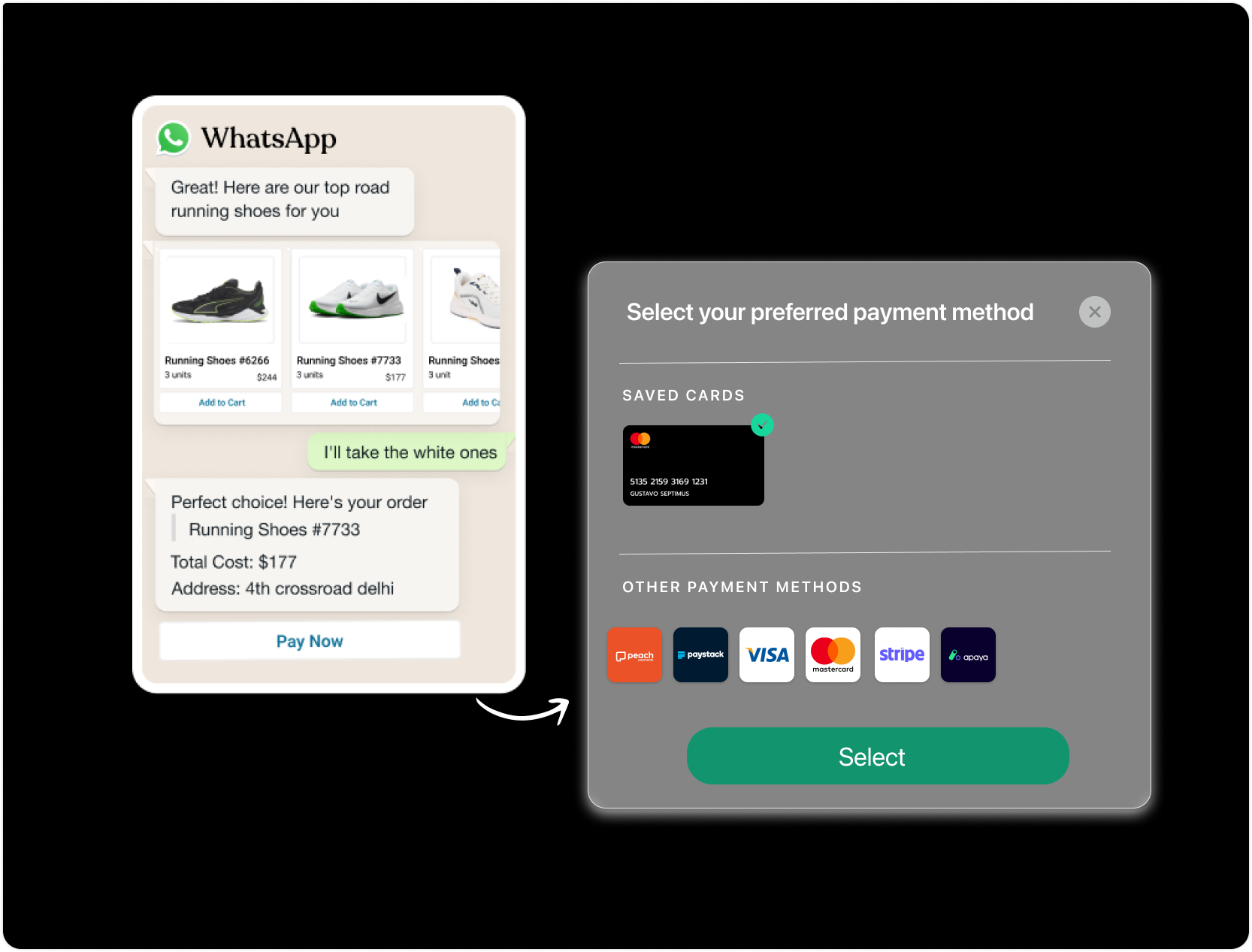
- Review the order: Once the customer is happy with the selection, Flowcart sends the cart with two options: Edit Cart or Pay Now.
- Proceed to payment: Once satisfied with their cart, the customer selects Pay Now, then Proceed to Pay. They complete the payment while staying in the WhatsApp conversation.
- Confirm delivery: The customer can also change the delivery address during checkout and confirm the updated details before placing the order.
.gif)
The Payment Network Behind In-Chat Checkout
In-Chat Checkout connects to 50+ payment gateways, including Peach Payments, Stripe, Razorpay, Paystack, Apaya, Paymob, and many more. The network gives Flowcart coverage across Africa, India, the Gulf, Europe, and all the global markets, with support for local payment infrastructure in the regions where merchants operate.
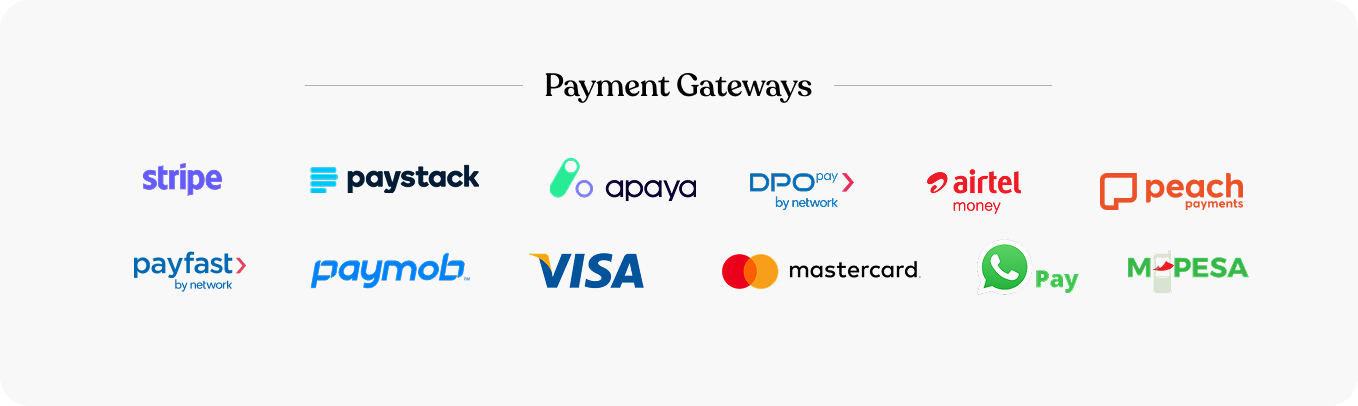
For brands selling across markets, this gives Flowcart the infrastructure to support different currencies, local payment preferences, and checkout requirements through one experience. The Mastercard collaboration expands the payment options available through this network, moving beyond cards and bank transfers to include options such as buy-now-pay-later (BNPL) within In-Chat Checkout.
Flowcart currently processes approximately $3 million in payments each month through its payment network.
Beyond E-commerce: Bringing Everyday Services to WhatsApp
The Mastercard collaboration also expands where Flowcart's payment infrastructure can be used. The opportunity is not limited to online stores selling products. Organizations that provide everyday digital services can also use WhatsApp as a direct channel for customers to access and pay for those services.
This includes mobile talktime top-ups, electricity and water bill payments, and other digital services that customers often manage through separate apps, agents, or in-person payment points.
For banks, telecom providers, and utility companies, this creates another way to put those services in front of customers. Instead of asking customers to open an app or find an agent, customers could start the interaction on WhatsApp and complete the service and payment in the same conversation.
The Revenue Flow Continues After Checkout
Flowcart's In-Chat Checkout also sits underneath the flows that bring customers back to buy. This matters because creating another buying opportunity only helps if the customer can complete it easily.
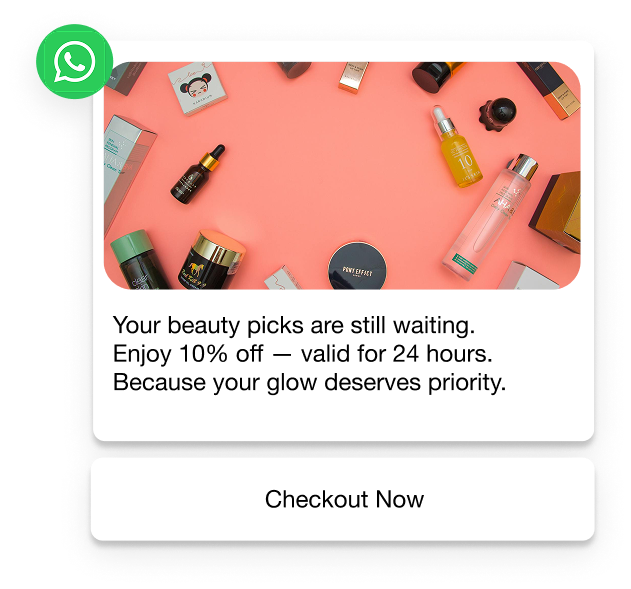
Consider abandoned carts. A customer may add products to their cart on a website and leave without paying. Flowcart can bring that customer into WhatsApp with a recovery message and take them back to their order. The customer can then complete the purchase through In-Chat Checkout, not go elsewhere.
Brands using WhatsApp for cart recovery typically see around 10% conversion. With a lower-friction journey from purchase intent to payment, Flowcart can take recovery rates to 25% or higher.
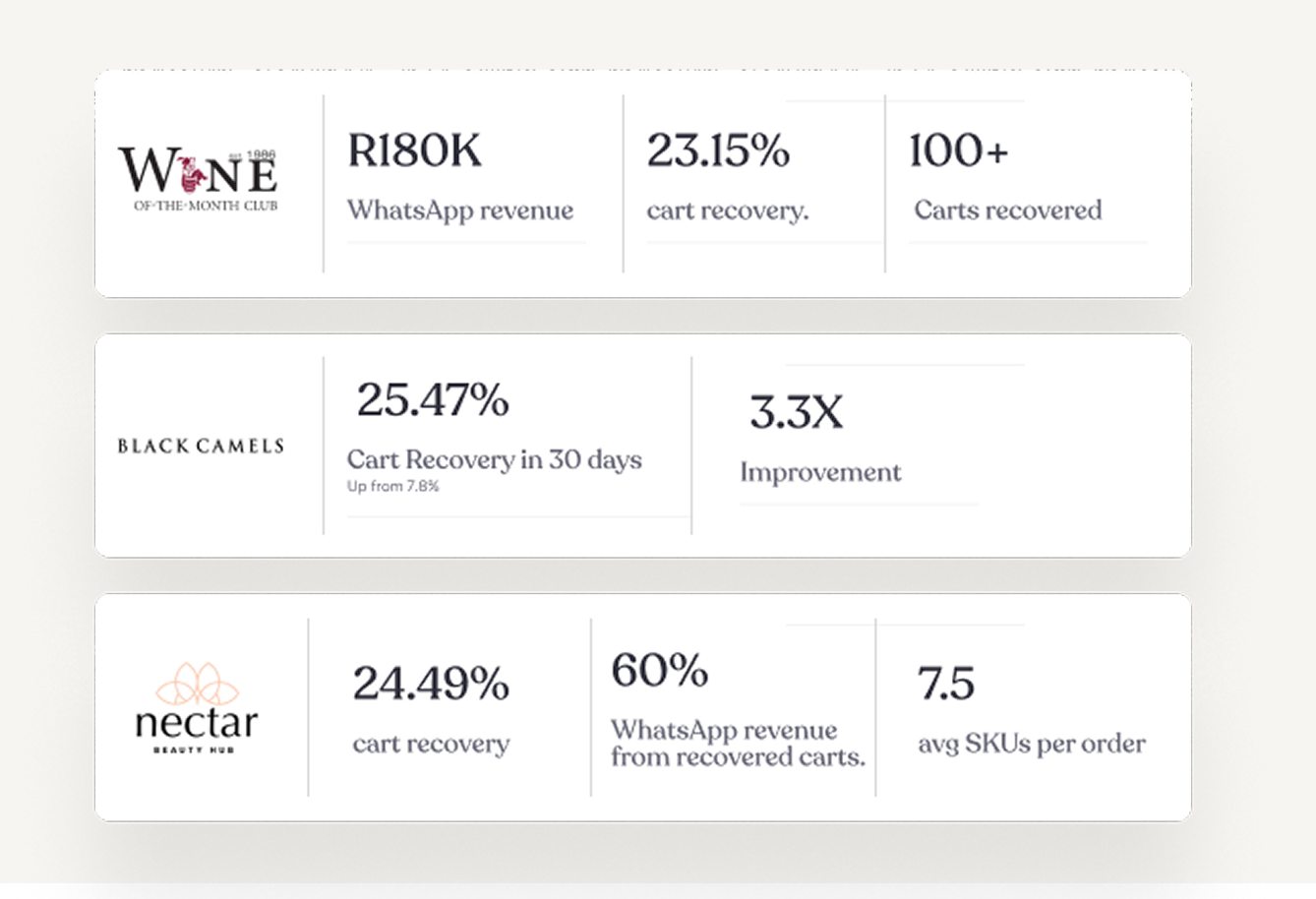
Nectar Beauty, for example, recovers 27% of abandoned carts through Flowcart.
The same checkout layer can support repeat purchases through subscription and retention agents. A Flowcart agent can identify when a customer is due for another purchase, nudge them in WhatsApp, and guide them through the order. Once the customer is ready, In-Chat Checkout gives them a direct path to payment.
That creates a connected loop: the agent creates or recovers purchase intent, and In-Chat Checkout turns that intent into a completed transaction.
This is where the Mastercard collaboration fits into the wider system. By expanding the payment options available within that checkout layer, Mastercard adds to the infrastructure behind both recovered and repeat purchases.
What Mastercard Adds to the Revenue Opportunity
Flowcart already has revenue flowing through several parts of the WhatsApp journey: abandoned cart recovery helps win back customers who did not complete a purchase, while retention agents create opportunities for repeat orders.
The Mastercard collaboration adds to that existing revenue opportunity by expanding what the payment layer can support within In-Chat Checkout. That includes a broader range of embedded payment options, from cards and credit to buy-now-pay-later and card offers, giving customers more ways to complete a purchase without leaving the buying journey.
For merchants, that means customers who discover a product, ask questions, and decide to buy in WhatsApp can complete the purchase in more ways within the same flow. Your customer can make the buying decision in the conversation and choose payment options that match it, without being sent somewhere else.
See In-Chat Checkout in your own store. Book a Flowcart demo!
About Flowcart
Flowcart is a WhatsApp commerce platform that helps brands and enterprise retail businesses turn conversations into sales and repeat purchases. Its AI agents handle product discovery, build carts, and respond to customers in natural language, while In-Chat Checkout connects the conversation directly to payment.
Flowcart works with the systems e-commerce businesses already use, including commerce platforms such as Shopify, WooCommerce, and Adobe Commerce (Magento), as well as ERPs including Zoho, Odoo, Prana ERP, SAP, and NetSuite. Its payment network connects to 50+ gateways, including Peach Payments, Paystack, Razorpay, and Stripe, and is expanding through its strategic collaboration with Mastercard. Flowcart supports businesses across Africa, India, the Gulf, Europe, and other global markets.
Brands using Flowcart can drive revenue beyond the first purchase by using its AI Agents to turn one-time buyers into repeat customers.

.png)




%201.webp)



.png)