.png)
.png)

.png)
Key Takeaways
Learn how to build a full WhatsApp commerce funnel from acquisition to retention, not just a support inbox.
See proven tactics like CTWA, in-chat checkout, AI flows, and loyalty programs that lift conversions, AOV, and repeat sales.
Discover how Flowcart powers end-to-end WhatsApp selling with automation, analytics, and real case studies from D2C brands.
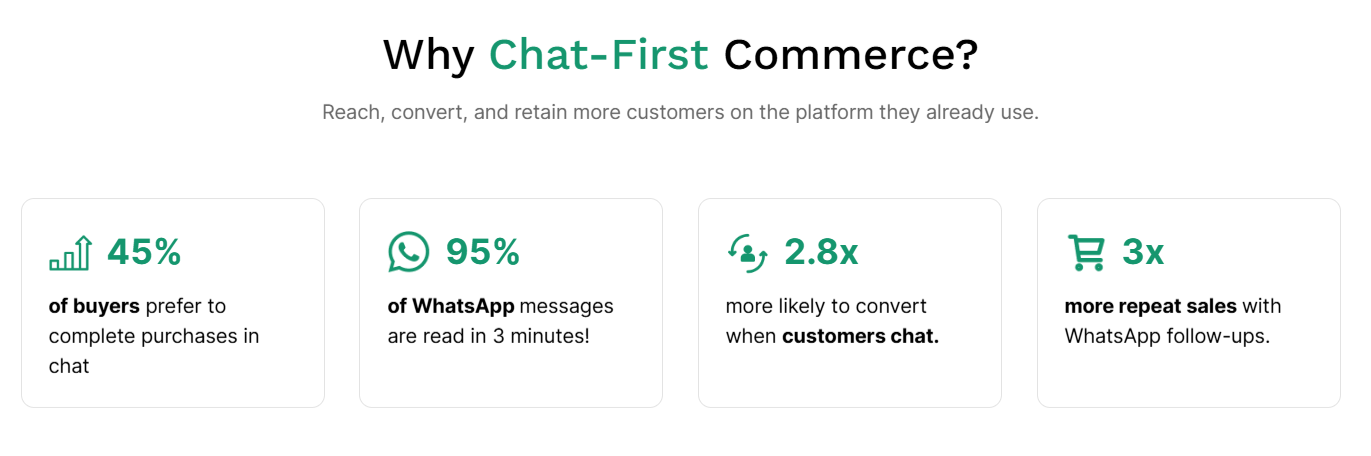
WhatsApp boasts several tall figures.
- 95% of messages are read in 3 minutes
- Customers are 2.8x more likely to convert on chat
- 3x more repeat sales with follow-ups
- 45% of buyers prefer to complete the purchase inside chat
Sneha Mehta, the CEO & Co-Founder of Uncover Skincare, also used Flowcart’s smart broadcast feature on WhatsApp to drive 3x more revenue than email. That proves there's a ton of marketing and sales opportunities for a platform that was once all about messaging.
However, only a few brands make good use of these opportunities. Some still see WhatsApp as a support inbox and a lead-capture channel rather than a full commerce alternative to traditional channels.
This results in lost sales, high checkout friction, multiple touchpoints, frustrated customers, and a bearish revenue outlook.
To avoid such outcomes, we’ll share practical strategies that will help you turn WhatsApp into your most profitable commerce storefront.
What is WhatsApp conversational commerce?
WhatsApp conversational commerce is a marketing and sales approach that uses WhatsApp to generate leads, nudge them toward conversion, complete purchases in chat, and follow up post-purchase to build healthy brand-customer relationships.
- This is different from traditional commerce, which usually happens on a website, involves forms and multiple touchpoints, and offers a barely interactive experience.
- In WhatsApp commerce, your customers interact with you or your bot to initiate, confirm, or pay for an order in the same thread.
An example of a brand adopting WhatsApp commerce for growth is Kings Collection. The fast-growing fashion brand in Kenya utilized Flowcart’s WhatsApp commerce platform to handle customer interactions, facilitate real-time orders, direct customer engagement, and provide in-chat delivery tracking.
The result? 400% growth in sales and 70% of total orders processed on WhatsApp.
What WhatsApp commerce is not: Generating and supporting leads inside chat while you close sales outside WhatsApp. That’s simply using WhatsApp as a lead capture channel.
What does the WhatsApp Commerce Funnel look like?
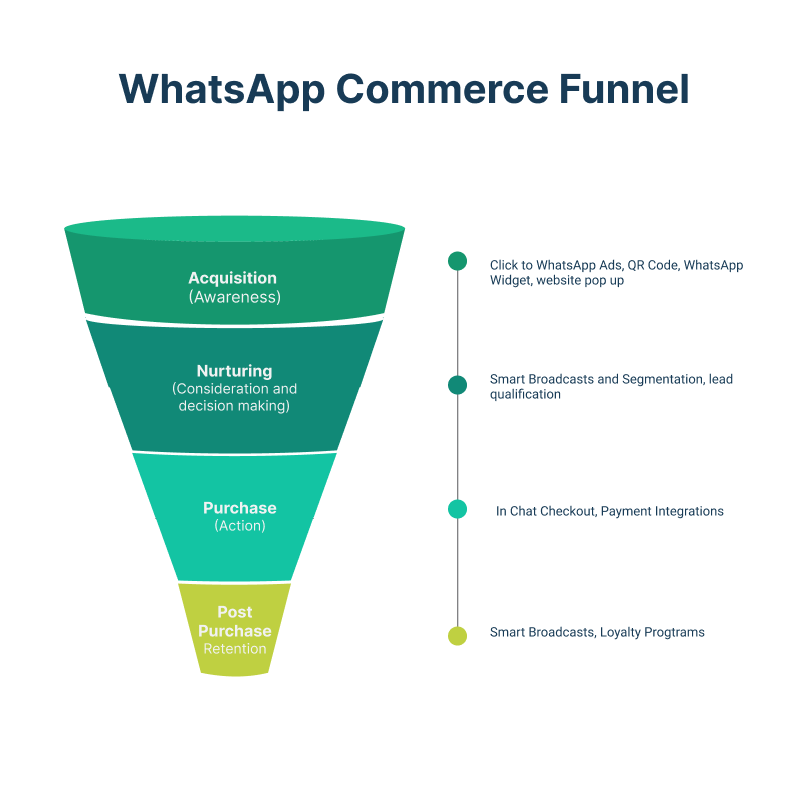
The WhatsApp commerce funnel is a series of connected, conversation-driven stages that span from a lead’s first contact with your brand to their conversion and becoming a loyal customer.
This funnel includes lead acquisition or generation, nurturing, conversion or purchase, and retention.
Acquisition (Awareness)
This is your customers’ first interaction with what you sell. That’s why it’s called the awareness stage. To acquire leads and bring them on WhatsApp, you can do the following:
- Launch a Click-to-WhatsApp ad (CTWA) either directly from WhatsApp or use Flowcart’s click-to-WhatsApp ad feature
- Share QR codes at events, webinars, or add it to physical locations to direct customers to your WhatsApp
- Embed WhatsApp widgets and pop-ups on your website
- Insert chat links inside your emails or SMS
Once they click any of these access points, they are redirected to your WhatsApp chat with or without a preset message. This is the beginning of their conversational experience with you.
Flowcart’s click-to-WhatsApp ad feature streamlines this experience even better. Suppose a customer clicks your CTWA for a particular product. Flowcart serves them the product-specific flow, not a generic welcome.
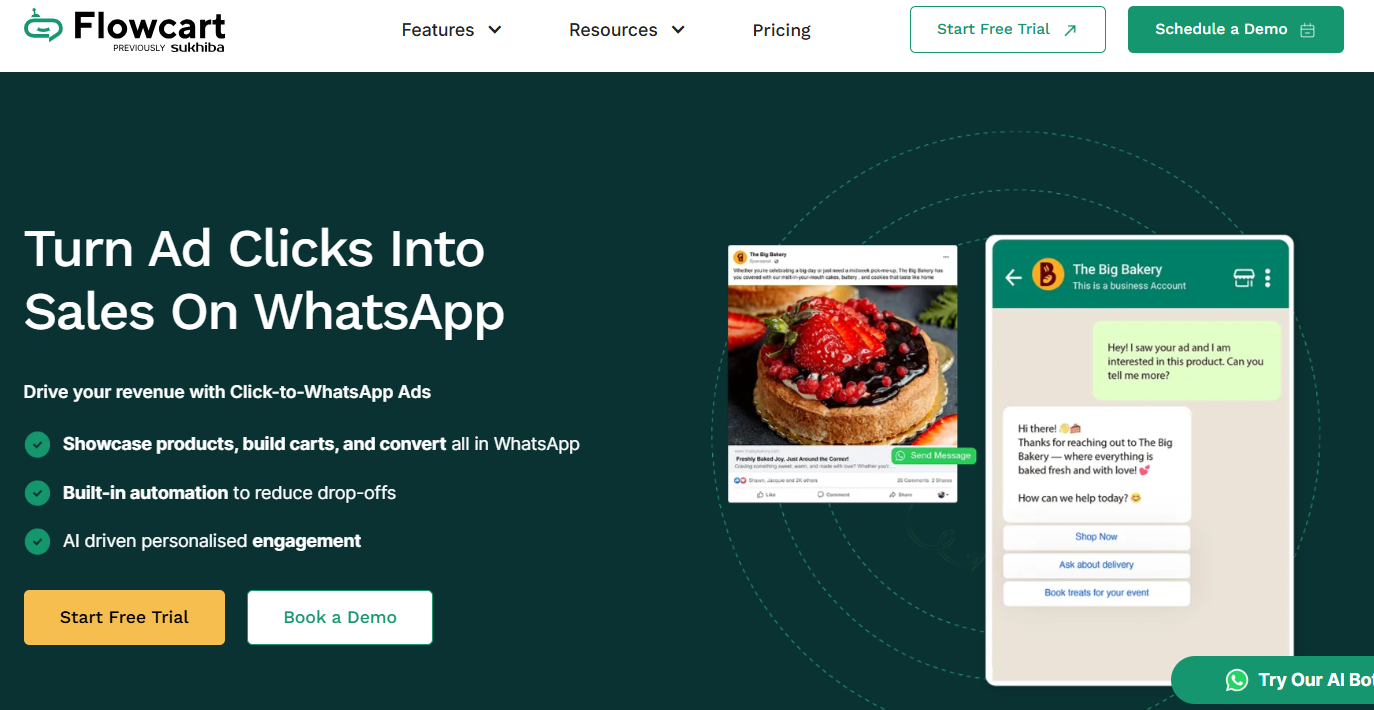
Samaking used this approach to turn every ad click into a guided sales and boosted conversions by 40%.
Nurturing (Consideration and Decision-making)
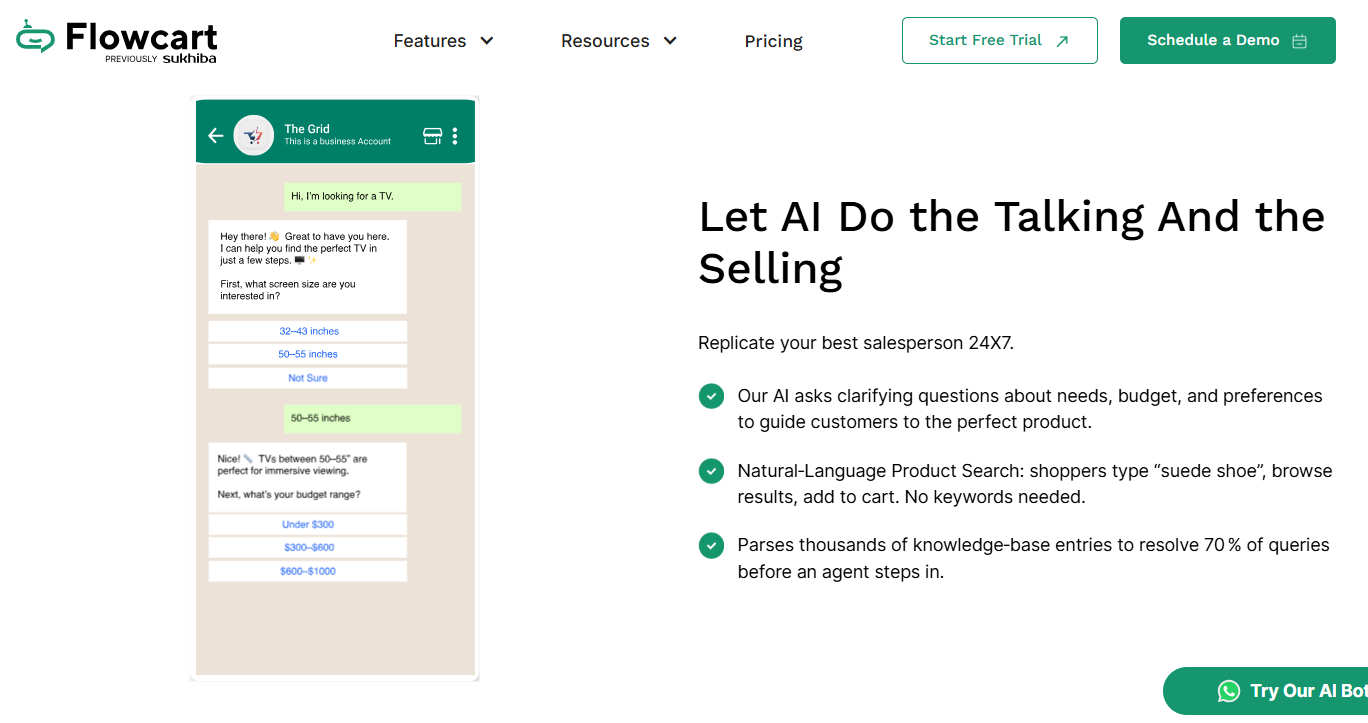
Lead qualification and nurturing happen at this stage. During qualification, you ask them a few questions surrounding budget, preferences, and needs to guide them to the right product.
Flowcart’s WhatsApp flows make this easy by automating the whole process and asking only questions that will keep your leads, not drive them away.
After qualification, you already know more about the lead and can send personalized broadcasts. Your lead is also considering your products and weighing the option of buying. The more personalized your messages are, the more likely they are to buy.
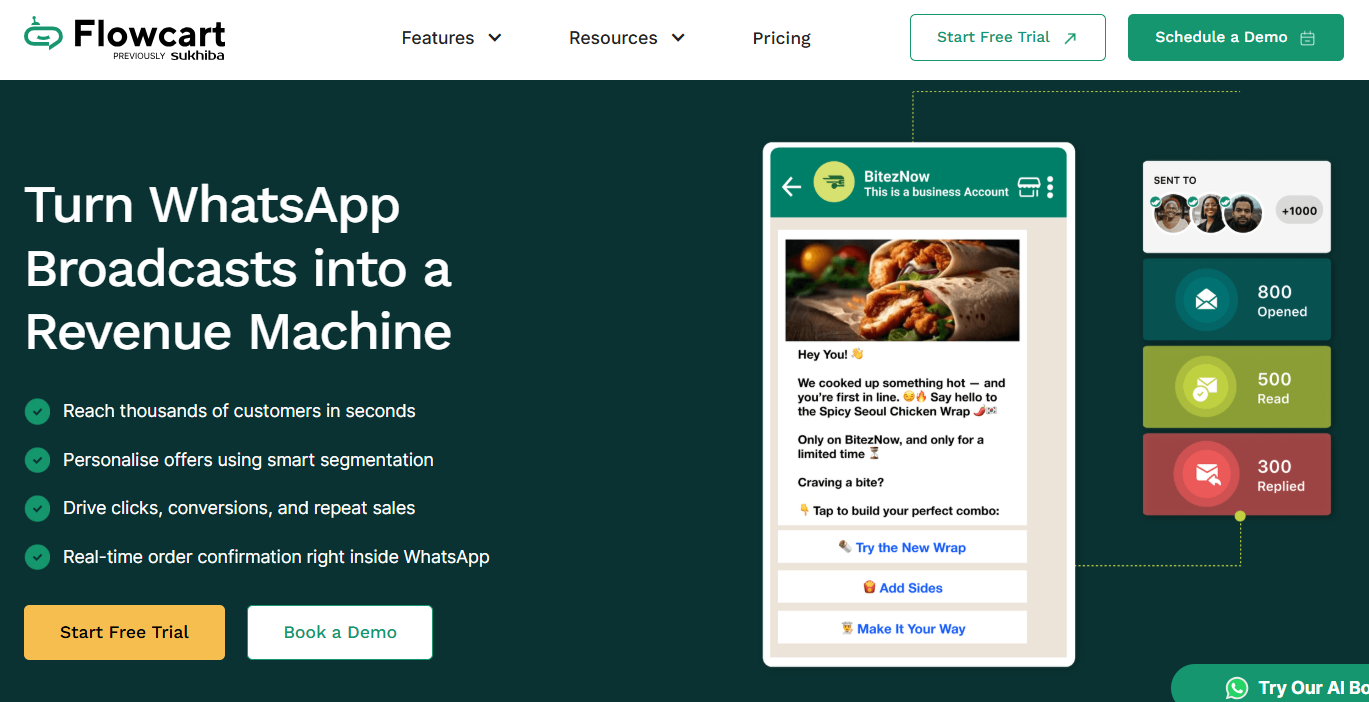
Flowcart’s AI-powered smart broadcast feature enhances this stage by segmenting based on initial qualification and personalizing each message, rather than blasting leads with irrelevant copies
Purchase (Action)
The third stage in your WhatsApp commerce funnel is where leads become customers and make a purchase after a period of consideration. This is also the most delicate step. If customers have to complete checkout outside the chat, they’re likely to drop off.
So, the cherry? WhatsApp Commerce keeps payments in the chat. In locations where available, like India, Brazil, Indonesia, and Mexico, your customers can use WhatsApp Pay for swift purchases.
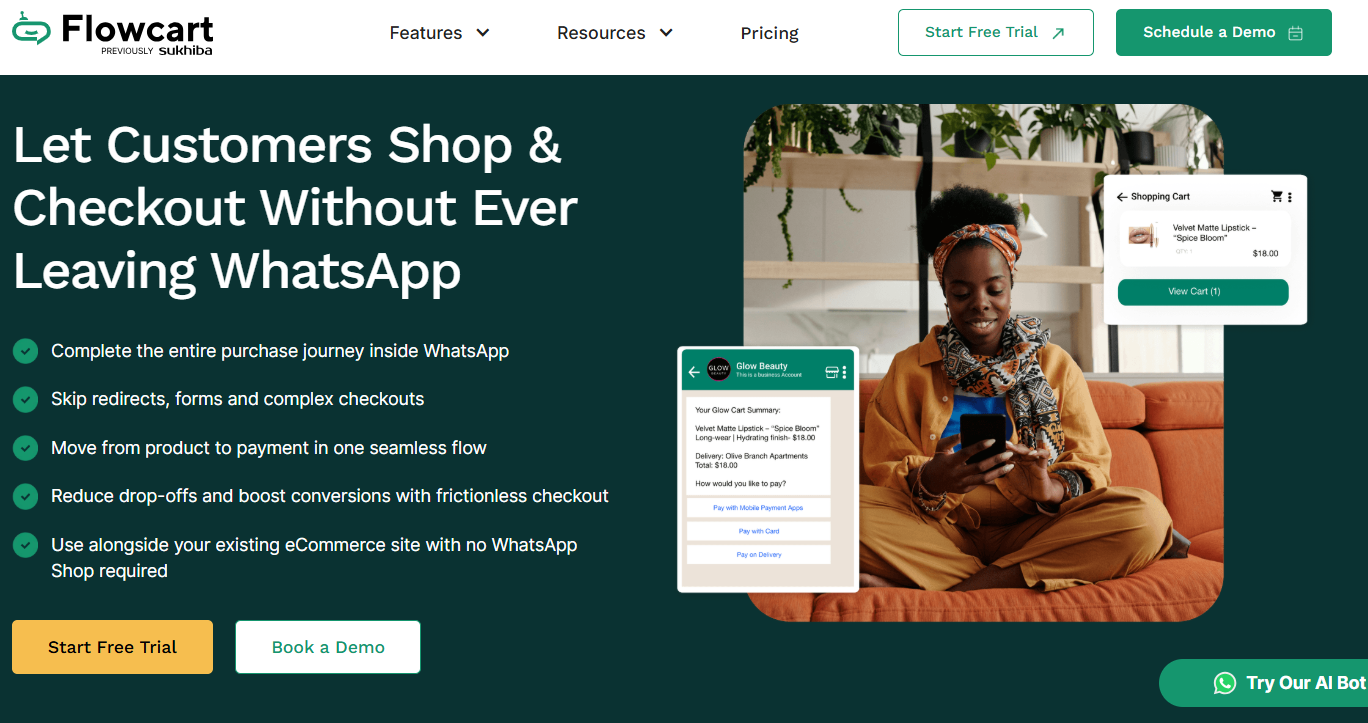
Flowcart’s in-chat checkout feature offers 30+ global payment options, including Stripe, Paystack, Razorpay, mobile wallets, and more, to streamline in-chat payments across all locations.
Post-purchase (Retention)
Once a customer makes a purchase, that’s not the end. WhatsApp helps you re-engage them for repeat purchases.
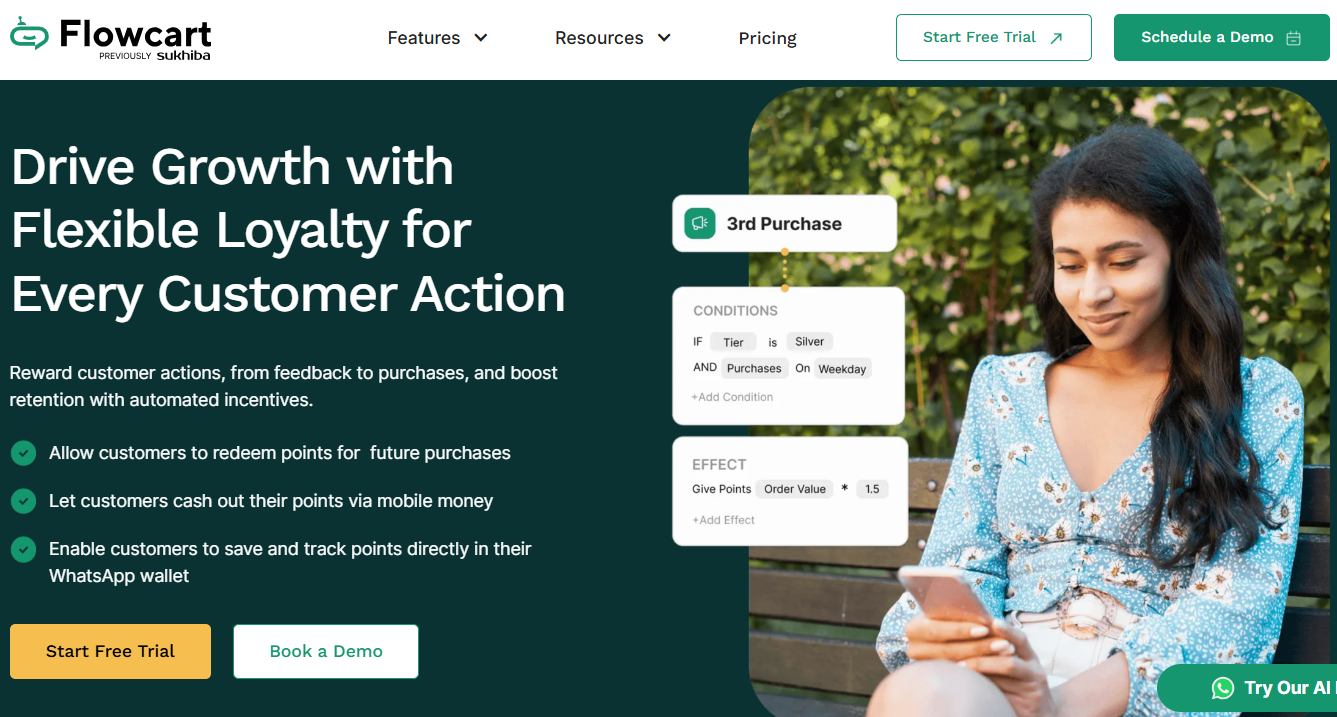
This is also where you introduce a loyalty program to gamify your buyer’s journey. Flowcart’s loyalty program feature helps you reward customer actions and automate incentives with redeemable points.
Why WhatsApp Commerce Is Exploding in 2026
According to a Juniper Research study, global conversational commerce spending will reach $135 billion by 2027, up from $39 billion in 2023. And 45% of this spending will happen primarily through WhatsApp and a few other apps.
Here’s why that’s happening:
Most of your customers are likely on WhatsApp already
WhatsApp has over 3 billion active users, according to a 2025 Statista report. That’s about one-third of the world’s population and contains a large proportion of your likely customers.
They already spend most of their time there, opening the app more than 929 times a month, and find it more comfortable to make purchases while chatting with friends and family.
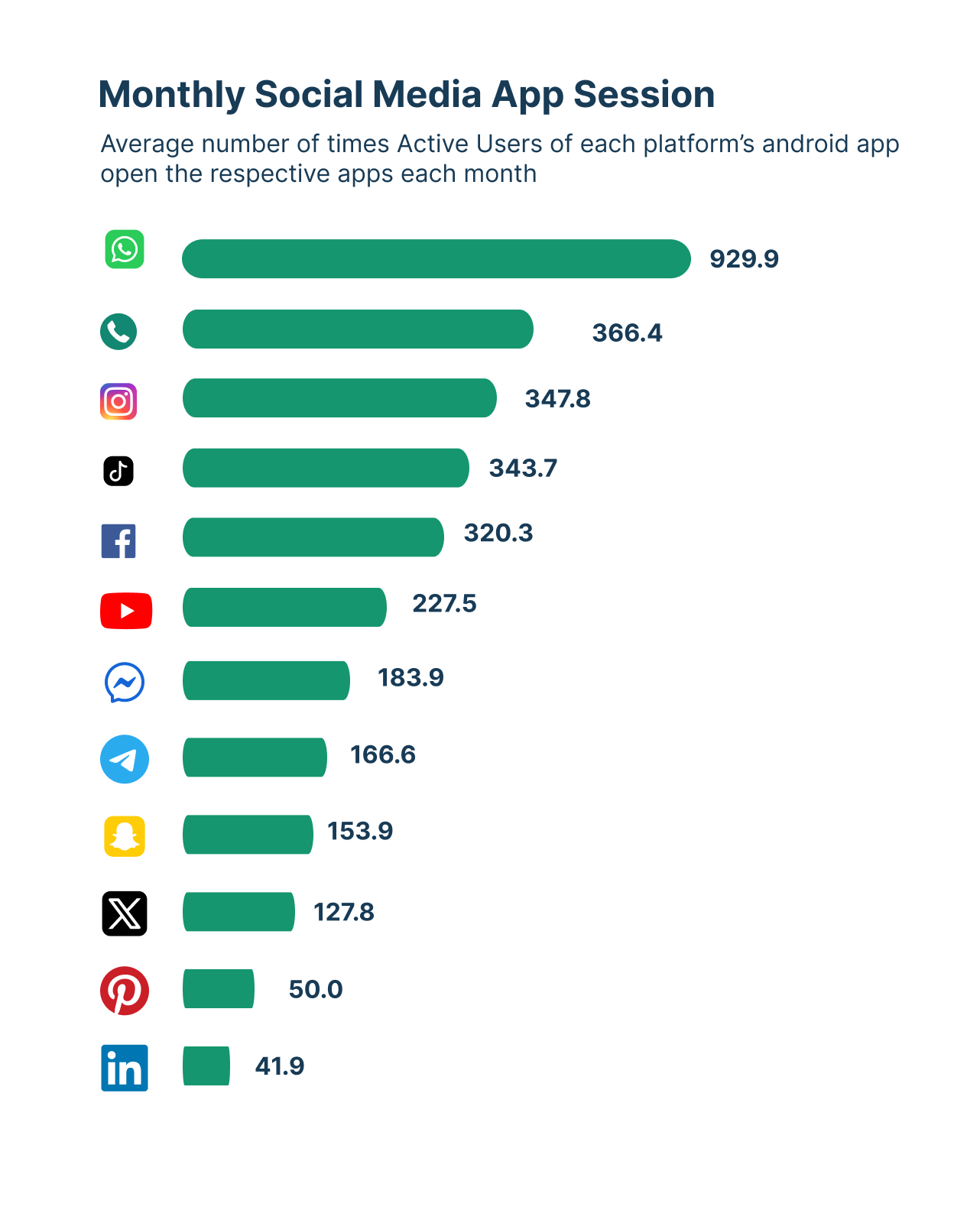
A chart from Datareportal shows users open WhatsApp up to 929 times monthly
Traditional marketing channels are disconnected
Traditional channels run through a couple of disconnected ends, directing customers from one tab to another. This leads to tab fatigue and explains why many of these customers drop off, resulting in over 70% loss due to abandoned carts.
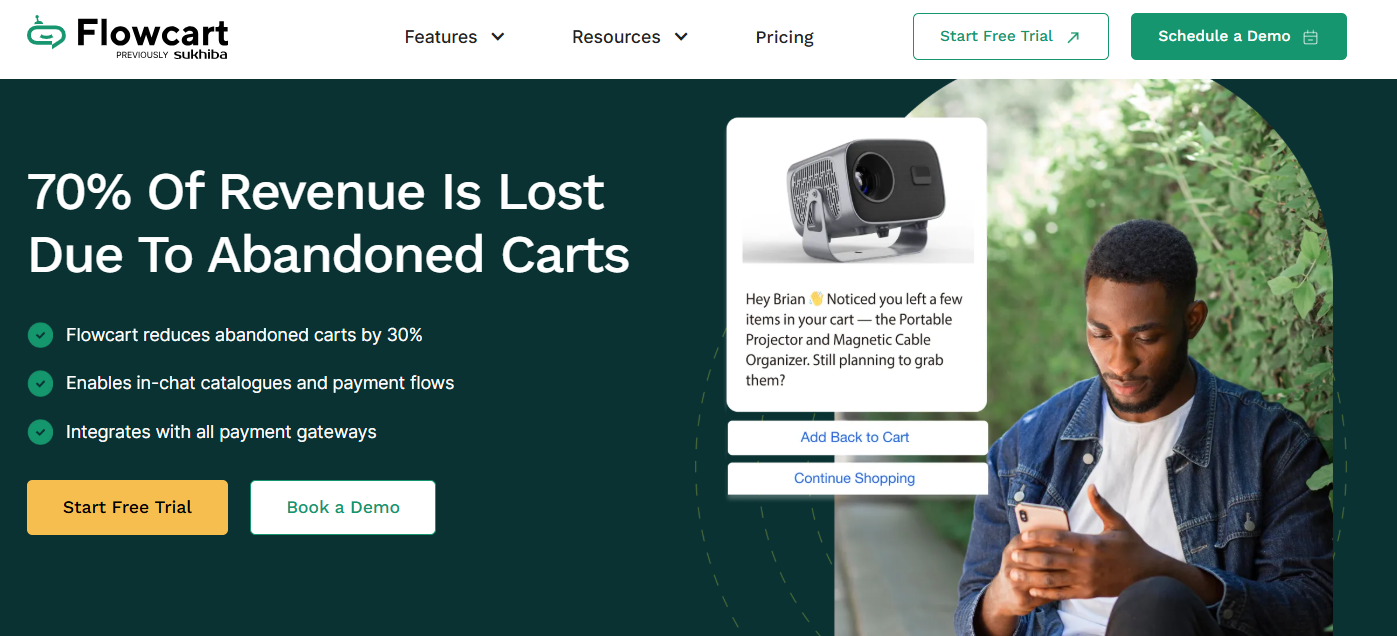
On the contrary, WhatsApp commerce keeps everything on the same thread, from lead generation and conversion to in-chat checkout and post-purchase programs. Integration with Flowcart’s abandoned cart recovery feature cuts no less than 30% of abandoned carts and helps boost your revenue.
Customers want real-time interactional conversations
Hiverhq’s survey shows approximately 63% of consumers prefer live chat. They prefer a two-way conversation, which happens in an instant over a send-and-wait email type of communication. WhatsApp commerce provides that.
Your customers come in from click-to-whatsapp ads, QR codes, or any other access points and receive an immediate response to their enquiries. This reduces interactional blockers and increases customer satisfaction.
Key Features and Benefits of WhatsApp Commerce
WhatsApp commerce, especially when powered by an AI-native platform like Flowcart, offers tons of features that facilitate success. But these are the core:
Comprehensive product catalogs and collections
Remember Shopify? Yes, platforms like Shopify were the standard of product display in global commerce. But that has changed. On WhatsApp Business, you can display up to 500 products, individually or in collections, using the catalog feature.
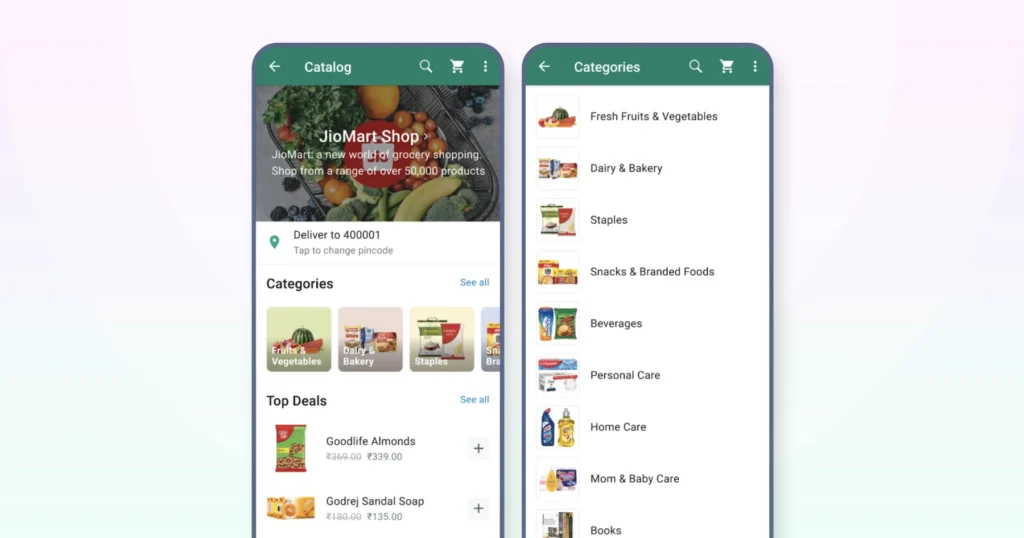
You can add product descriptions, locations, costs, and other details to make the purchase seamless. The most notable inclusion is the Add to Cart button.
Flowcart extends how products are displayed in WhatsApp by using AI-driven flows and segmentation rather than being limited to static catalogs. For instance, using the AI-generated carts feature, you can directly target customers with personalized, scrollable collections right inside chat and help them decide faster. You can also make each product in the catalog interactive using different content formats, such as carousels, videos, PDFs, and images.
Order confirmation without account creation
Traditional commerce prioritized nudging customers to create an account. That’s understandable. You need contact details to initiate reengagement. However, 19% of consumers in Baymard’s survey say they’ve abandoned a purchase midway because of that.
WhatsApp commerce solves the impasse. The moment your customers message you on WhatsApp, you already have their contact, and they don’t need to create an account since they likely already use the app. This makes in-chat order confirmation possible.
In-chat checkout without leaving the conversation
Topping the cherry is in-chat checkout without leaving WhatsApp. This is possible via WhatsApp Pay, which is only enabled in Indonesia, Brazil, Mexico, and India. Flowcart’s in-chat checkout feature expands your payment options for broader targeting and a smoother checkout experience.
Customers complete all their transactions within WhatsApp’s secure end-to-end interface, helping protect their payment details.
Post-purchase support within the same thread
Business does not end after a single purchase. WhatsApp commerce helps you continue conversations where you left off and re-engage your leads-turned-customer with more personalized recommendations.
Flowcart’s AI-generated carts and smart broadcasts enable hyper-personalized marketing, while the loyalty program keeps the reengagement process fun and interactive for your customers.
How to comply with the WhatsApp Commerce Policy
WhatsApp has a number of policies you’re required to uphold. Violating them can result in irreversible suspension and even legal implications if it infringes on users’ privacy.
Here’s how to comply with these policies.
Use doubt opt-in only
What’s the fastest way to ruin your business reputation and to get suspended on WhatsApp? Sending messages to customers without their consent. That’s why this Reddit user is frustrated.
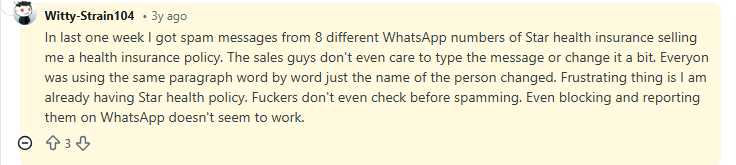
A Reddit user expressing frustration over blast messages on WhatsApp
WhatsApp states that you can message a user only if they have given you their contact information and consented to receive messages or calls from you. As for the opt-in method, you’re free to choose whichever works well per your regional laws.
Best practice is to implement double opt-in. At the point of entry from CTWA, QRs, pop-ups, widgets, or chat links, they agree to receive a message. Once on board, send them a short message to confirm their consent.
WhatsApp recommends using a different opt-in for calls and another for messaging.
Accurate product details
Every product should have its detailed description, pricing, delivery timelines, and refund terms clearly stated to avoid transactional confusion or incorrect flagging by WhatsApp.
Most importantly, avoid misleading claims, vain guarantees, prohibited products, or bait offers that offer no value to your customers. And your product details should not contain offensive content, such as sexually explicit materials.
Prohibited products include drugs, alcohol, firearms, medical and healthcare products, endangered species, hazardous goods, body parts or fluids, and currencies, whether fake or real.
Respect message frequency limits
There’s no hard and fast rule on how frequently you can send a message. But you shouldn't blast your customers with daily broadcast messages, either. At best, once a week or every two weeks is fair and should follow personalized flows.
Also, according to WhatsApp, once a user messages you, you have only 24 hours to start a conversation with them without using a template. After that window, you can only respond with an approved template.
Provide a clear business identity
Maintain a detailed WhatsApp business profile containing your email address, website addresses, and/or telephone number(s). And each info must be kept up to date. This helps to prevent impersonation and avoid misleading customers, both of which can result in account termination or suspension.
Other things to add include your business location, opening and closing hours, and business specifics your customers should know.
Honor customer requests
Customers’ voice matters now more than ever.
In WhatsApp’s own words, “You must respect all requests (either on or off WhatsApp) by a person to block, discontinue, or otherwise opt out of communications from you via WhatsApp, including removing that person from your contacts list. Do not confuse, deceive, defraud, mislead, spam, or surprise people with your communications.”
6 Practical WhatsApp Commerce Strategies to Boost Sales
WhatsApp is the modern commerce machine, and it can effectively scale your business. But that depends on how you use it. These are six key strategies you can implement.
1. Use WhatsApp ads to gain hot leads
QR codes, WhatsApp widgets, pop-ups, and chat links are all great ways to acquire leads. But if you want to generate a sustained number of hot leads, click-to-WhatsApp ads are your go-to.
When you should use CTWA:
- You just started WhatsApp commerce and have no customer base
- You want to grow your revenue and profits
- You have the capital to fund the first few ads
Flowcart sends your CTWA conversion data to Meta to help it learn about your ideal customers and automatically improve your ads over time. This results in targeted ads, which can boost your conversion rate by as much as 40%.
Even better? Combine all the entry points, from QRs to CTWA, for the best results
2. Minimize checkout process
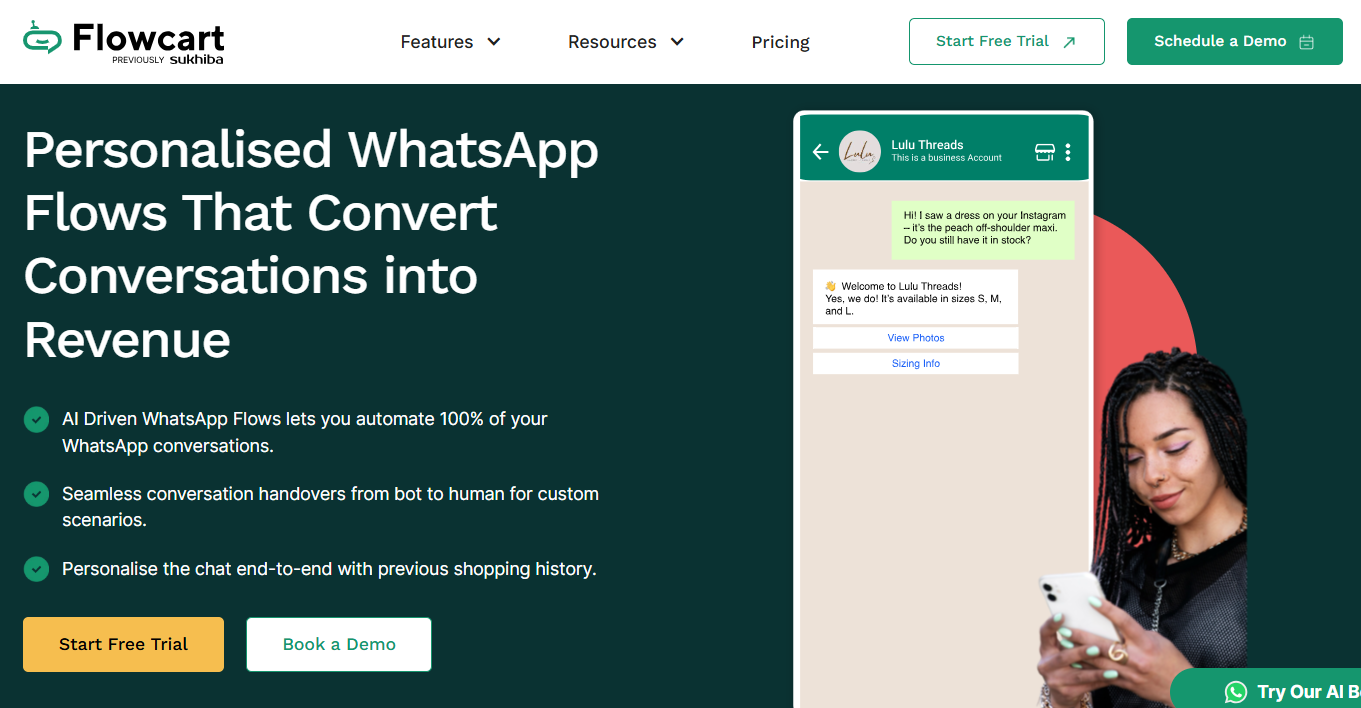
At most, help your customers complete checkout in less than 3 steps. No unnecessary questions or bulky requirements. Also, keep your menu simple and easy to navigate, with fewer touchpoints.
Flowcart’s automated WhatsApp flow makes this possible by using personalized flows to guide your customers through checkout. The result? 28% higher conversion rate on first sessions.
3. Push bundles and add-ons to lift AOV
Amazon gained 35% of its revenue from upselling and cross-selling. You too can. During order confirmation, you can push personalized complementary products. For instance, a hair serum or oil in addition to the customer’s initial shampoo pick. Make it optional so they can proceed to checkout if they’re not interested.
The recommended products should be affordable, if not cheaper. You can tie them to free delivery if it covers the cost. “Add this product to your cart to win a free delivery.”
Flowcart’s AI-generated carts use customer purchase history to recommend the right products to your customers during and after checkout. This boosts upsell and average order value by 18%.
4. Automate repeat purchase reminders
With proper follow-up, WhatsApp commerce can yield 3x more repeat sales. But that’s a century’s worth of work if you want to consistently follow up on your hundreds, or even thousands, of customers. The best option is to automate the entire process.
Flowcart categorizes your customers based on previous interactions and purchase history using its AI-powered segmentation feature. Then it initiates a loyalty program and uses smart broadcasts to send personalized reengagement messages, exclusive offers, and time-limited deals.
Additionally, Flowcart’s AI-generated carts curate customer-aligned products and nudge customers to make repeat purchases.
5. Keep human takeover available when automation stalls
WhatsApp commerce automation is non-negotiable if you want to scale your business. But you still need human oversight when your customers need help with more complex tasks or questions.
So, keep human takeover available and ready at all times during work hours. Flowcart’s automated flows reroute instantly to your human team when it notices a blocker, even before the customer asks.
6. Track drop-offs inside chat (and fix the exact step causing exits)
This is the most important. You need detailed analytics to know what’s wrong, where, when, and how to fix whatever issues crop up. Analytics also use heatmaps to show which products customers asked for most and which have the fewest counts.
However, WhatsApp does not provide tangible analytics. That’s where WhatsApp business API platforms like Flowcart become even more indispensable. Besides tracking your customers and sales activity, you also measure your sales reps’ inputs, such as session time and the number of sales closed.
Once you notice a blocker in your customer journey, say too many touch points, fix it immediately.
Common WhatsApp Commerce Mistakes to Avoid
Relying on a spray-and-pray strategy is the first common mistake. The “Just set up the ad and let it pull in leads. We’ll know what to do after” category. This can result in unyielding ad spend.
To avoid that, design your flows, create marketing SOPs, craft and pre-approve response templates, and implement the strategies we’ve discussed above.
Other mistakes include:
- Treating WhatsApp as a support inbox: WhatsApp is a full commerce channel where you generate leads, nudge them towards conversion, close sales, and build a loyal customer base. It is not a support box for another channel.
- Blasting promotions without personalization or context: People hate generic messages. Only use WhatsApp broadcasts with proper personalization. Also, limit frequency to your customers’ requests or at most once every one to two weeks.
- Asking for too much information before showing products: Lead qualification is essential, but it shouldn’t take more than three questions. Their needs, preferences, and budget.
- Ignoring post-purchase follow-up and reorder nudges: WhatsApp commerce does not end at checkout. Send a thank-you message, collect feedback, and re-engage customers with a strong loyalty program. Repeat sales boosts customer’s lifetime value and your revenue.
Using Flowcart to Scale WhatsApp Commerce
Marketing and selling on WhatsApp can quickly become a hassle as your business scales. More customer messages, more orders, more complaints, chaotic transactions, lost sales, and inefficient segmentation. These represent the peak of manual handling.
And that’s why you need an AI-powered WhatsApp business API platform like Flowcart.
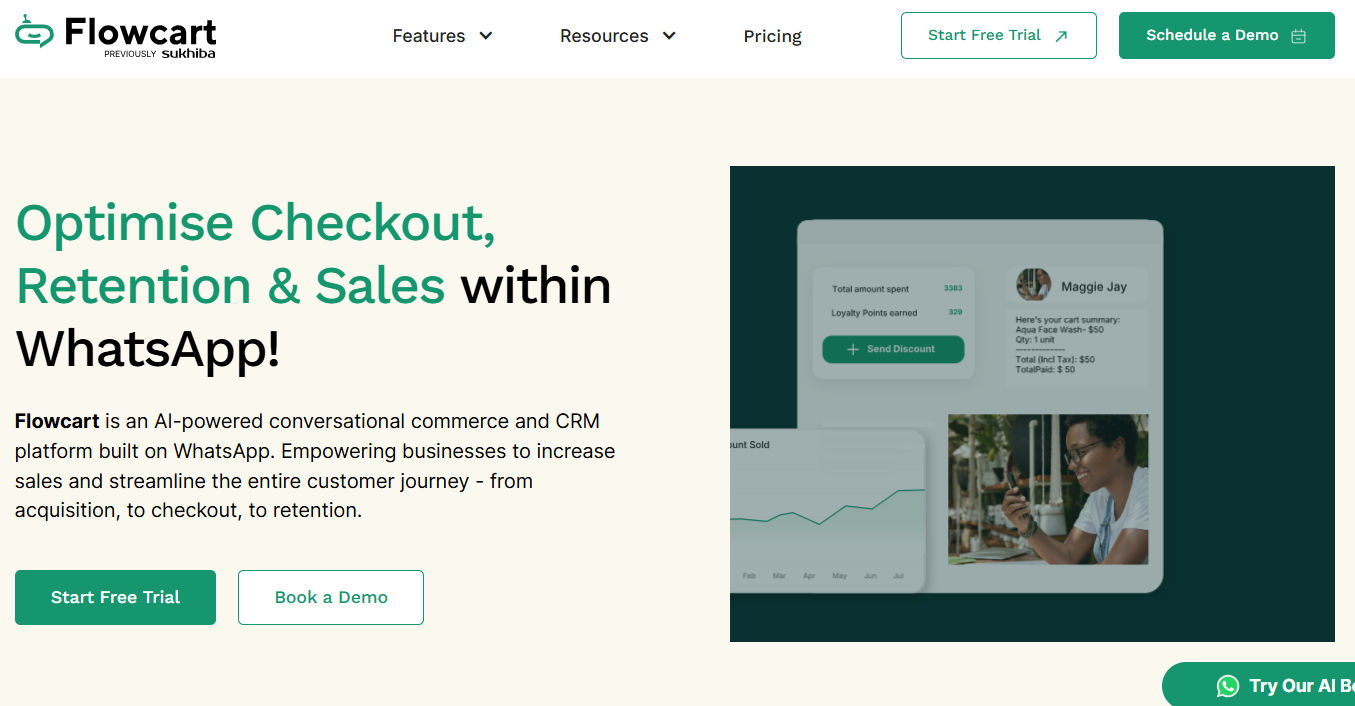
What can Flowcart do?
- Integrate with platforms like Shopify and sync products directly to WhatsApp
- Enable in-chat checkouts with over 30+ payment options, including Razorpay, Stripe, and Paystack
- Generate leads through click-to-whatsapp ads, QR codes, website popups, and widgets
- Qualify leads using AI-driven WhatsApp conversation flows
- Segment customers automatically for personalized messaging and offers
- Recover abandoned carts with timely WhatsApp follow-ups
- Centralize marketing, sales, support, and communication in one system
- Build repeat purchases and long-term customer relationships through loyalty programs
Darling Hair, a hair manufacturer and distributor in Kenya, used Flowcart to achieve 300% record sales growth and 7x the number of unique customer accounts.
Ready to achieve the same results? Book a demo with us today.
Conclusion
WhatsApp commerce is gold if you use it right. Your customers already live there, and that makes conversational transactions possible.
Practical strategies to boost sales include using click-to-WhatsApp ads to generate hot leads, minimizing the checkout process, and pushing bundles and add-ons to lift AOV. Automate repeat-purchase reminders, keep human takeover available, track drop-offs in chat, and fix the exact step causing exits.
To comply with WhatsApp policies, use double opt-in to collect consent, provide accurate product descriptions, respect messaging limits and customer requests, and provide a clear business identity.
FAQs
What is WhatsApp commerce?
WhatsApp conversational commerce is a marketing and sales strategy that uses WhatsApp to generate leads, nudge them toward conversion, complete purchases in chat, and follow up post-purchase to build healthy brand-customer relationships.
How is WhatsApp commerce different from WhatsApp marketing?
WhatsApp marketing uses WhatsApp solely as a lead-capture channel, redirecting leads to another channel for conversion, payment, or follow-up. WhatsApp commerce is a fully-built marketing and sales approach where everything from lead generation to purchase happens inside chat.
Can I sell on WhatsApp without a website?
Yes. You don’t need a website to sell. Business WhatsApp lets you create up to 500 product catalogs and sell directly in chat. To handle higher volumes, you can integrate a WhatsApp API such as Flowcart.
How to set up a WhatsApp checkout for my store?
You need a WhatsApp Business API for product syncing and payment integration.
Platforms like Flowcart connect your store, sync products, generate carts, and enable in-chat checkout with multiple payment options, including Stripe, Razorpay, and Paystack.
Is WhatsApp commerce allowed in my country?
WhatsApp commerce is allowed globally. Native WhatsApp Pay is currently supported in select countries, including India, Brazil, Mexico, and Indonesia. Outside these regions, in-chat checkout is enabled via external payment integrations offered by WhatsApp API platforms such as Flowcart.
How to reduce cart abandonment on WhatsApp?
Keep checkout in chat, limit the process to 1 or 2 replies, and automatically follow up when a customer drops off. Flowcart’s abandoned cart recovery and smart follow-ups help recover up to 30 percent of incomplete orders.
How to increase repeat sales via WhatsApp?
Use post-purchase follow-ups, reorder reminders, loyalty programs, and personalized recommendations. Flowcart segments customers by purchase history and automates smart broadcasts and AI-generated carts to drive repeat purchases.
Which WhatsApp commerce platform is best for D2C brands in 2026?
The best platform is one that supports product sync, in chat checkout, automation, segmentation, analytics, and policy compliance at scale. Flowcart is built specifically for D2C and ecommerce brands looking to turn WhatsApp into a full revenue channel rather than a support inbox.

.png)





%201.webp)



.png)