.png)
.png)

.png)
Key Takeaways
WhatsApp is replacing traditional funnels by turning conversations into the primary engine for activation, sales, and retention.
Brands use Flowcart to run WhatsApp-led acquisition, in-chat checkout, and lifecycle campaigns that compress time-to-decision and time-to-order.
Done right, WhatsApp-led growth unlocks new segments, lifts revenue, and scales with automation instead of adding funnel complexity.
For the last decade, digital growth has been built on a familiar stack: email, paid ads, landing pages, and product onboarding. But as acquisition costs climb and retention declines, a pattern has emerged across high-growth markets: the fastest customer activation is happening in WhatsApp.
Unlike other channels, WhatsApp isn’t merely a communication tool; it functions as a high-intent environment. Customers voluntarily engage, expect rapid responses, and treat interactions as extensions of the product experience.
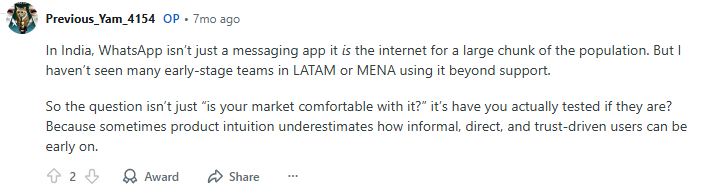
Reddit Thread: Whatsapp as a Prototype Channel for Growth
In India, this model has matured into a measurable growth engine: founders use WhatsApp to prototype features, train onboarding cohorts, and validate positioning before a single marketing dollar is spent. These aren’t “campaigns” they are controlled, opt-in feedback loops that convert conversations into product insights and recurring usage.
What’s notable is that this approach hasn’t scaled equally across LATAM, MENA, or Western SaaS ecosystems not because the opportunity is smaller, but because most teams still frame.
The core insight behind WhatsApp-led growth is that:
- Real demand often emerges where real conversations happen.
- Retention starts where trust is built.
- And conversions follow engagement not the other way around.
In 2025 and beyond, the shift is no longer experimental—WhatsApp is emerging as the primary interface for activation, lifecycle management, and revenue generation. The companies adopting it aren’t chasing novelty; they’re systematically replacing low-performing funnels with a channel that delivers materially higher open rates, faster decision cycles, and stronger lifetime value.
This raises a crucial question: what does WhatsApp-led growth actually mean in practice?
What is Whatsapp-Led Growth?
For more than a decade, digital growth has been built around funnels: landing pages to capture leads, email drips to nurture them, and product dashboards to measure adoption. WhatsApp-led growth replaces this stitched experience with a continuous one.
When a user enters a chat, they aren’t “submitting a form.” They are opening a conversation. The history of that conversation becomes the backbone of the customer relationship: onboarding, orders, support, follow-ups, reactivation, all recorded in a single thread.
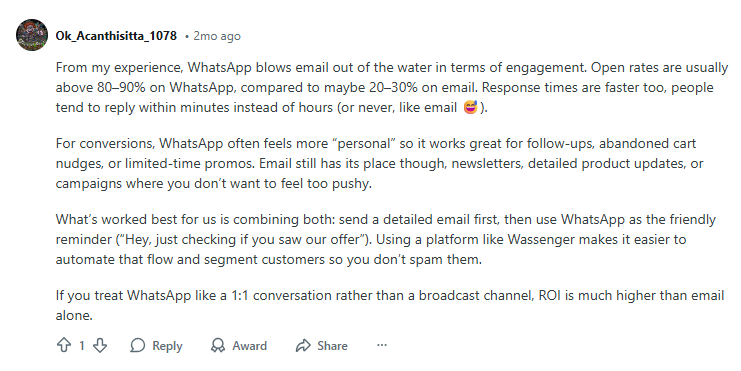
Reddit: Whatsapp is better than email
WhatsApp isn’t a component of the funnel, it is the funnel. It is the surface through which customers discover products, compare options, understand pricing, request support, make purchases, and come back for more. What email took days to accomplish, WhatsApp does in minutes. What a landing page struggles to convert, a conversation can clarify instantly.
This shift becomes tangible when you look at how real companies apply it. S&S managed 295 price tiers, forcing every order through manual quotes, emails, or phone calls. With Flowcart on WhatsApp, customers were recognized automatically, shown correct pricing, and guided through a structured purchase flow turning hours of friction into instant transactions and repeat business.
Key Benefits of a WhatsApp-Led Growth Model
A WhatsApp-led growth model doesn’t succeed because it is trendy. When businesses stop forcing users through artificial funnels and start meeting them in their native communication space, growth stops looking like persuasion and starts looking like partnership.
Table: WhatsApp-Led Growth vs Traditional Funnel Models
Here are the core benefits of this model:
1. High Customer Penetration and Native Engagement
Growth strategies usually begin with audience-building: email lists, app installs, web signups, retargeting pixels. WhatsApp skips this stage entirely because the user base is already there. In many markets, it is not one of the top communication channels, it is the default behavior.
That density matters. Acquisition is not forced; it’s inherited. A user doesn’t need to learn a new interface, install an app, or make an account. They simply do what they already do: open a chat.
For businesses, this removes the most expensive part of funnel economics: dragging people into unnatural environments. When the entry point is familiar, friction is negligible. And once a conversation starts, it rarely feels like a transaction. It feels like continuity with the way the customer already lives digitally.
2. WhatsApp Business API Enables Automation, Personalization, and Scale
When growth teams hear “WhatsApp,” they imagine manual replies and support queues. What they should imagine is a programmable environment. The WhatsApp Business Platform introduced API-level access that transforms the medium into something closer to a runtime layer for customer operations:
- Lead capture turns into onboarding flows
- FAQs turn into guided decision trees
- CRM updates turn into contextual nudges
- Sales handoffs turn into live agent continuity
- Payment events turn into automatic retention triggers
The genius is not that the messages are conversational. It’s that the surface never changes. With every action happening inside the same interface, companies don’t need to teach users how to navigate a funnel. They only need to guide a dialogue. That simplicity is a competitive moat.
3. Conversational Commerce Converts Faster Than Traditional Funnels
Traditional digital growth separates thinking from buying. You browse on a site, check your inbox for a coupon, complete an OTP screen, and receive a confirmation in a different channel. WhatsApp collapses the distance between intent and action.
The product pitch, the objection, the answer, and the payment can occur in one thread. In markets where Meta Pay and UPI integrations are rolling out, that shift is even more powerful. WhatsApp becomes not just a place to talk about a purchase it becomes the place where the purchase happens. The difference is not cosmetic. When the point of decision and the point of transaction are the same, the need for funnels disappears.
4. Conversation History Drives Retention and Lifetime Value
Email threads fragment. Web sessions expire. Support tickets reset context. WhatsApp does not.
It holds the entire customer relationship in one continuous history. Every message—support or sales, onboarding or retention lives inside the same thread. Companies don’t have to reintroduce themselves. Customers don’t have to repeat their story.
For businesses with operational complexity, this continuity is transformative. For a traditional funnel, that would have required multiple tools, multiple steps, and multiple departments. In WhatsApp, it becomes a thread.
5. WhatsApp Messages Carry Built-In Social Trust
People do not treat a WhatsApp notification the way they treat a banner ad or a marketing email. The icon they tap is the same one they use to talk to parents, colleagues, and friends. The environment is inherently personal, identity-anchored, and responsive. That familiarity creates an advantage most channels struggle to earn: implicit credibility.
A product drop on Instagram is noise. A product drop in WhatsApp feels like an inside tip. A subscription reminder by email is administrative. The same reminder in WhatsApp feels like a favor.
The medium does the work that marketers spend years trying to fake: it makes brands feel human. That emotional proximity is why a single well-designed conversation can outperform weeks of ads.
6. WhatsApp Unlocks Blue-Ocean Segments Traditional Funnels Can’t Reach
Digital growth has always disproportionately favored the technically fluent: people who use desktop browsers, understand login flows, tolerate email verification, and can navigate dashboards.
WhatsApp breaks that bias. Seniors, first-time internet users, low-tech workers, rural consumers, mobile-only shoppers these groups respond naturally to messaging. They don’t need onboarding. They don’t need training. They just chat. For many brands, this is not a “nice-to-have.” It is a revenue unlock. These segments are not small, they are often the largest and most loyal and they compound organically through group sharing and local trust networks.
7. WhatsApp Reduces Time-to-Value and Accelerates Revenue
Most digital growth tactics try to increase engagement numbers. WhatsApp-led growth is about reducing elapsed time.
- Time-to-first-response.
- Time-to-decision.
- Time-to-order.
- Time-to-support resolution.
In SaaS, weeks of onboarding become a single conversation. In D2C, abandoned carts become a one-line reply. In services, a trial becomes a recurring contract without leaving the thread. It is the direct connection between value and velocity. When the customer doesn’t have to switch environments, the company doesn’t have to fight for attention. The result is not just better conversion, it is a shorter path to it.
How Brands Use WhatsApp for Acquisition, ConversionActivation & Retention?
WhatsApp has become a powerful channel for brands to engage customers throughout the journey from initial interest through long‑term loyalty. Platforms like Flowcart enable this by converting WhatsApp from a messaging channel into a full‑fledged commerce engine. Below we explore how brands use WhatsApp for each stage:
Acquisition: Building Trust and Capturing Leads
At the acquisition stage, the objective is to turn interest into a qualified lead and do so with low friction and context‑relevance. WhatsApp helps by enabling immediate, conversational‑style engagement, often triggered from ads or chat links, and bringing the user into a brand‑controlled flow.
Tactics:
- Click‑to‑WhatsApp ads (CTWA) that drop a user directly into a WhatsApp chat, where a pre‑loaded flow greets them and begins the journey.
- No‑code WhatsApp flows: automated chat sequences that welcome the user, gather interest or preference information, and route accordingly.
- Rich media (catalogues, images) and interactive buttons inside chat to drive initial browsing and lead capture.
Example: WhatsApp Commerce for Electronics Shoppers
One of Flowcart’s featured clients is an electronics‑retail brand (Electromart) which leveraged the platform’s acquisition capabilities. By deploying click‑to‑WhatsApp ads that directed users into a chat flow pre‑populated with product catalogue links and interest filters, they managed to reduce time‑to‑lead and increase conversion efficiency.
The key takeaway: Using WhatsApp at the acquisition stage, the brand eliminated the need for a separate landing page, reduced friction, and opened a conversational path right away.
Activation: Turning Interest into Action
Once customers have been acquired, the next challenge is to activate them, that is, to get them to take meaningful actions such as making a purchase or completing their profiles. WhatsApp’s personalized, immediate communication makes it ideal for nudging users through these early stages of engagement.
Tactics
- Automated chat flows that onboard the new user: welcome → brief‑survey of preference → product recommendation → live agent escalation if needed.
- In‑chat checkout or cart creation: the flow builds a cart inside WhatsApp, allows the user to confirm, and directs them to payment.
- Real‑time assistance: when the user shows intent (browses, clicks), trigger a live agent inside chat to help close the purchase.
Example: Kings Wear – Increased 4× Online Sales and Streamline Fulfilment via WhatsApp
Another example from Flowcart’s site is Kings Wear, a fashion/e‑commerce brand. By embedding WhatsApp flows that guided new customers from product browsing to cart build to checkout combined with fulfilment alerts and chat‑based support—they achieved a 4× increase in online sales.
What this shows: Activation via WhatsApp works well when the flow is optimized for conversion, includes live‑agent backup, and is tightly integrated with fulfillment/logistics.
Retention: Nurturing Long-Term Relationships
Retention is about keeping customers engaged over time and encouraging repeat business. WhatsApp’s conversational nature makes it an excellent tool for creating ongoing relationships that feel more personal and valuable to the customer.
Tactics
- AI‑powered segmentation: brands use purchase history, engagement data, and chat behaviour to send tailored broadcasts or offers via WhatsApp.
- Smart broadcasts & automated campaigns: triggered messages for cart abandonment, product restocks, upcoming rewards.
- In‑chat loyalty programmes: points, exclusive offers, redemption flows inside WhatsApp to keep the experience seamless.
- Proactive support: pre‑empt issues by reaching out via WhatsApp (shipping delays, product tips), which strengthens loyalty.
Example: Uncover - Increased 3× WhatsApp Revenue and Expand Across Africa
Flowcart’s case study highlights how, after initial acquisition and activation, the brand used WhatsApp‑based loyalty flows and segmented broadcasts to drive repeat purchases resulting in a 3× lift in WhatsApp‑driven revenue.
10 Proven WhatsApp-Led Growth Strategies for 2026
As we move into 2026, WhatsApp continues to be a critical tool for brands looking to drive customer engagement, sales, and retention.Below are some of the most effective WhatsApp-led growth strategies brands can use to maximize their success.
1. Personalized Product Recommendations
In 2026, personalization will be one of the key drivers of customer loyalty and conversion. WhatsApp allows brands to send tailored product suggestions based on customer preferences, browsing behavior, or past purchases. For example, a fashion brand can share images and details of shoes that match a customer’s previous style choices, increasing the likelihood of a sale.
💡Pro Tip: Use automated WhatsApp flows to dynamically generate product recommendations based on real-time customer data from your CRM. This ensures the recommendations are both timely and relevant.
2. Flash Sales & Limited-Time Offers
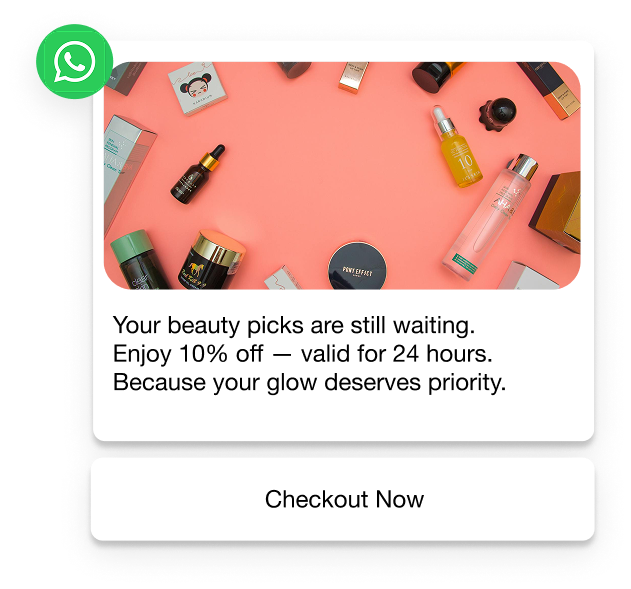
Urgency creates action. Flash sales and limited-time offers delivered via WhatsApp can be a key tactic for driving immediate conversions. WhatsApp allows brands to push notifications directly to their customers, sparking urgency and driving traffic to their websites or stores.
💡Pro Tip: Send exclusive flash sale notifications to your segmented contact list with a countdown timer. This visual urgency boosts conversions and incentivizes quicker action from customers.
3. Customer Service and Support
Real-time customer service via WhatsApp is not just a convenience but an expectation in 2026. Brands can use WhatsApp to resolve queries quickly, address concerns, and provide customer support in a seamless, conversational manner. This not only improves satisfaction but also builds trust and loyalty with customers.
💡Pro Tip: Use chatbots for initial queries and hand over to a live agent when the interaction becomes more complex. This hybrid approach ensures fast responses with the flexibility of human support when needed.
4. Lead Magnets and Opt-Ins
WhatsApp can be a powerful tool for lead generation when used with lead magnets such as free resources (eBooks, webinars, reports). By sharing opt-in links via WhatsApp, businesses can easily capture new leads and begin nurturing them for future conversions.
💡Pro Tip: Offer a time-limited free download or exclusive access to a webinar as an incentive for leads to opt-in via WhatsApp. This increases conversion rates by offering immediate value.
5. Exclusive Content and Sneak Previews
Sharing exclusive content and early access offers will be a core part of keeping your audience engaged and excited. By using WhatsApp, brands can provide customers with a sneak preview of upcoming products or services, creating buzz and anticipation before a full launch.
💡Pro Tip: Share behind-the-scenes content, product teasers, or early access invites directly via WhatsApp, creating a VIP-like experience that encourages loyalty and builds a stronger emotional connection with your customers.
6. Referral Programs
Referral programs can be an effective method for generating new customers. WhatsApp simplifies this process by allowing customers to directly share referral links with their network. In return, they can be rewarded with discounts, bonuses, or loyalty points.
💡Pro Tip: Implement trackable referral links in your WhatsApp messages, ensuring that both the referrer and the new customer receive their rewards instantly once the action is completed.
7. Event Invitations & RSVPs
WhatsApp is the perfect channel for event management, particularly for ensuring high attendance and smooth communication. Whether it’s a product launch, virtual event, or an exclusive gathering, sending invitations and RSVPs via WhatsApp increases engagement and simplifies coordination.
💡Pro Tip: Use WhatsApp’s group chat feature to send personalized event invites and reminders. This creates a sense of community and builds anticipation for the event, especially if you plan to share sneak peeks or special updates leading up to the event.
8. Appointment Scheduling
Service industries can use WhatsApp for appointment scheduling. Whether it’s for healthcare, beauty, or consulting, customers appreciate the convenience of confirming, rescheduling, or canceling appointments directly via WhatsApp.
💡Pro Tip: Integrate WhatsApp with your appointment scheduling software to provide real-time updates and confirmations, ensuring your customers are always in the loop.
9. Product Launch Announcements
WhatsApp can be an invaluable tool for creating excitement and anticipation ahead of product launches. By sharing exclusive announcements, behind-the-scenes sneak peeks, or countdowns, brands can drive interest and generate pre-launch sales.
💡Pro Tip: Send out exclusive pre-order links or VIP access offers to your most engaged customers via WhatsApp, making them feel part of an exclusive community ahead of the product’s official release.
10. Optimizing Your WhatsApp Business Profile
A professional, well-optimized WhatsApp business profile is crucial to building trust with your customers. Ensure your profile includes clear contact details, a logo, business description, and other important information.
💡Pro Tip: Regularly update your WhatsApp Business profile with new products, promotions, and seasonal offers. This keeps your customers informed and engaged without them needing to ask for details.
Tools & Platforms Powering WhatsApp-Led Growth
Here’s a look at some of the leading platforms that enable businesses to maximize the potential of WhatsApp, with a focus on key features, pricing, and target audiences.
Common Mistakes to Avoid in WhatsApp-Led Growth Campaigns
While WhatsApp presents a tremendous opportunity for brands to enhance customer engagement, drive sales, and build loyalty, it's easy to make mistakes that can hinder campaign success. Here are some critical missteps to avoid when executing WhatsApp-led growth campaigns:
1. Lack of Clear Objectives
One of the most common mistakes is launching WhatsApp campaigns without a clear goal or objective in mind. Whether it’s increasing sales, enhancing customer support, or building brand loyalty, running a campaign without clear KPIs can lead to ineffective messaging and poor customer experiences.
How to Avoid This: Establish specific goals for each WhatsApp campaign, such as increasing sales by a certain percentage or reducing customer service response times. Regularly review performance metrics and adjust campaigns to ensure you're meeting your objectives.
2. Not Properly Segmenting Your Audience
WhatsApp provides a direct line to your customers, but one-size-fits-all messaging rarely works. Sending generic messages to a broad audience can lead to disengagement and opt-outs. Without proper segmentation, you're missing opportunities for personalized engagement and targeted messaging.
How to Avoid This: Use customer data to segment your audience based on factors like purchase history, preferences, demographics, or behavior. Tailor your messages to each segment to ensure they are relevant and engaging.
3. Failing to Integrate WhatsApp with Other Channels
WhatsApp is a powerful tool, but using it in isolation can limit its impact. Failing to integrate WhatsApp with other communication channels like email, SMS, or your website can create a disjointed customer experience and cause missed opportunities for cross-channel engagement.
How to Avoid This: Ensure that WhatsApp is part of an omnichannel strategy where customer interactions are seamlessly connected. Integrate WhatsApp with your CRM and other customer engagement platforms to ensure a consistent and cohesive experience across all touchpoints.
4. Not Setting Expectations for Response Times
WhatsApp’s real-time nature sets high expectations for quick responses. Ignoring or delaying replies can frustrate customers, leading to poor experiences and potential lost sales. While WhatsApp allows for quick engagement, it's crucial to manage response times effectively.
How to Avoid This: Set clear expectations with your customers about response times—for example, an automatic message acknowledging their inquiry with a timeframe for a response. Additionally, consider using chatbots for initial responses, followed by human escalation for more complex queries.
5. Inconsistent Branding and Messaging
WhatsApp, like any other communication channel, requires a consistent brand voice and style. Sending messages that are inconsistent with your overall brand identity or tone can confuse customers and reduce trust.
How to Avoid This: Define a consistent voice and tone for your WhatsApp communications that aligns with your overall brand messaging. Ensure that all team members involved in WhatsApp communications are trained on your brand guidelines.
6. Over-Promoting or Being Too Sales-Driven
WhatsApp is primarily a messaging platform, not a direct sales platform. Over-promoting products, sending too many sales-focused messages, or pushing for transactions in every message can quickly lead to customer fatigue and opt-outs.
How to Avoid This: Focus on building value-driven relationships with customers. Use WhatsApp for personalized engagement, such as offering product recommendations based on interests or providing customer service. Keep the sales-focused messages balanced with helpful content and support.
7. Not Optimizing for Mobile Experiences
WhatsApp is a mobile-first platform, so it’s essential to optimize all messages and experiences for mobile devices. Long, complex messages or non-mobile friendly content (like images that don't load properly) can negatively affect user experience and engagement.
How to Avoid This: Ensure that all content you share through WhatsApp is optimized for mobile. This includes using short and concise text, mobile-optimized images, and ensuring that any links or buttons are easy to click and navigate on a small screen.
8. Not Providing Easy Opt-Out or Unsubscribe Options
One of the most important aspects of WhatsApp marketing is respecting user preferences. Failing to provide an easy way for customers to opt-out or unsubscribe from messages can lead to frustration, complaints, and potential violations of privacy regulations.
How to Avoid This: Always offer a clear and simple way for customers to unsubscribe from future messages, either through an automated option in the WhatsApp chat or by following opt-out instructions in the message. This helps maintain trust and ensures compliance with data protection laws.
9. Underestimating the Power of Automation
While WhatsApp is often thought of as a direct communication channel, many businesses fail to leverage the automation capabilities available on the platform. Automation can help scale engagement, but without it, businesses may struggle to handle large volumes of customer interactions effectively.
How to Avoid This: Use automation tools like chatbots, automated workflows, and message triggers to manage customer interactions at scale. Automation not only saves time but also ensures that customers receive immediate responses, even during off-hours.
10. Ignoring Analytics and Feedback
WhatsApp campaigns can be highly effective, but ignoring analytics and customer feedback can result in missed insights and opportunities for improvement. Without tracking performance, it’s difficult to know what’s working and where to optimize.
How to Avoid This: Continuously monitor the analytics of your WhatsApp campaigns. Track metrics like response time, conversion rates, click-through rates, and customer satisfaction. Regularly gather feedback from customers to improve your strategy and refine your approach.
How to Implement a WhatsApp-Led Growth Strategy with Flowcart?
With Flowcart, businesses can seamlessly leverage WhatsApp to enhance customer acquisition,conversion activation, and retention through personalized, real-time interactions. The platform's comprehensive suite of tools enables businesses to engage customers at every stage of their journey, creating meaningful experiences that drive conversions and build long-term loyalty.
From attracting new leads through Click-to-WhatsApp integrations and automated lead capture flows, to activating customers with in-chat checkout and gamification, Flowcart empowers brands to streamline their WhatsApp-driven sales funnels.
With advanced features like behavior-based segmentation and loyalty rewards, Flowcart ensures that customers remain engaged and continue to return for more. Furthermore, Flowcart’s scalable infrastructure and multi-channel sync capabilities ensure that businesses can expand their WhatsApp operations without compromising on quality or personalization, while analytics and ROI tracking provide the insights needed to continuously optimize your strategy.
Flowcart offers a robust, all-in-one solution for businesses looking to harness the power of WhatsApp. By combining the platform’s automation, CRM integrations, and in-chat payment systems, you can create a seamless and frictionless customer journey that drives growth at every stage whether you're a small retailer or a large enterprise.
Adopting a WhatsApp-led growth strategy with Flowcart will not only help you stay ahead of the competition but will also establish lasting, loyal customer relationships that contribute to long-term success. Ready to take Flowcart for a spin?
.png)





%201.webp)



.png)