
.png)
Key Takeaways
WhatsApp can handle the full sales journey, from lead capture to in‑chat checkout and repeat purchases.
AI-powered flows, segmentation, and smart broadcasts drive higher conversions than email and manual WhatsApp selling.
Flowcart centralizes WhatsApp sales, CRM data, and payments so teams scale revenue without losing personalization.
Over 175 million consumers message a business account on WhatsApp daily. Not for sticker wars but to inquire about a product, make an order, or follow up on their incoming delivery.
Early-adopting brands are also on a spree to make the most of the consumer-centered app and boost sales. Take the comment from this Reddit user as an example.
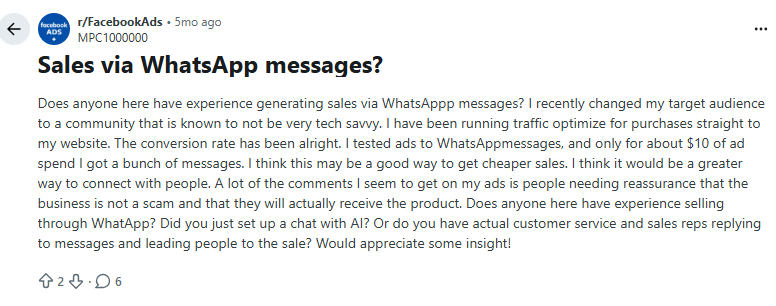
This shift is driven by customers who want faster, more personal conversations than cold calls or emails can deliver. They expect brands like yours to meet them where they already spend their time, and WhatsApp makes that possible.
In this guide, we’ll show you how to leverage WhatsApp to generate leads, nurture prospects, and close sales faster.
Why WhatsApp Works for Sales
WhatsApp has over 3 billion monthly active users. That’s about a third of the World’s population, close to the same number as Facebook's, and 3 billion potential customers.
More importantly, 17.4% global social media users choose WhatsApp as their favorite platform. The majority of these people say they use social platforms, ultimately referring to WhatsApp as well, for finding products in catalogs and inspiring purchasing decisions.
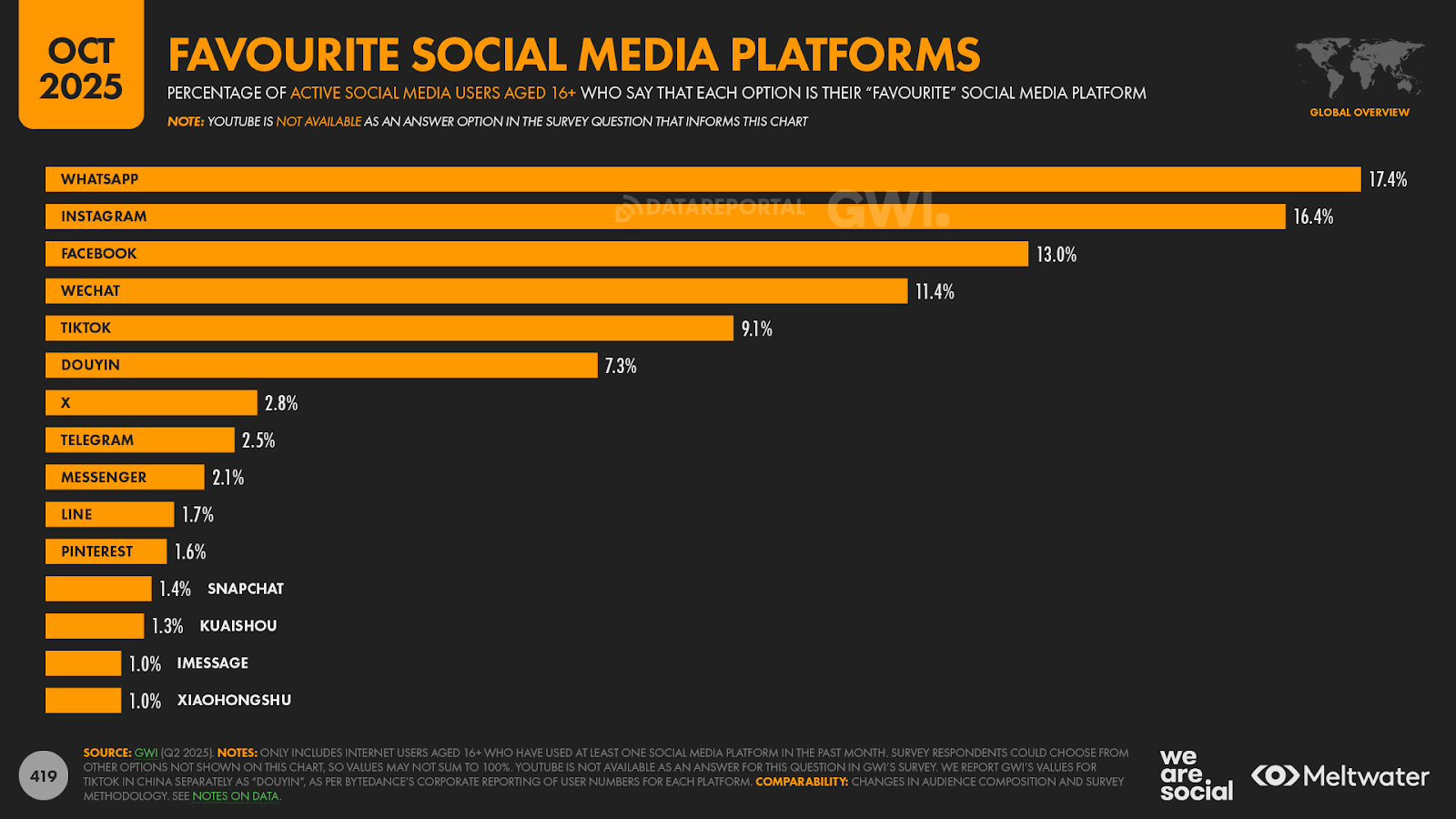
In a sentence, WhatsApp provides a broad consumer base and a ready-to-purchase customer segment, making it effective for sales-driven campaigns. Beyond that, WhatsApp also works because:
It provides instant communication and higher response rates
An average WhatsApp user opens the app multiple times a day, whether to communicate with family and friends or respond to corporate inquiries.
For some consumers, that’s their primary messaging platform.
So, when you send a message, which could be an offer or a discount, or anything, users see it instantly. Compared with the open rate of traditional channels like email, which sits around 20%, WhatsApp boasts a 98% open rate.
Moreover, users are more likely to respond when your messaging is well-personalized and caters to their interests.
Customers trust businesses that they can message directly
A Qoura user named Laura asked:
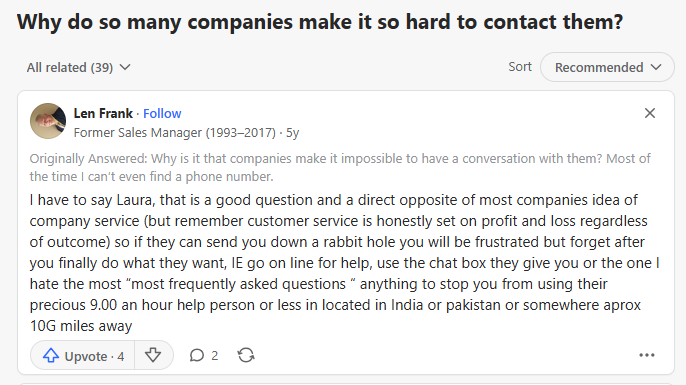
Len Frank’s response to Laura is quite a mind opener. Businesses spend approximately 8% of their annual revenue on support, ranging from thousands to millions of dollars, depending on company size.
Yet, most neglect the most crucial needs of their target consumers and the core of customer support. A direct conversation channel like WhatsApp.
A study found that 89% of consumers want to initiate a two-way conversation with businesses via messaging apps.
WhatsApp helps you fulfill this desire and provides a sense of proximity for your audience.
This improves trust, boosts your satisfaction score, shortens the sales cycle, and addresses your customers where they expect.
It enables a perfect mix of personalization and automation
Genericity irks people. If you don’t believe, see what this Reddit user shared.
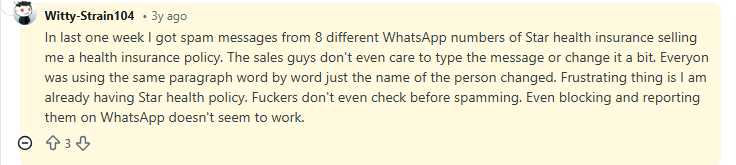
71% of consumers prefer messages tailored to them over generic messages. If you do not provide that, your messages may end up ignored or your business line might be blocked.
And that’s another area where WhatsApp excels for sales.
Native WhatsApp features, such as “Labels,” enable you to segment your customers or prospects by interest, purchase stage, or behavior. Then you can easily create personalized messages targeting them in groups or individually based on their labels.
For more advanced personalization, that’s where WhatsApp marketing automation platforms like Flowcart come in. Take Spinners and Spinners as a case study.
Using Flowcart, the company linked customer phone numbers to unique customer IDs, enabling every WhatsApp conversation to automatically surface the correct account details, pricing rules, and order history.
Pricing workflows were fully automated, with the correct price list applied in real time and quotes sent back instantly on WhatsApp. This ensured their customers received personalized prices and faster responses.
How can you start selling via WhatsApp?
The benefits are glaring. Low-cost operational channel compared to cold calls. Higher open rates and revenue outcomes when stacked against emails. Now, the next big question is how to sell on WhatsApp if you haven’t started yet.
Create a WhatsApp Business account
WhatsApp Business is available on the Play Store and App Store. Head to your phone’s store and download the mobile app. Follow the prompts once downloaded and register with your active number.
If you already have a non-business WhatsApp number and want to create a business account with the same number, enter it during registration.
Set up a complete business profile
Once your number is verified, you’ll be prompted to create a business profile. WhatsApp Business is now your new digital storefront, similar to a mini-Shopify. That means you need to be as explicit and detailed as possible.
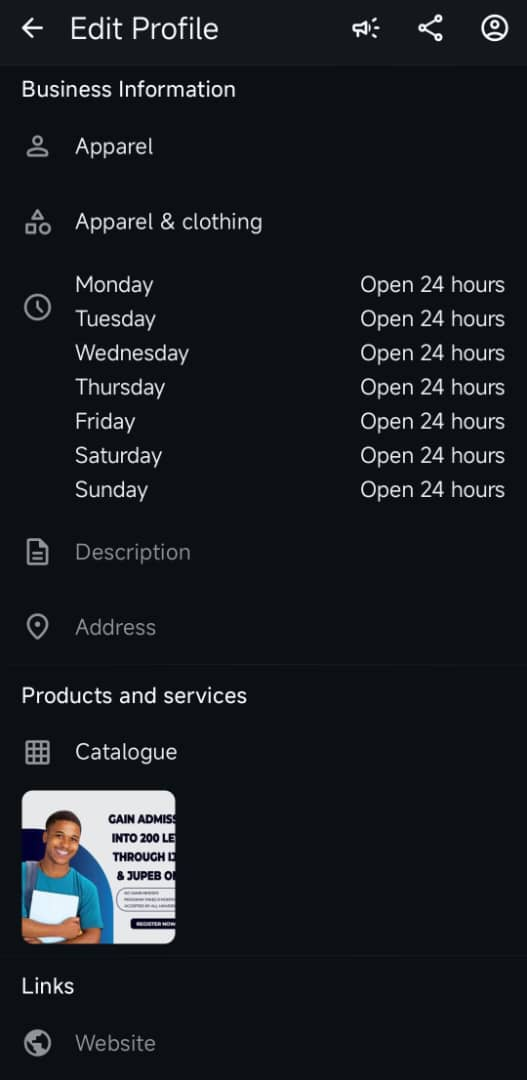
Enter your business's official name, select a category that best describes your offerings, and upload a logo that accurately represents your brand. To add more info, you can edit your profile under the “settings” option.
Insert business hours, description, address, active email, website, and other essentials.
Design your catalog with products
WhatsApp's catalog is synonymous with Amazon's product page. That’s where your audience can browse all the products you have in stock. Add all your key offerings there, with brief descriptions that can be read in a single scroll, and include the price.
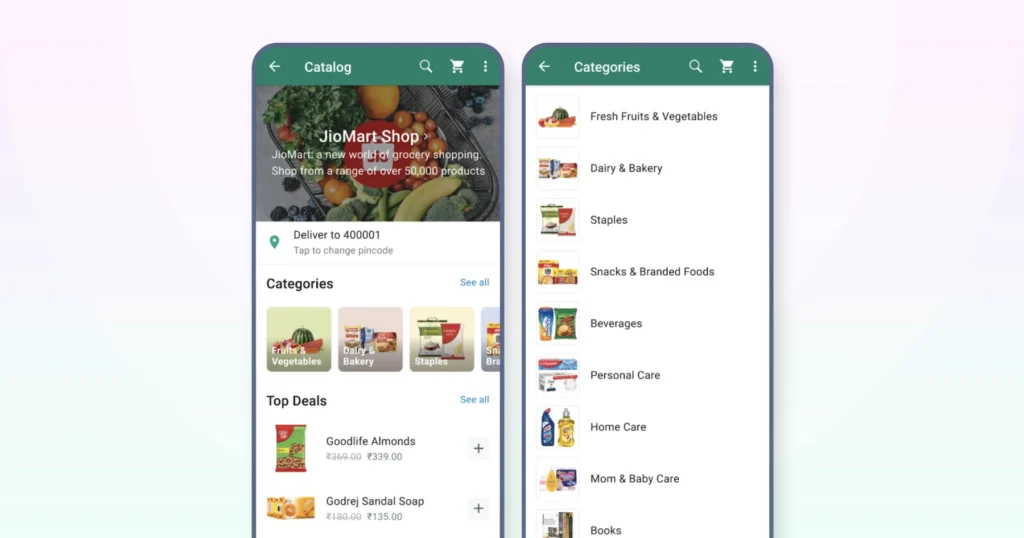
Also include visuals like videos and images. The maximum video size is about 10 MB, and you can add up to 500 products to your catalog. This is suitable for small-sized businesses. If you need a catalog with a broader product selection and a more automated checkout process, consider using a WhatsApp Business API platform like Flowcart instead.
Organize customers using labels or basic segmentation
Business WhatsApp’s Label feature allows you to manually segment your leads into categories based on predefined factors such as purchase status, demographics, buying behavior, and more. You can decide what each label represents and update your team on their usage.
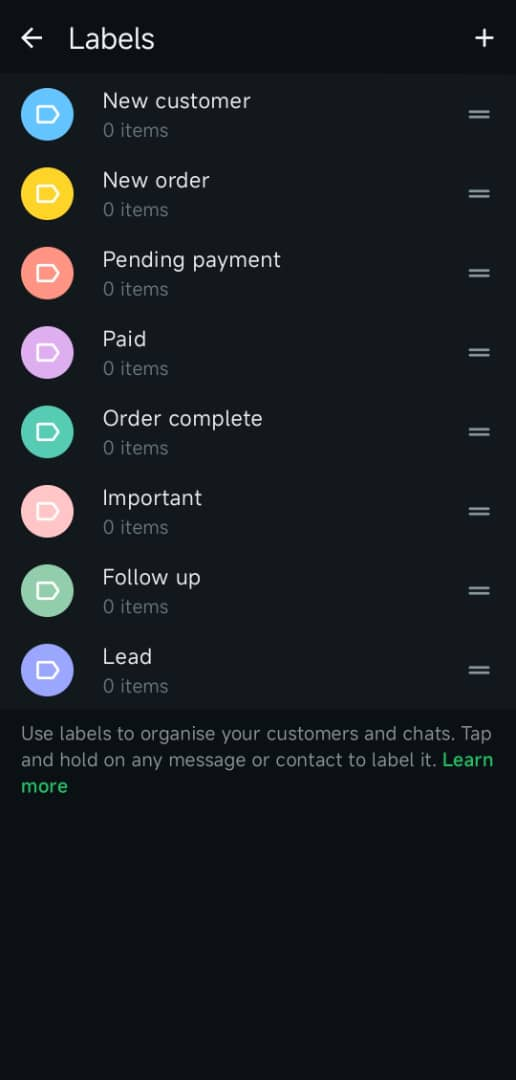
This is basic segmentation and time-consuming, especially if you handle multiple customers a day. Moreover, you might forget to follow up on some of your labelled leads or sync them with customer support when necessary. This leads to failed handoffs.
You can avoid such outcomes by scaling up your sales process using Flowcart’s AI segmentation tool instead.
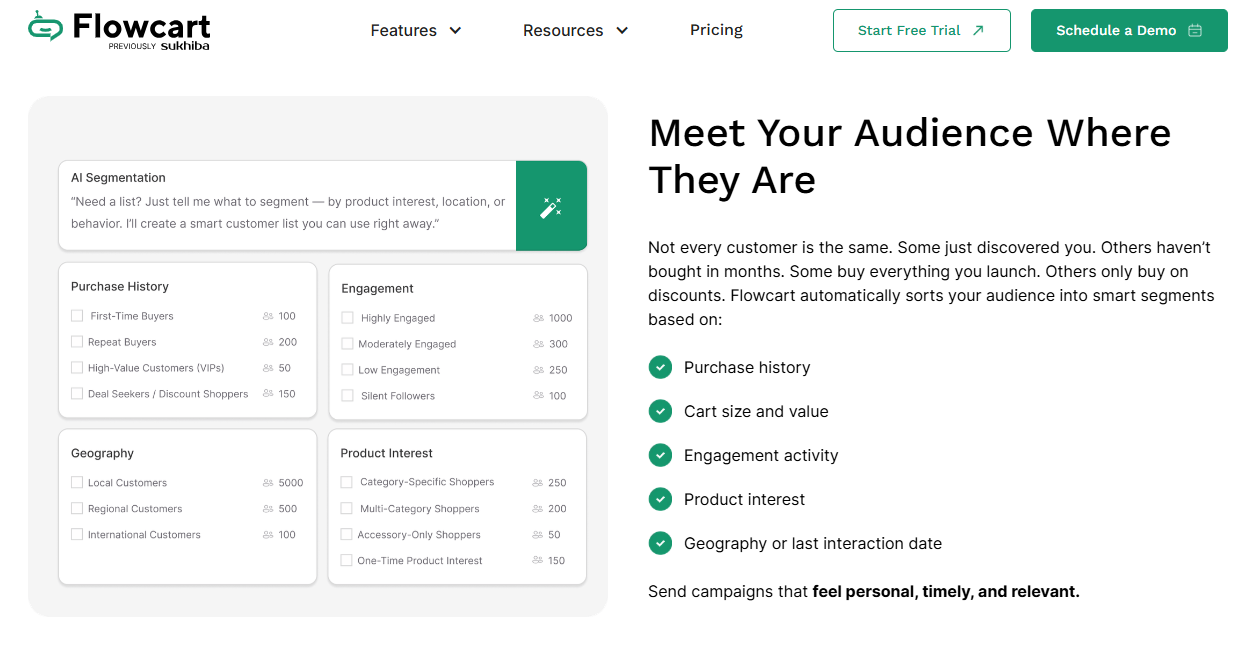
“With Smart Broadcasts, we turned WhatsApp into a revenue channel. Every message we send now has ROI built in. We send over 10,000 personalized messages a month and drive 3X more revenue than email,” Sneha Mehta, CEO & Co-Founder, shares.
Enable quick replies for common questions
Once your business scales, manually replying to every message on time becomes nearly impossible. The implication is that your potential customers bail out and seek an alternative that responds faster.
This is where automation becomes non-negotiable.
You can either automate your responses with WhatsApp’s “Quick replies” feature or use a WhatsApp Business API for more efficient outcomes.
To activate Quick Replies, navigate to the Business Tool section, typically in the bottom-right corner on Android and sometimes in the top-right corner on iOS.
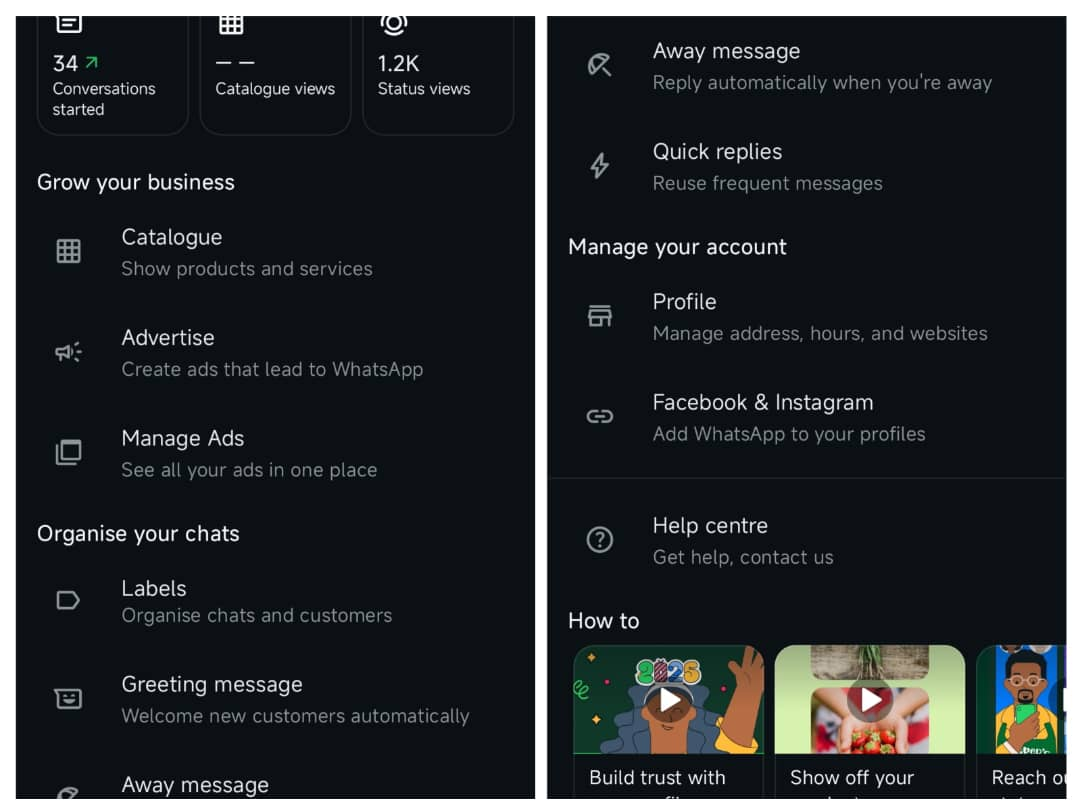
One big problem? WhatsApp Business only allows up to 50 uncategorized quick replies in total. This is insufficient to handle additional customers and does not enable comprehensive personalization.
That’s where a WhatsApp Business automation feature, like Flowcart’s WhatsApp flows, comes in.
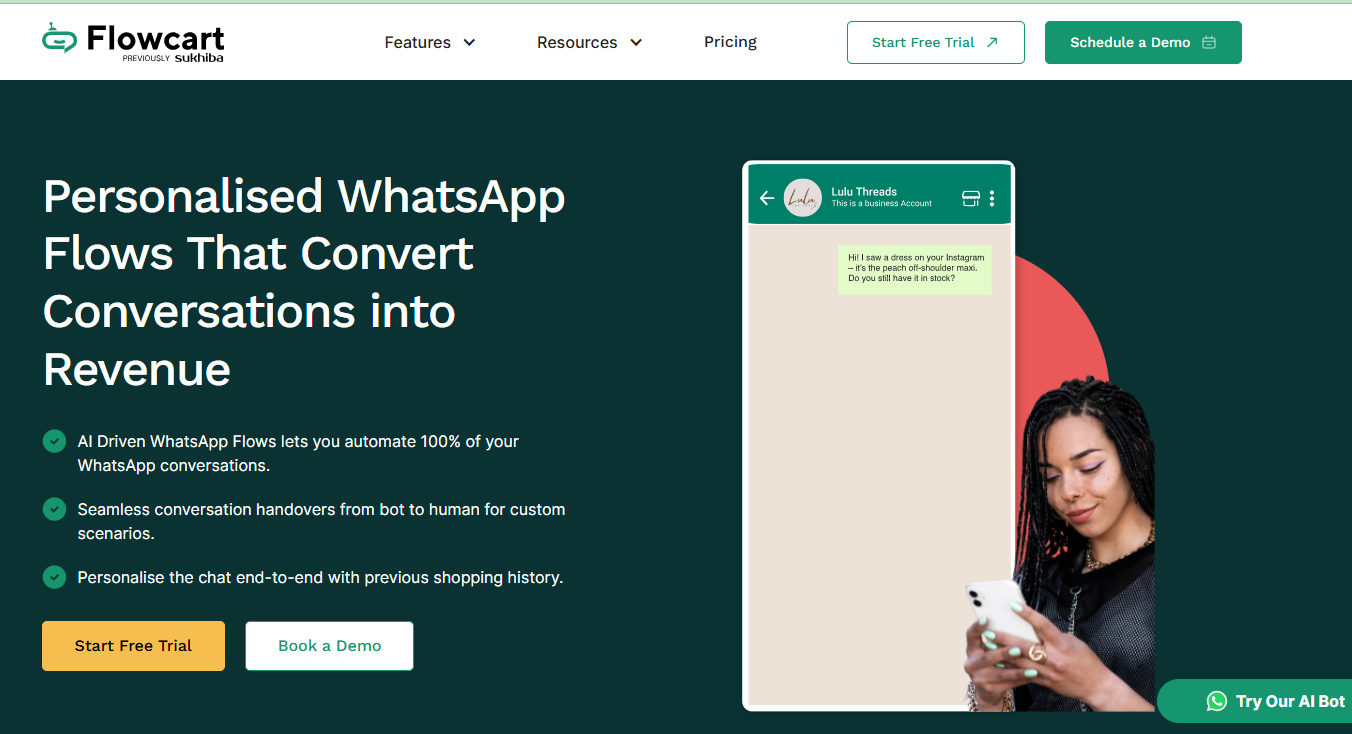
You can create up to 5,000 categorized quick responses and set them up in a flow tailored to each customer segment. Businesses using Flowcart’s WhatsApp flow help shoppers reach a product in fewer than three taps and achieve a 28% higher conversion rate in first sessions.
Share your WhatsApp link across the website, social media, and ads
You’re ready to hit the ground running. Copy your store link, often on the top-right corner of your business page, and share it in communities or places where your potential customers might be.
Of course, that’s a spray-and-pray approach, and it might not be effective.
If you want a more strategic approach, launch an integrated ad on your business page to reach more segmented, product-aligned customers. Clinton Obura, the CEO and Founder of Samaking, used Flowcart’s Click to Whatsapp Ads to boost returns on ad investments.
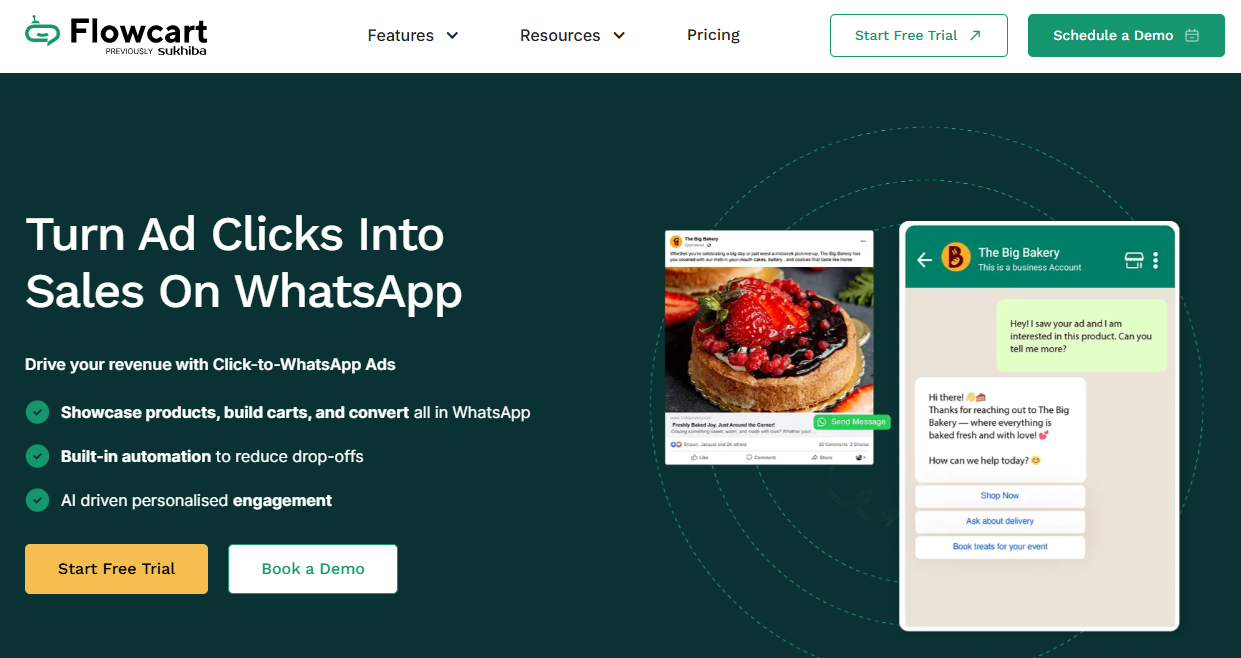
“With Flowcart, we stopped wasting clicks. Every ad now turns into a guided WhatsApp sale, and our conversion rate jumped by 40%,” Clinton shares.
Receive payment inside chat
Using WhatsApp Webview, customers can make payments directly in the messaging app without switching tabs or opening a browser. This reduces drop-offs and cart abandonment rates.
Flowcart’s in-chat checkout feature offers 30+ payment options, including Stripe, Peach, Paystack, and Razorpay. This gives your customers both domestic and international payment options.
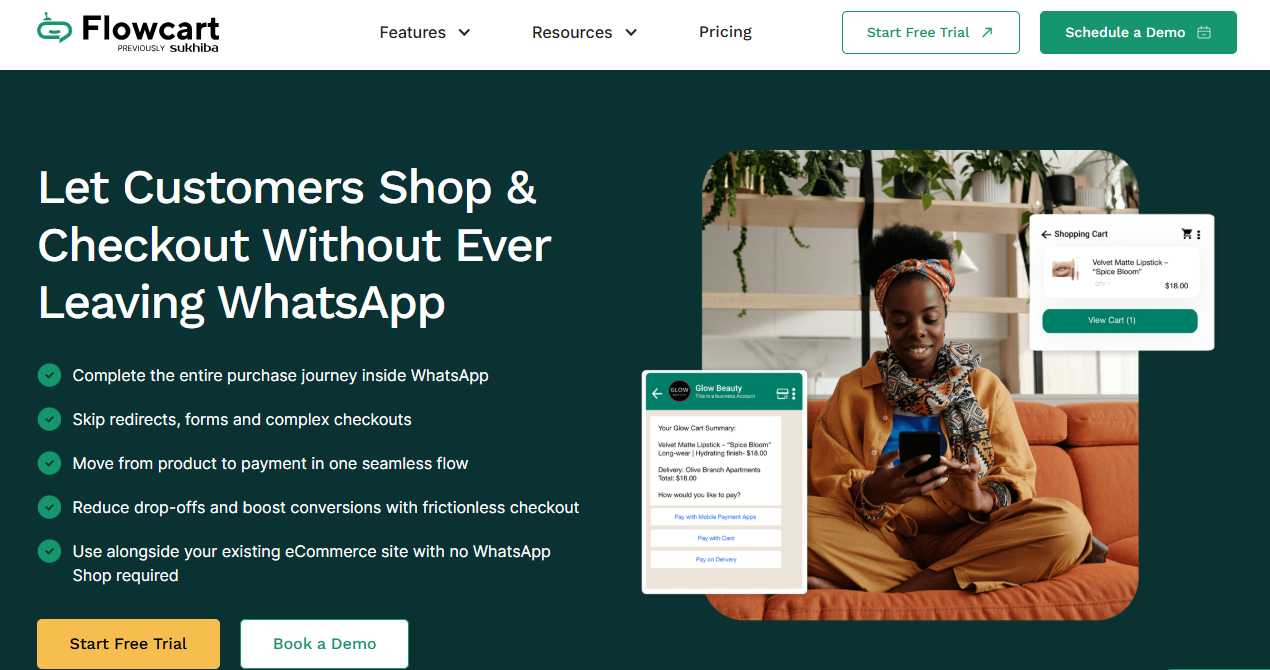
Businesses using Flowcart have recorded a 70% drop in average checkout time and an 800% increase in cart recoveries.
8 WhatsApp Sales Strategies That Drive Results
WhatsApp is built and ready for sales. But whether you hit your goals depends on three things, according to Scot Leese, a 6x sales Leader and Fractional CRO.
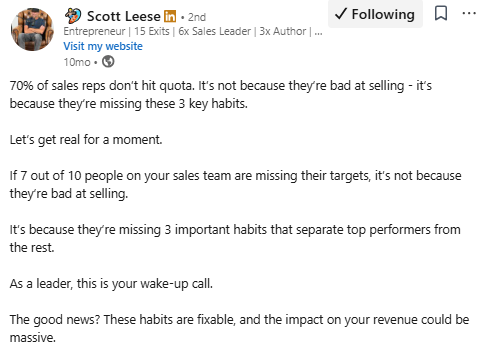
The first is prioritizing the right leads; the second is following up consistently; and the third is leveraging data to drive outcomes.
This section outlines strategies to address these habits and other priorities to ensure success.
1. Capture and qualify leads through WhatsApp entry points
In response to Scott Leese’s stand, another LinkedIn user, also a Sales Leader, raised another point worth noting.
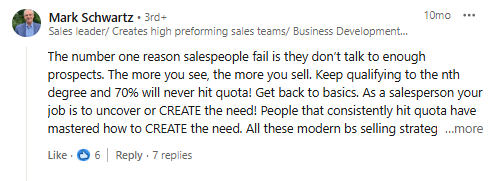
Mark argues that sales teams need more leads. On one end, this is true. The more leads you capture, the more you can convert, provided all other things are in place, of course.
To capture these leads, employ inbound strategies such as WhatsApp Ads, QR codes shared in communities, and emailing your existing customers to continue conversations on WhatsApp.
After this, qualify them using sales-enabled questions that reveal intent, budget, urgency, and readiness to buy.
Why it matters: Numbers are as important as quality. Sacrificing one for the other only leaves your sales pipeline weak.
How Flowcart helps
Capturing and qualifying leads can be a big hassle, especially if you’re targeting a large market. Flowcart’s Click-to-WhatsApp-Ads tool makes this easy and helps you set up instant campaigns that generate ready-to-convert leads within an optimized budget.
Flowcart also provides quick entry points, such as scannable QR codes, that you can share digitally, print, or use both. Taking it a step further, potential customers can communicate with you via Flowcart’s website chat-ins.
The cream? Flowcart utilizes built-in automation and AI-driven personalized engagement flows to qualify and keep your leads in the pipeline till they convert. Samaking used this approach to increase its conversion rate by 40%.
2. Segment all leads based on the qualification pattern
The only downside to acquiring more sales-ready leads is chaos. You now have more numbers to juggle, and leads can easily drop out in between without anyone sniffing a thing.
Segmentation and labelling help to prevent this. You can use WhatsApp’s label feature to segregate your customers into different categories and track them accurately.
Different segmentation criteria exist. But for maximum lead engagement, you can employ the qualification pattern. This includes SQLs, MQLs, and PQLs.
Sales-qualified leads (SQLs) often repeat purchases. So, your work to nudge them down the funnel accounts for half of what you need to convert marketing-qualified leads (MQLs) and product-qualified leads (PQLs).
Why it matters: Segmentation helps you launch highly personalized WhatsApp sales campaigns, from targeted discounts and follow-up messages to product arrival announcements.
This also reduces drop-offs, since you know who is who and how best to meet them in their comfort zone.
How Flowcart helps
While native labels help, they’re inefficient for more than a few dozen customers. That’s where Flowcart’s AI-powered segmentation tool comes in. It automatically groups your leads based on actions like lead qualification, clicks, past purchases, or product views.
The built-in automation leverages segments created to trigger personalized messages at the right moment in your customers’ journey and improve campaign ROI. With that, you can easily generate 3x revenue, just like Uncover did.
3. Personalize chats using past order data
Every conversation can shorten or lengthen your sales cycle. To achieve the former, personalize each message you send based on previous order data.
For example, a customer has ordered a 5-inch burger before. Two days later, you can send them a message saying you have a deluxe version or a burger of the same size with a twist. This makes the messaging relevant.
Or imagine a customer who ordered a blue-customized t-shirt last week suddenly messaged you without specifying their intent. You can simply ask if they’d like to repurchase the same product, a complimentary type, or something entirely different.
Why it matters: People love messages, both proactive and reactive, tailored to their needs. It makes them feel valued when you take the time to understand what they truly want or do the hard thinking for them. Previous purchase or order history serves as a goldmine to help you reach that sweet spot.
How Flowcart helps
Flowcart’s AI-generated carts and WhatsApp flows do the heavy lifting by personalizing product suggestions in chat using past purchase history and customer insights. This cuts product discovery steps and ensures your customers can take a single leap from “Hi” to “I’m buying this”.
There’s also the Smart Broadcast feature, which tailors messaging to each customer or lead rather than blasting all contacts with the same generic messages. The combination of these tools streamlines both messaging and delivery, ensuring they reach your customers at the right time.
4. Share product videos and quotes in chat
The playbook? Your WhatsApp sales should start and end inside the chat box. That includes sharing all product information in the chat, such as video demos, quotes, delivery details, and discounts.
Why it matters: The fewer the touchpoints you have, the less the chances your customers will drop off. If they have to tap their screens multiple times or go outside WhatsApp to read a detail, it’s only a matter of a few seconds before their interest wanes, and they abandon the cart.
How Flowcart helps
Flowcart reduces these touchpoints through automated WhatsApp flows that help shoppers access everything they need within the chat. For instance, leads referred through Ads automatically land in your store. They see all the data, from product images and videos to cost and brochures, with just a tap.
Businesses using Flowcart’s WhatsApp flows help users reach checkout in less than three taps, see a 28% higher conversion rate, and 5x Return on Ad Spend (ROAS).
5. Create urgency with expiring offers
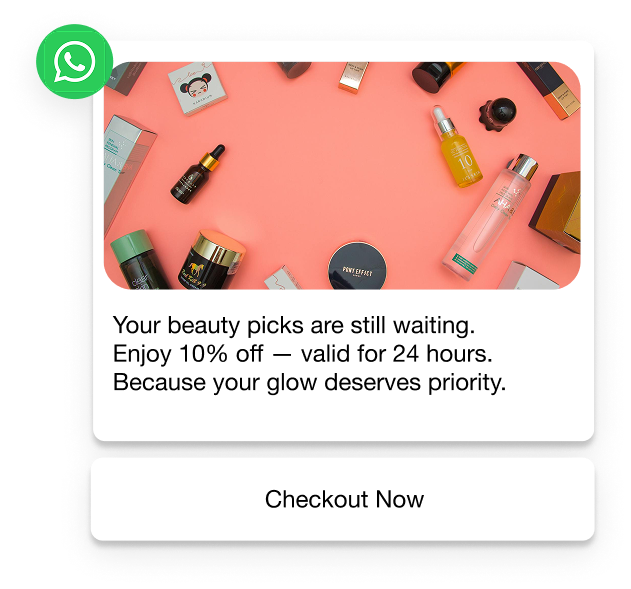
Sometimes, all your leads need is a simple nudge. This can take the form of a follow-up message offering a time-limited discount or a one-off offer expiring soon. Using Flowcart’s AI-driven segmentation, identify the hot leads who need this and send them a notification.
Why it matters: Urgency creates fear of missing out (FOMO) on a tempting offer, since the same opportunity may not come again. This approach is much more effective during festive seasons and for leads who are already sales-qualified.
How Flowcart helps
Knowing when to use urgency and who to use it for is the key to a successful FOMO campaign. Flowcart leverages its segmentation and loyalty data to infer these two factors.
For instance, customers who have already shown intent to purchase a product but dropped off midway are eligible for expiring offers. Using the loyalty program tool, Flowcart promotes personalized FOMO offers to them and tracks responses.
6. Sync chats with your CRM
If you’re using only WhatsApp Business for sales, you might not necessarily be able to track and collect any tangible data due to WhatsApp’s privacy settings. The only alternative is to use a WhatsApp Business API platform like Flowcart and integrate it with your CRM.
This syncs your chats directly into a database, making analysis easier and enabling you to pinpoint trends, high-value customers, and anomalies such as spikes in drop-offs and cart abandonment.
Why it matters: Data is at the core of any successful WhatsApp sales strategy. It informs your personalization plans, offers, campaigns, and so many other decisions. Without it, you’re literally working blind.
How Flowcart helps
Flowcart unifies sales, messaging, and payments by seamlessly integrating with CRMs, Shopify, WooCommerce, and ERPs. This eliminates silo and improves sales delivery while reducing possible errors due to data lag or disconnect.
With Flowcart’s centralized data tracking, you gain a bird's-eye view of your most active sales rep, conversion rate per unit, errors, patterns, and many other details essential to improving sales success.
7. Automate pre-sales and hand-off to reps
Most purchase queries are repetitive and simple. You should let AI handle those for you. Once there’s an objection, configure your bot to reroute directly to a sales rep and take up the process.
Why it matters: Letting AI do the heavy lifting for pre-sales conversations ensures your sales team can focus on high-end conversions and personalized conversations with high-value customers.
How Flowcart helps
Flowcart provides AI-driven workflows that automate almost 100% of your conversations using Natural Language Processing (NLP). And once a complex or custom scenario arises, the workflow seamlessly transitions from bot to sales rep with no lag.
What’s more is that the AI senses high-end moments and immediately pulls in an agent instead of waiting till it reaches a deadlock. Brands that automated pre-sales reduced ticket backlogs by an average of 70% before agents intervened.
8. Retain customers with post-purchase support
A customer’s first purchase is not their last. Don’t end the conversation there once they've made a payment. Help them successfully adopt the product they bought, solicit feedback, send complementary products, re-engage with expiring offers, and coordinate with the marketing team to reignite interest.
Why it matters: There is a potential for at least 3x more repeat sales when you follow up with an existing customer. This translates to higher Customer Lifetime Value (CLTV). Additionally, acquiring a new customer costs 10x more than retaining an existing customer.
How Flowcart helps
Flowcart keeps your existing customers warm with tailored campaigns, including casual check-ins, based on your configurations. They can communicate with the store bot if they encounter any issues, and the AI routes them to a sales rep if it can’t handle the query.
Everything happens on a single thread, and the buying process stays uninterrupted. AI-generated carts provide product-suggestion support, and the workflow tool keeps their inbox busy.
Real-life examples: How businesses use WhatsApp
Everything sounds theoretical? No worries, some businesses, like Darling and Samaking, already use WhatsApp to scale their revenue. Let’s see what they did and how.
Darling
Darling Hair is a hair manufacturer and distributor in Kenya that uses WhatsApp to connect with stylists who may need hair products, promote new styles to salons, send special offers, and implement loyalty programs.
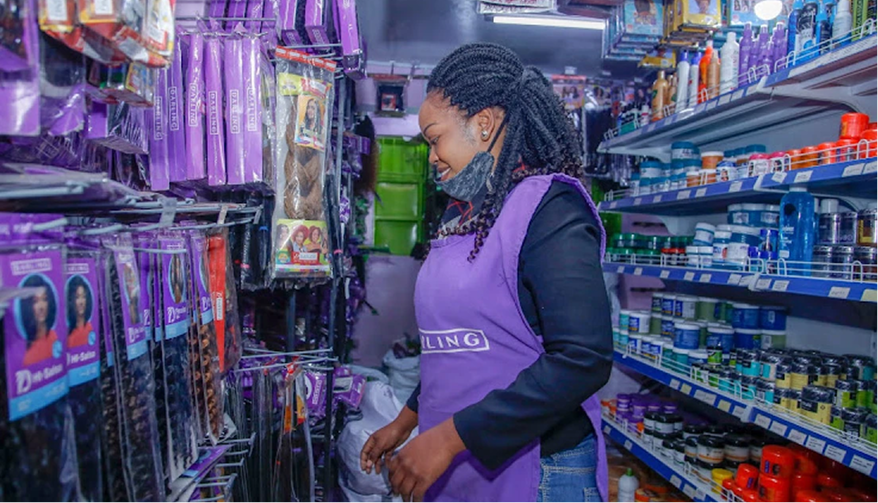
To scale sales, Darling Hair partnered with Flowcart. The WhatsApp automation platform helped them capture customer data for segmentation, tailor campaigns to customer needs, and optimize existing loyalty programs to improve outcomes.
The result? Darling broke record sales by 300% and increased unique customer accounts by 7x.
Samaking
Samaking is an aquaculture platform in Kenya using WhatsApp to sell fish directly to businesses and retail customers. Its customers browse available products, ask questions, place orders, and complete payments directly on WhatsApp.
Similar to Darling Hair, Samaking partnered with Flowcart. This helped centralize all WhatsApp conversations into one system, power a WhatsApp storefront for end-to-end ordering, and send personalized broadcasts to customers. This enabled the team to manage growing inquiry volumes, maintain consistent responses, and ensure visibility across sales and support.
The result was clear growth. Samaking now runs all transactions through WhatsApp, achieved 50 percent month-on-month topline revenue growth, and continues to expand operations.
4 Best Practices for WhatsApp Sales Success
Using WhatsApp for sales is gold. Electromart agrees with this, as it generates over 100 high-value orders per month via WhatsApp.
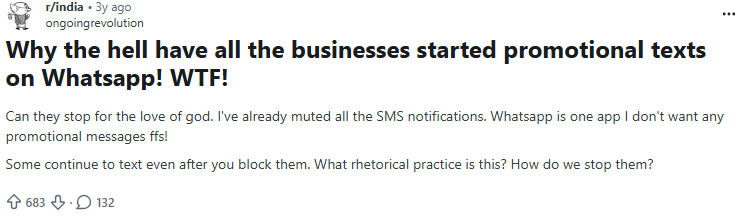
But that only depends on how well you use it. On one end, you may trigger your potential customers and get blocked. You can trust a customer like this Reddit user to do that:
On the other hand, when you implement WhatsApp for sales correctly, you can 4x your online sales like King’s Collection did.
This section outlines the four practices to adopt to achieve results like King’s.
Consent is not optional
WhatsApp is a personal space. You can’t just buy numbers on black markets or force your way through. It’ll backfire. Too many reports can get your business number blacklisted.
So, ensure each contact in your database is inbound. That is, your customers messaged you first, not the other way round.
They can message you from an ad they saw, a digital or physical QR code, or a link you shared in some communities. Any is fine. What matters is that they took the first step in messaging.
Also, don’t randomly spam your targets with messages they didn’t sign up for. Ensure you have their consent to share marketing resources. A simple, “Would you like us to update you whenever we have new offerings?” goes a long way.
Build a clear chat to purchase flow
Traditional sales channels have too many touchpoints from the initial message to checkout. That explains why many people drop off mid-cycle.
Bringing the same to WhatsApp sales may increase the rate of abandoned cards and negatively impact your revenue.
Instead, adopt the straight-line method, where there’s no distraction or noise between the customer's first message and checkout. Flowcart’s in-chat checkout feature helps to achieve this.
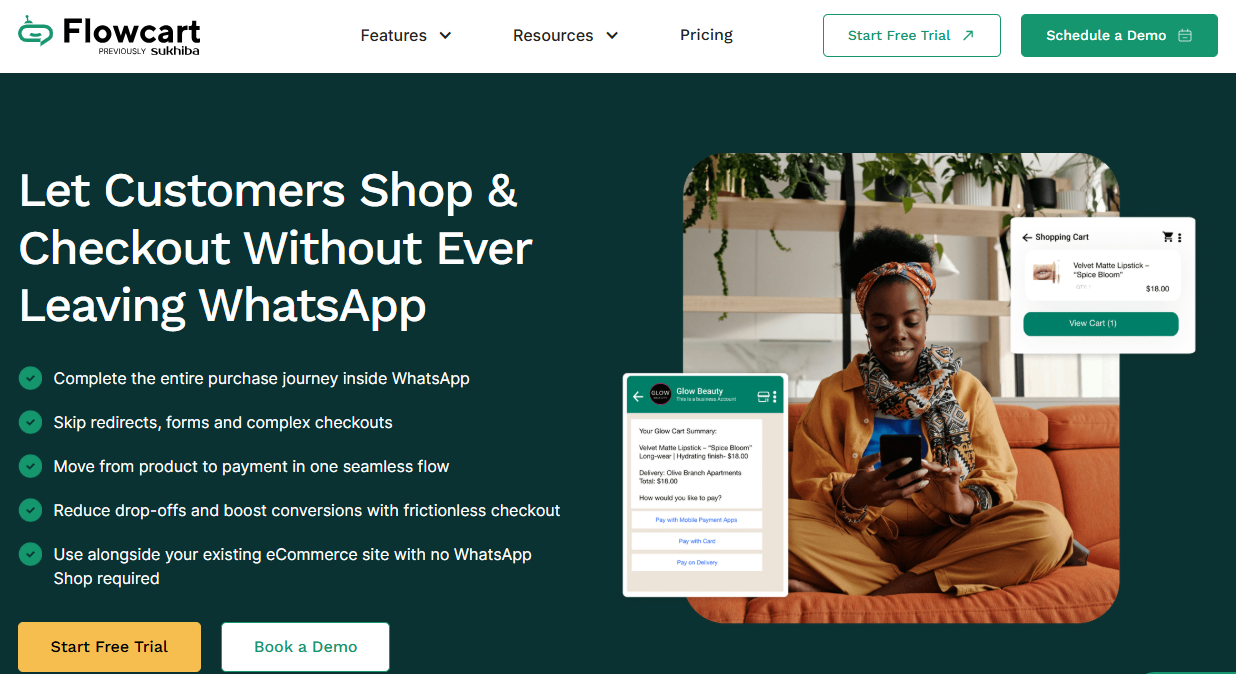
With it, your customers can skip form filling, redirects, and complex checkout processes.
“Our WhatsApp funnel used to stop at interest. Now it ends in revenue. In-chat checkout has changed the game for us,” one of our clients, Mkurugenzi, remarks.
Trigger follow-ups from behavior, not broadcasts
We get it. You want to send that follow-up broadcast message to remind them of your presence. After all, businesses achieve 3x repeat sales with follow-ups.
That’s a good tactic. However, broadcast messages do not account for your customers' individual needs or pain points. It’s generic. And consumers hate genericity.
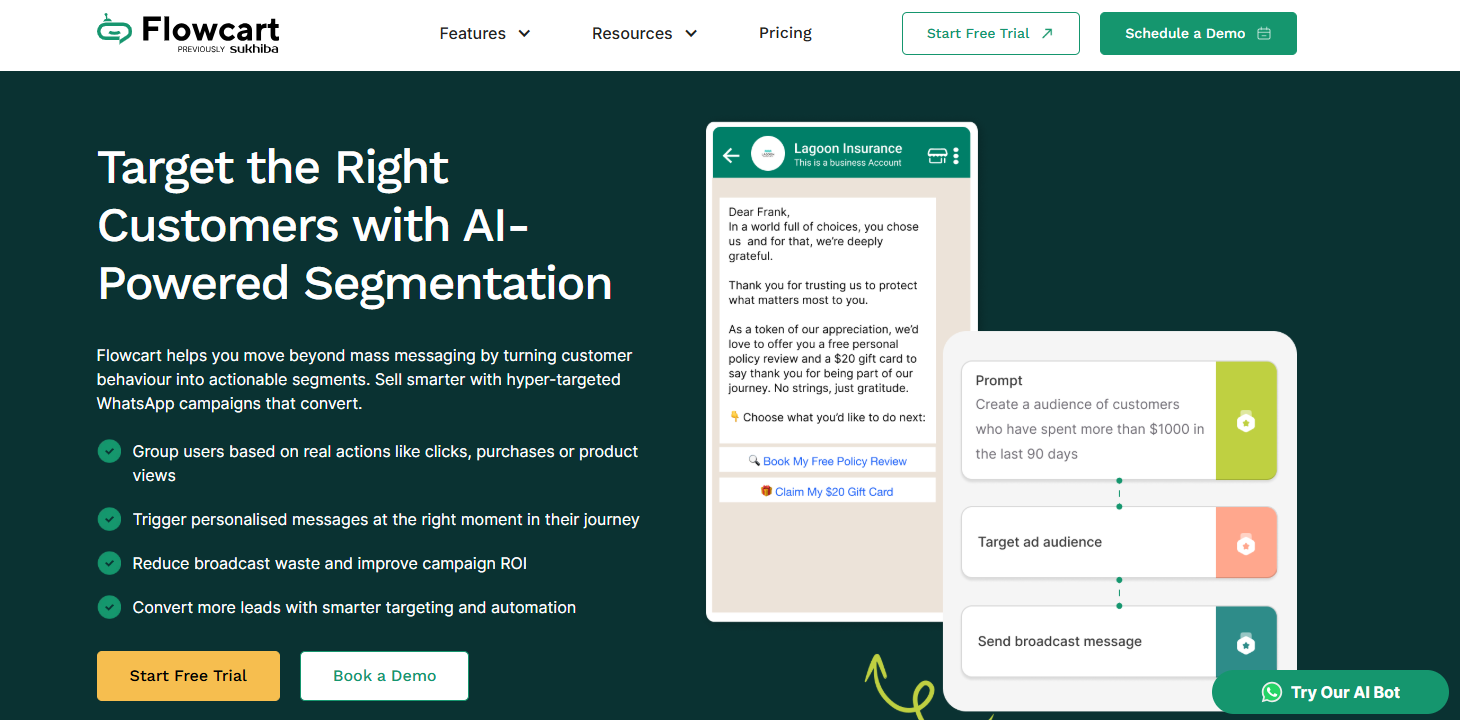
Beyond generic broadcasting, configure personalized follow-ups for each recipient based on their behaviour, including past purchases, browsing intent, and conversion stage.
For instance, customers who spend more than $1000 can receive weekly nudges to complementary products or new, renewable entries. Those who haven’t purchased anything before can receive discounts. Different messages for different needs.
Flowcart’s WhatsApp smart broadcast makes this possible by syncing with your CRM to align broadcasts with customer behaviour and increase relevance.
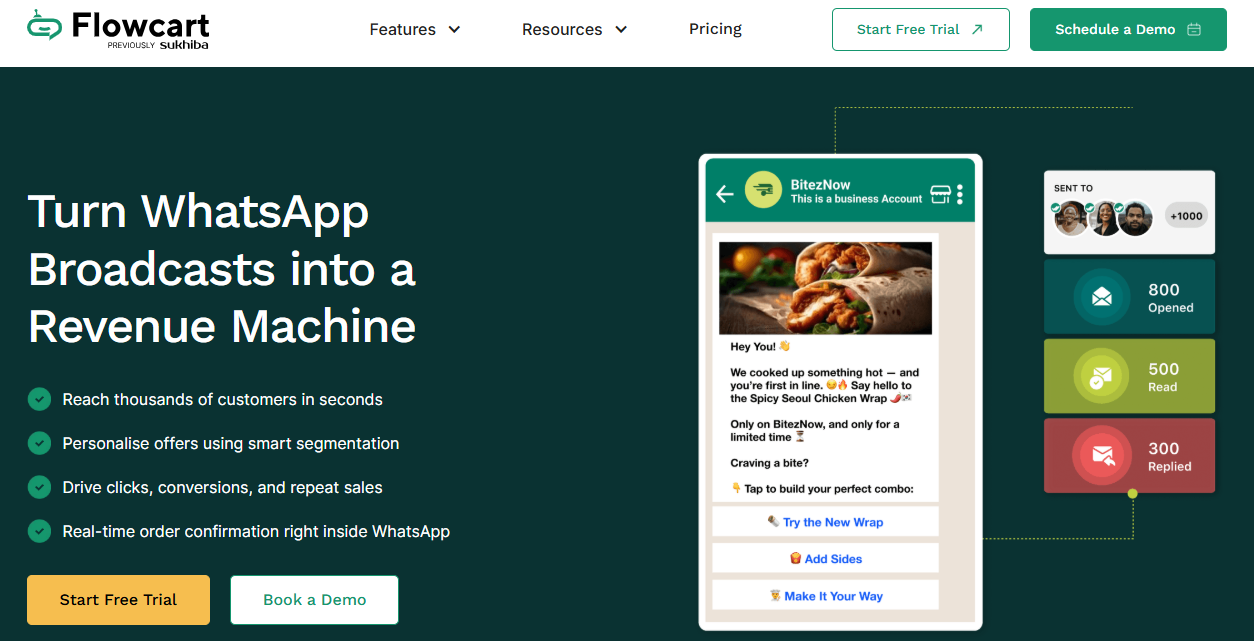
“With Smart Broadcasts, we turned WhatsApp into a revenue channel. Every message we send now has ROI built in. We send over 10,000 personalized messages a month and drive 3X more revenue than email,” Sneha Mehta, the CEO & Co-Founder of Uncover Skincare, shares.
Run sales and support from one WhatsApp number
Healthy U, a health and wellness retailer in East Africa, struggled with disconnected sales and communication workflow. That’s because each of the brand’s 30+ stores used individual WhatsApp numbers to initiate and track sales.

This approach resulted in decentralized communication and fragmented customer interactions. Sales numbers declined, visibility dropped to zero, and there was no actionable data to inform personalization.
That’s what happens when you run your sales and support from multiple numbers.
To address this, Healthy U partnered with Flowcart to consolidate multiple contacts into a single, centralized business WhatsApp number. This approach consolidated customer interactions and unified the point-of-sale system.
The result? Week-on-week sales increased by 50%, customer experience improved, scalability increased, and efficiency improved.
How Flowchat Helps Sales Teams Succeed
WhatsApp is no doubt a powerful sales tool. However, most of its native features can only support a few dozen customers before things get chaotic. Additionally, you need to implement them manually, and there are no useful analytics to track your success.
That’s why using Flowcart, a centralized WhatsApp sales automation platform, is crucial. Brands like Healthy U used Flowcart to:
- Boost orders from returning customers by 50%
- Unify sales and data from over 8+ physical stores
- Grow monthly revenue to KES 1M+
Flowcart can help you achieve the same results through intelligent automation for follow-ups and reminders, lead qualification process, and order checkout. The sales and support oriented whatsapp API integrate with CRM to provide full visibility into your sales activities and help you optimize your strategy for better results.
With the built-in loyalty tool, Flowcart helps you retain your loyal customers and reward them for staying. This increases retention rates, boosts customer lifetime value, and reduces customer acquisition cost.
Ready to see how Flowcart can turn WhatsApp into your best sales engine? Book a demo with us today.
Conclusion
WhatsApp for sales is here to stay, and take this from us, it is the future of conversational sales. You need to be ready to meet your customers where they spend most of their time and are likely to respond to you.
To maximize revenue, implement the strategies and best practices outlined in this guide. Also, adopt Flowcart to help you achieve your goals and scale growth faster.
FAQs
Can WhatsApp really replace cold calls for sales?
No. WhatsApp for sales is not here to replace cold calls. However, it will become a more effective alternative to connecting with your customers. Data also show that WhatsApp has higher open rates and a higher revenue score than email and other sales channels.
How do I automate sales follow-ups without losing personalization?
Flowcart uses the data from your CRM and other integrated platforms to segment customers and create tailored campaigns for each contact. All you need to do is set up your WhatsApp Business account with Flowcart, and it handles the rest.
Is WhatsApp effective for B2B sales?
Yes. WhatsApp is effective for B2B sales just as much as B2C. The only blocker is that you don't have contacts of the key decision-makers in the B2B niche you want to target. A bit challenging, but Flowcart can help address it with Click-to-WhatsApp Ads.
Can I send product catalogs and payment links via WhatsApp?
Yes. You can share product catalogs, images, videos, prices, and payment links directly in WhatsApp chats. Customers can browse products, ask questions, and complete payments without leaving the conversation.
How do I track ROI from WhatsApp sales campaigns?
Manually monitor metrics, such as leads generated, conversion rate, average order value, repeat purchases, and revenue from WhatsApp-driven chats. A better alternative is to use Flowcart to automate analytics and provide a comprehensive ROI report.






%201.webp)



.png)