.png)
.png)

.png)
Key Takeaways
- WhatsApp marketing automation uses the WhatsApp Business API to automate conversations, enabling businesses to run cart recovery, order updates, and promotional campaigns at scale.
- Automated flows such as welcome sequences, abandoned cart reminders, and post-purchase follow-ups help convert chats into a consistent revenue channel.
- With 98% open rates and fast response times, WhatsApp automation drives significantly higher engagement compared to traditional email or SMS campaigns.
- Platforms like Flowcart combine chatbots, AI-driven carts, payments, and CRM integrations to turn WhatsApp into a fully trackable sales and customer support channel.
Email campaigns for e-commerce businesses either arrive too late for abandoned cart recovery, get buried in promotional folders or lack the interactivity needed for product discovery and purchase completion.
SMS works for order updates, but cannot showcase product catalogues or handle complex customer service enquiries about returns, sizing or inventory.
That’s why you need WhatsApp. It’s one of the most engaging marketing channels that boasts high open and reply rates and delivers measurable whatsapp marketing benefits for ecommerce brands.
With WhatsApp, you can enable real-time customer support, complete transactions within single conversation threads and allow product browsing, while automated flows handle cart recovery, shipping updates and reorders through integrated payment providers like M-Pesa, Paystack and Razorpay WhatsApp marketing automation.
The numbers don’t lie:
- 45% of buyers prefer to complete purchases in chats over e-commerce apps.
- Prospects assisted over chat are 2.8X likely to convert.
- Sales teams perform 300% better on WhatsApp as compared to traditional shop visits and manual order handling.
Broadcasts and flows are just the tip of the WhatsApp marketing iceberg when it comes to implementing scalable strategies.
You can do much more: from two-way communication, embedding rich catalogues in the messaging interface, personalising carts and recovering abandoned carts to integrating payments that complete transactions within the chat and setting up loyalty programmes that automatically track purchase history and apply rewards.
strategies.
You can do much more: from two-way communication, embedding rich catalogues in the messaging interface, personalising carts and recovering abandoned carts to integrating payments that complete transactions within the chat and setting up loyalty programmes that automatically track purchase history and apply rewards.
What is WhatsApp Marketing Automation?
WhatsApp marketing automation involves the use of specialised software and WhatsApp Business API to automate whatsapp lead generation, conversion and retention via intelligent chatbots, automated workflows and integrated commerce systems.
Thus, you can transform WhatsApp from a messaging platform to a complete revenue-generating sales channel.
The WhatsApp Business API is the technical foundation that enables businesses to build sophisticated automation flows and integrate commerce systems, one of the key WhatsApp marketing tools for scaling revenue :
- set up event-triggered messaging i.e. automated responses to form submissions, purchases or website visits
- build sophisticated chatbot flows with conditional branching for complex customer enquiries
- implement abandoned cart recovery campaigns and send cart functionality to re-engage customers who left items unpurchased
- set up gamification features tied to retention strategies, such as loyalty programs, rewards, and interactive challenges
- integrate with CRMs (Zoho, HubSpot) and e-commerce platforms (Shopify, WooCommerce) in real time
- track ROI, conversion rates and customer journeys across various touchpoints
- accept payments directly within WhatsApp conversations via integration with payment providers (M-Pesa, Razorpay, UPI, Stripe)
- showcase inventory with native shopping experiences
- broadcast approved promotional content to segmented lists.
Note that the WhatsApp Business App is distinct from WhatsApp business API. The former offers limited automation capabilities and basic features like business profiles, whereas the latter has all the Business App features plus advanced automation and integrations.
The Whatsapp Business API is accessed via a Meta-approved third-party Business Solution Provider (BSP), such as Flowcart, an AI-powered conversational commerce and CRM platform.
WhatsApp Marketing Automation Workflows: 13 Revenue-Generating Sequences
These 13 proven sequences consistently drive revenue for ecommerce businesses and showcase effective WhatsApp marketing strategies:
1. Welcome Series and First Purchase Incentive
New customers receive introductory messages with brand information, product highlights, and first-purchase incentives as part of an effective whatsapp lead nurturing sequence.
For example:
"Hi Sarah! Welcome to [Brand]. As a thank you for joining us, here's 15% off your first order. Our bestsellers this month are our vitamin C serum and retinol cream. Which skin concern would you like to address first?"
2. Multi-Stage Cart Recovery
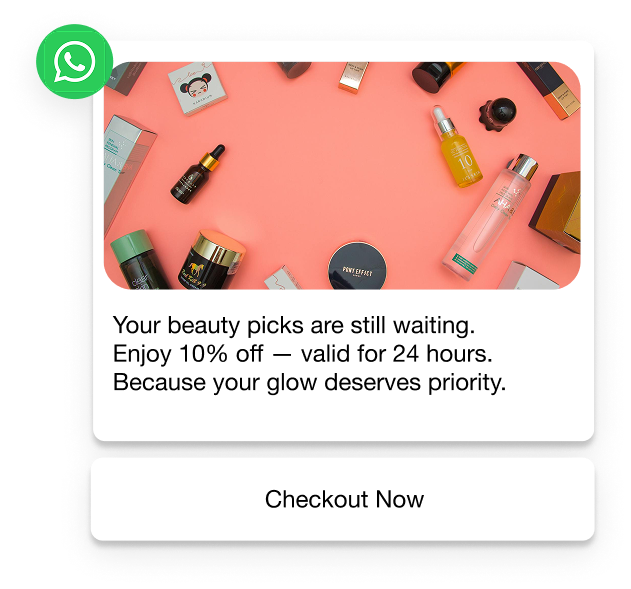
Sequential messages remind customers about incomplete purchases and form a core part of whatsapp automation strategies designed to recover abandoned carts.Advanced implementations include fallback to email or SMS if WhatsApp messages go unread, ensuring maximum recovery potential.
For example:
Day 1: "You left something in your cart! Your wireless headphones are waiting for you." Day 3: "Still thinking about those headphones? Here's 10% off to help you decide."
Day 7: "Last chance! Your cart expires tomorrow. Complete your order now."
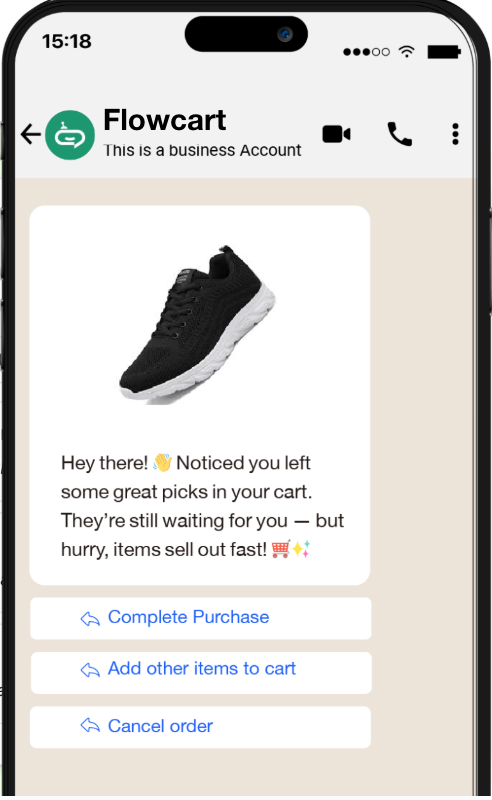
3. Browse Abandonment
Customers who view products but don't add items to cart receive follow-up messages with product recommendations, social proof or limited-time offers. This captures interest before it completely dissipates.
For example:
"I noticed you were looking at our running shoes earlier. Just wanted to let you know we have a new colour available and they're currently 20% off. Would you like to see them?"
4. Back-in-Stock Notifications
Automated alerts notify customers when previously unavailable items return to inventory. Flowcart's inventory categories enable granular tracking, allowing businesses to segment notifications by product type, brand or customer preference history.
For example:
"Great news! The black iPhone case you asked about is back in stock. We only have 12 left. Would you like me to reserve one for you?"
5. Price Drop Alerts
Customers receive notifications when items on their wishlist or previously viewed products decrease in price. This automation captures price-sensitive customers who delay purchases.
For example:
"The Samsung tablet you saved has dropped from R4,999 to R3,999. This is the lowest price we've seen. Interested in grabbing it before the price goes back up?"
6. Reorder/Refill Reminders
Time-based triggers remind customers to repurchase consumable products based on typical usage cycles. It is particularly effective for skincare, supplements, pet food, and household supplies.
For example:
"It's been 6 weeks since you ordered your protein powder. Most customers reorder around this time. Would you like me to add your usual chocolate flavour to a new order?"
7. COD to Prepaid Conversion
Automated prompts during checkout highlight benefits of advance payment such as faster processing, priority shipping, or exclusive discounts. This reduces cash handling costs whilst improving operational efficiency.
For example:
"I see you've chosen cash on delivery. Did you know prepaid orders get free express shipping and process same-day? Would you prefer to pay by card instead?"
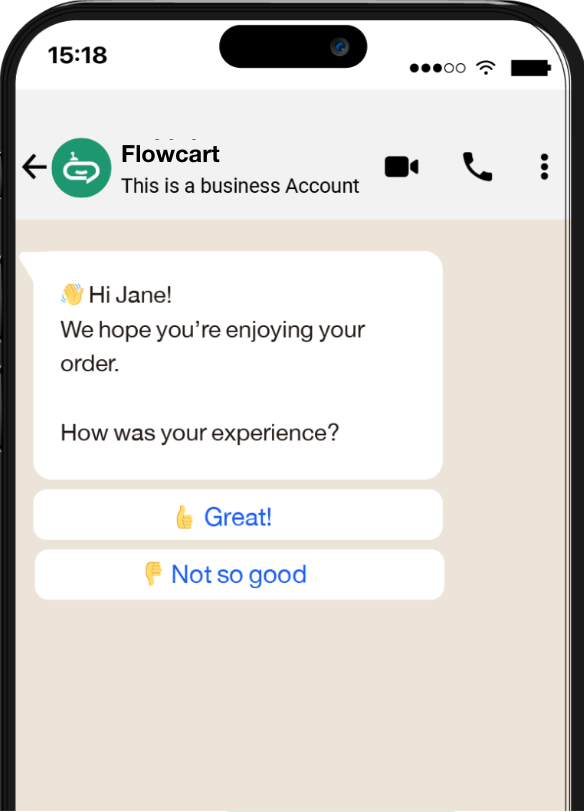
8. Post-Purchase Engagement & Reviews
Delivery confirmations trigger sequences that provide usage tips, collect feedback and encourage review submissions. User-generated content requests capture authentic testimonials for future marketing.
For example:
“Hope you're loving your new skincare routine! How's the vitamin C serum working for you? If you're happy with it, would you mind leaving a quick review to help other customers?"
9. Post-Purchase Cross-Sell
Strategic product recommendations trigger immediately after successful purchases, leveraging the customer's buying momentum. These sequences suggest complementary items that enhance the original purchase experience.
For example:
"Congratulations on your new iPhone 15! 🎉 To complete your setup, our customers love these accessories: Premium wireless headphones (15% off today), Fast charging cable, Protective case with screen protector. Which would enhance your phone experience most?"
10. Loyalty Programme & Referral Rewards
Point-based systems automatically track purchases and distribute rewards whilst referral programmes incentivise sharing, strengthening customer loyalty on whatsapp. Loyalty automation drives high retention by creating ongoing value exchange beyond individual transactions. Customers remain engaged through tier progression and exclusive member benefits.
For example:
"Congratulations! You've earned 250 points from your recent purchases. You're now a Gold member with free shipping on all orders. Plus, refer a friend and you both get 500 bonus points."
Flowcart embeds the loyalty functionality directly within WhatsApp conversations, automatically tracking customer purchases and awarding points. The system sends real-time notifications when customers earn rewards, with messages appearing immediately after completed transactions.
Points accumulate automatically in customer profiles, enabling businesses to offer tier-based benefits and personalised experiences based on purchase history.
The platform integrates loyalty rewards into its checkout process, allowing customers to redeem points during WhatsApp transactions. Also, Flowcart's segmentation capabilities use loyalty status to personalise messaging; VIP customers receive different promotional offers and early access compared to regular customers.
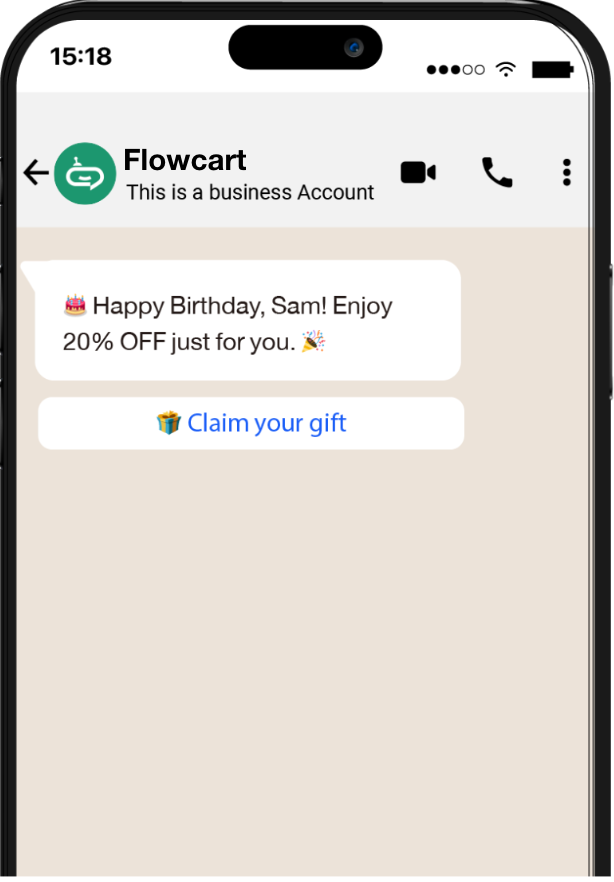
11. VIP Customer Early Access
High-value customers receive exclusive product previews, pre-sale access, and priority notifications for limited releases. This automation strengthens customer relationships whilst driving premium segment sales.
For example:
"As one of our VIP customers, you get 24-hour early access to our Black Friday sale. Everything is 40% off before we announce it publicly tomorrow. What would you like to grab first?"
12. Returns & Exchange Support
Guided workflows help customers initiate returns, track refunds and resolve product issues without human intervention. This automation maintains customer satisfaction whilst reducing support workload.
For example:
"Need to return your order? No problem! I can help you start the return process right here. Would you like a refund or exchange for a different size/colour?"
13. NPS Recovery
Customers providing low satisfaction scores receive immediate follow-up with resolution offers or compensation.
For example:
"I noticed you weren't completely satisfied with your recent experience. I'd love to make this right. Here's a 25% discount on your next order plus priority customer service. What can we do better next time?"
Flowcart enhances this through subscription management, recommended cart suggestions, in-chat checkout capabilities, registration flows, KYC processes, quiz-to-cart functionality and survey-to-loyalty-points conversion. These integrated features turn dissatisfied customers into engaged participants through personalised recovery experiences.
How do chatbots work with the WhatsApp Business API?
When customers reach the chatbot interface through Click-to-WhatsApp Ads (CTWA) or WhatsApp links (wa.me), the system captures lead information through structured flows designed for whatsapp lead automation. These automated interactions can extend beyond simple lead capture to support early-stage conversations and whatsapp for prospecting.
For example, here's how a complete automated order confirmation and promotional drip sequence works within a WhatsApp chatbot:
Step 1: Automated order confirmation (instant)
“Hi Sanah! Your order #57963 for has been confirmed.
We're preparing it for shipment, and you'll receive a tracking update soon! 📦"
Step 2: Shipping notification (triggered when order is shipped)
“Great news! Your order #57963 is on its way 🚚
Track live: [tracking link]
Estimated delivery: By 24th September, 10 p.m.
PS: We thought you might like our bestseller, [Related Product Name] – it pairs perfectly! Use code 'PERFECTPAIR15' for 15% off your next purchase at [catalog link]
Step 3: Delivery confirmation
"Hope you're loving your new lotion! 🧴
Quick favor: Could you leave a quick review? It helps other customers decide.
Leave review: [review link] As a thank you, here's 10% off your next order: THANKS10"
Post-purchase cross-sell follow-up (7 days after delivery):
Since you loved [purchased product], customers also bought:
- [Complementary Product 1] - Save 20%
- [Complementary Product 2] - Bundle discount available
- [Upgrade/Premium version] - Exclusive upgrade offer Shop now: [catalog link]"
Step 4: Replenishment reminder (triggered 60 days after purchase)
"Hey Sanah! It's been 2 months since your last order.
Running low on anything? Here are some items you might need: [Product recommendations based on purchase history]
💡 Pro tip: Set up auto-delivery and save 10% on every order!"
Cross-sell opportunity:
Try our new [premium/related product line] - 30% off for returning customers!"
Step 5: Post-purchase category expansion (triggered 45 days after purchase)
"Love your skincare routine? 💆♀️ Level up with our new categories:
- Hair care collection (matches your skin type)
- Wellness supplements
- Self-care accessories First purchase in any new category: 25% off with code EXPAND25"
Step 6: Win-back campaign (triggered if there’s no purchase in 90 days)
"We miss you! 💙
Here's an exclusive 25% off everything in our store - valid just for you.
Code: COMEBACK25 [Browse products]: [catalog link]
Expires in 48 hours!”
Now, let’s see how to direct customers into these automated conversations.
Flowcart’s Advanced Commerce Features
1. Catalogue Synchronisation
Existing e-commerce storefronts like Shopify and WooCommerce synchronise with WhatsApp product catalogues, automatically updating inventory levels, pricing changes and product availability. Also, orders placed on Flowcart are seamlessly reflected in your e-commerce dashboard, simplifying order fulfilment and reducing the risk of errors.
2. AI-Generated Carts
Flowcart’s AI analyses customer conversations and offers relevant product selections based on natural language requests like "skincare for sensitive skin" or "wireless headphones under ₹100." It also answers questions about budget, brand preference and other requirements—resolving 70% of queries instantly with seamless human hand‑off when needed. Such recommended carts cut product discovery steps and reduce abandoned carts by up to 30%.
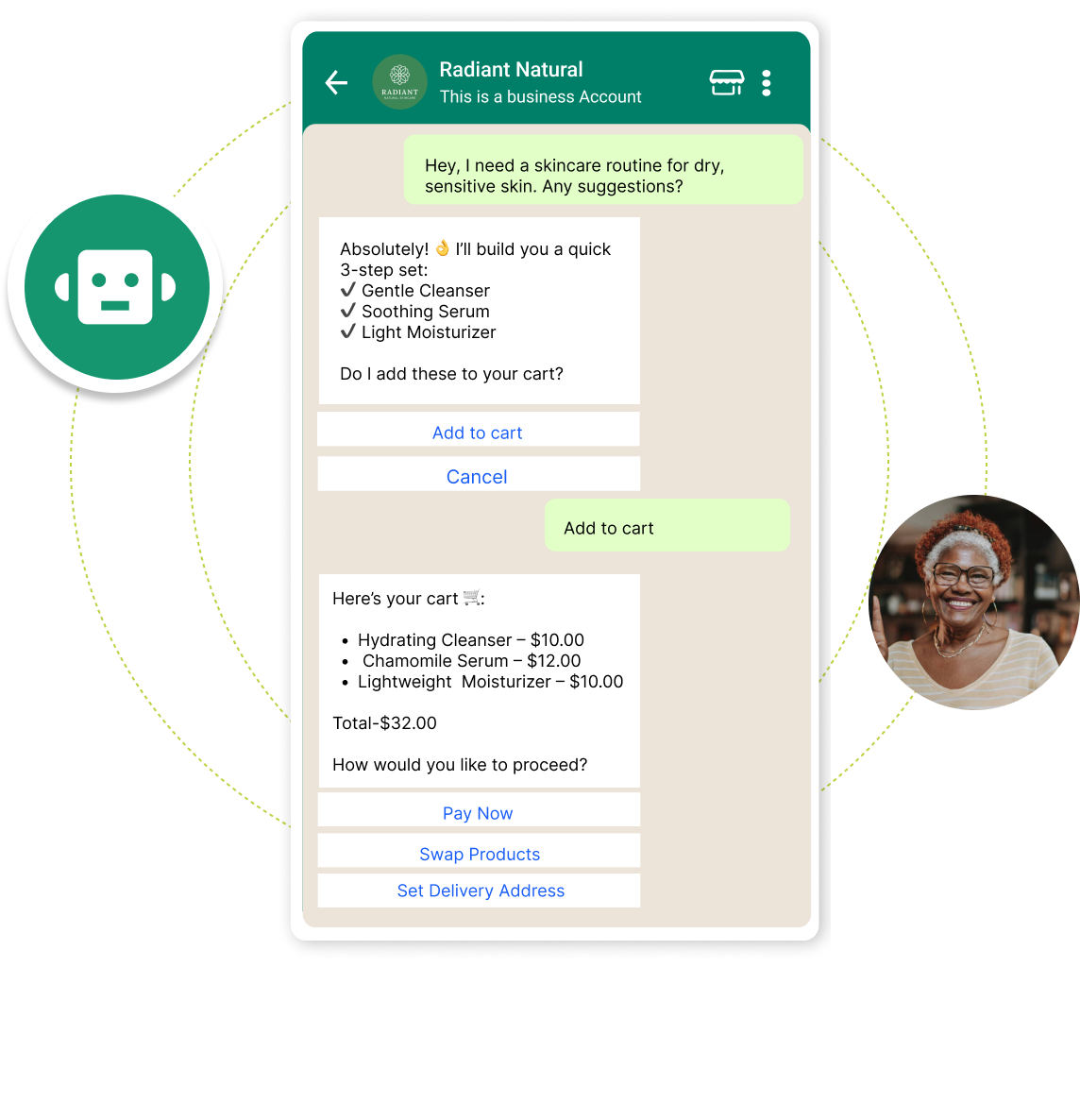
AI suggestions can include complementary items for cross-selling or upselling—a skincare request might generate a complete routine with cleanser, moisturiser, and sunscreen. Such smart upsells lift average order value (AOV) by 18%.
These curated selections include one-tap checkout links that streamline the purchase process while the system learns from successful conversions to improve future recommendations.
3. Web Catalogues with WhatsApp Checkout Integration
Basic WhatsApp catalogue functionality can be extended through web-based product displays such as whatsapp webviews built using headless e-commerce backend infrastructure.
These web catalogues provide unlimited product listings with detailed product pages featuring multiple high-resolution images, zoom functionality, product videos and detailed specifications. Customers can use advanced search filters to sort by price range, brand, category, customer ratings and product attributes like size, colour or material. Real-time stock indicators show availability across different variants, while dynamic pricing can display personalised offers based on customer segments or loyalty status.
The system supports sophisticated pricing strategies including location-based pricing connected to multiple warehouses, customer-type specific rates (wholesale vs retail), and dynamic pricing based on inventory levels or customer purchase history. This enables businesses to show different prices to different customer segments automatically.
The browsing experience works through intuitive category navigation, breadcrumb trails showing current location within the catalogue, and predictive search with auto-complete suggestions.
Instead of traditional web checkout, these catalogues redirect customers to WhatsApp for transactions. When customers select products, the system generates WhatsApp links opening conversations with pre-populated cart information.
4. Cash-on-Delivery to Prepaid Conversion
Flowcart includes automated prompts during the cart review process when customers select cash-on-delivery (COD) payment options. The system presents messages highlighting the advantages of prepaid payments, such as faster order processing, priority shipping, or exclusive discounts available only for advance payments.
The conversion prompts are integrated into Flowcart's automated checkout flow, appearing at the optimal moment when customers are already committed to purchasing but haven't yet finalised their payment method.
While these native shopping features provide the foundation for WhatsApp commerce, strategic automation sequences make sure that customers engage with them at the right moments throughout their journey.
How Flowcart Streamlines Automation Implementation?
1. Pre-built Automation Sequences
Flowcart packages each automation sequence as a complete blueprint that includes predefined triggers, message template sets, conversation flow variants and key performance indicators.
Rather than build automations from scratch, you can deploy proven sequences like "Abandoned Cart Recovery" or "VIP Early Access" with established benchmarks for success.
Each blueprint specifies the triggering event (cart abandonment after 2 hours), provides tested message templates with personalisation tokens, offers flow variants for different customer segments and tracks relevant KPIs such as recovery rate and revenue attribution.
Now, running these automation sequences without proper measurement is like flying blind—you need clear attribution data to prove ROI and improve performance over time. Let’s see how it’s done.
Measuring WhatsApp Automation Performance: ROAS and Conversion Tracking
To understand which WhatsApp campaigns truly drive revenue, businesses need accurate attribution that links ad spend, customer engagement and WhatsApp marketing cost to conversion outcomes.
Ad-to-Chat Attribution Through Click Tracking
CTWAs generate referral data whenever customers begin conversations from Facebook or Instagram. This webhook metadata includes campaign details, ad creative and audience segments—making it possible to see exactly which ads drive conversations and which audiences are most likely to convert.
Flowcart enhances this by stitching CTWA click IDs directly to order IDs, giving businesses end-to-end visibility from ad click through to purchase. This eliminates guesswork and delivers precise ROAS (return on ad spend) for each campaign, ad set and creative. Marketers can then optimise not on impressions or clicks, but on actual WhatsApp-driven revenue.
Embedded Carts for Conversion Tracking
Native checkout functionality within messaging platforms eliminates friction by allowing customers to complete purchases directly within conversations. It reduces cart abandonment while creating granular tracking opportunities as every interaction generates attribution data tied to specific marketing touchpoints.
Flowcart's embedded cart functionality enables customers to complete transactions without leaving WhatsApp, creating unprecedented ROI measurement capabilities. Marketers can track exact revenue performance of individual automation sequences—comparing welcome series conversions against cart recovery campaigns—and optimise based on actual conversion data rather than engagement metrics alone.
Conversion Tracking for Algorithm Optimisation
The Conversions API (CAPI) for Business Messaging allows businesses to send WhatsApp conversion events—purchases, leads, or other key actions—back to Meta. This server-side data creates a powerful feedback loop that helps Meta’s algorithm deliver ads to people most likely to engage and buy.
Flowcart automates this process, shipping lead and purchase data directly from WhatsApp into CAPI. It tracks a wide range of conversion types—cart additions, enquiries, completed orders and ties them to automation sequences, enabling more precise algorithm optimisation than standard web tracking.
Comprehensive WhatsApp Performance Tracking
True performance measurement goes beyond paid ads. WhatsApp engagement spans organic broadcasts, automated flows such as cart recovery, and service conversations that demonstrate whatsapp business benefits across the entire funnel.
Flowcart provides revenue-first analytics across all WhatsApp activity. It automatically appends UTM parameters to every touchpoint, tracks broadcast engagement, measures the ROAS of automation sequences, and calculates AOV and customer lifetime value uplift. This system-level tracking ensures you can optimise the whole WhatsApp funnel, not just isolated campaigns.
To achieve this level of tracking and attribution, businesses need seamless integration between WhatsApp, their e-commerce stack, CRM, and ad platforms.
Top 5 Marketing Automation Tools
1. Flowcart
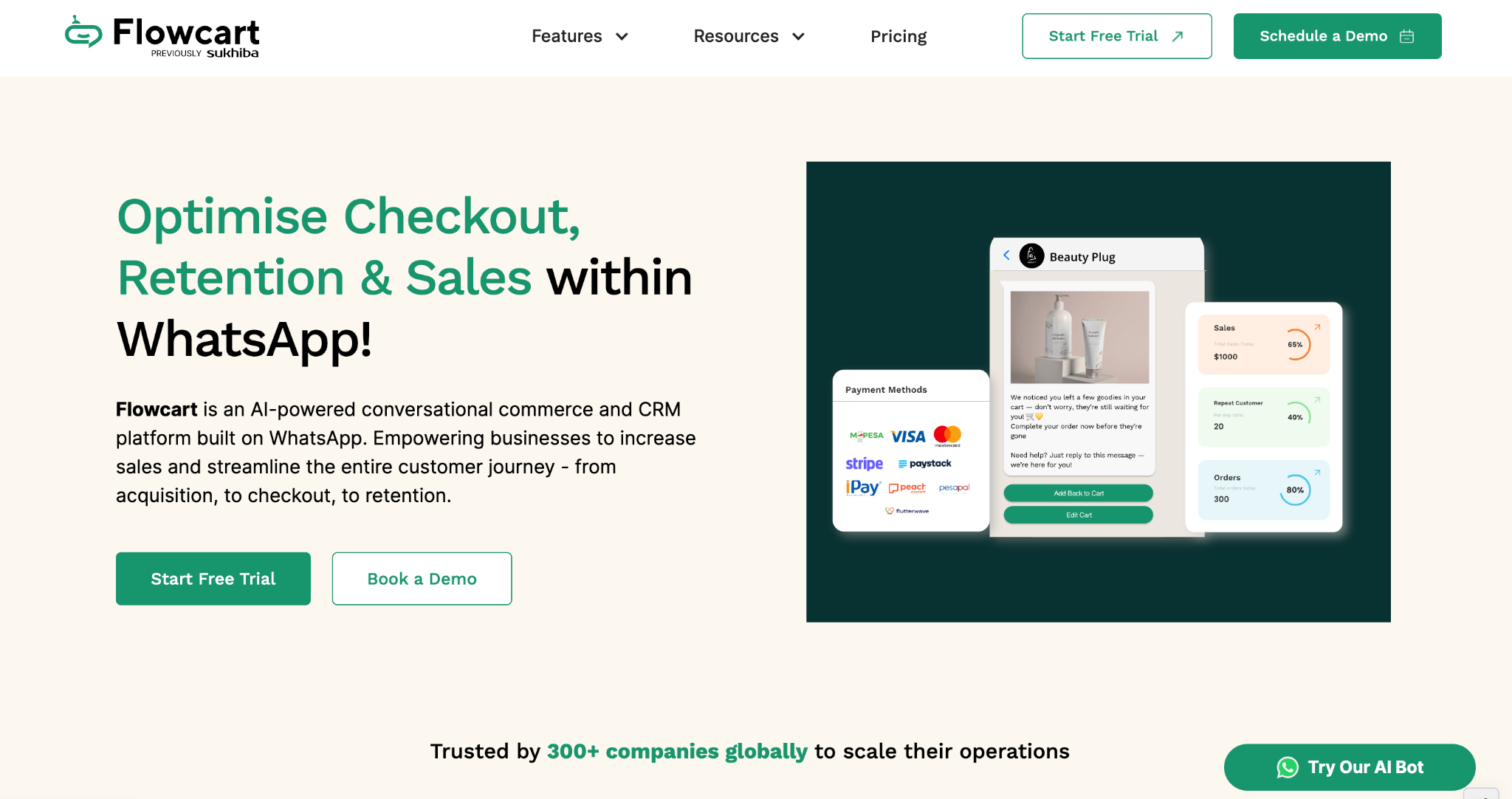
Flowcart enables brands to run WhatsApp-native conversational commerce, turning customer interactions into sales entirely within messaging apps. Flowcart is an AI-powered conversational commerce and CRM platform that streamlines the customer journey from acquisition to checkout and retention.
Flowcart supports journeys across acquisition, conversion, and retention, including WhatsApp campaigns, click-to-WhatsApp ads, abandoned-cart follow-ups, and loyalty-driven re-engagement. It integrates with Shopify, WooCommerce, ERPs, CRMs, and other systems, connecting chat, catalog, payments, and order flows in one place.
Flowcart is designed for businesses that want to optimize checkout, retention, and sales on WhatsApp without building custom infrastructure, making it ideal for DTC brands, retailers, and consumer businesses that rely heavily on chat as a primary sales channel.
Key Features
- WhatsApp-native commerce flows – Engagement to one-click checkout.
- AI-assisted buying & follow-ups – Drive conversions and retention.
- Order & product management – Integrates Shopify, WooCommerce, ERPs, CRMs.
- Pre-built campaigns & analytics – Cart recovery, loyalty, moment marketing.
Pros
- Direct in-WhatsApp sales journey – Customers stay in chat.
- Ready-to-go flows – Fast go-live for acquisition and retention.
- Conversational commerce + CRM – Reduces need for multiple tools.
Cons
- Chat-first focus – Less suited for non-WhatsApp use cases.
- Core performance channel – Best if WhatsApp is a main channel.
- Compliance required – Must follow consent & messaging regulations.
2. HubSpot Marketing Hub
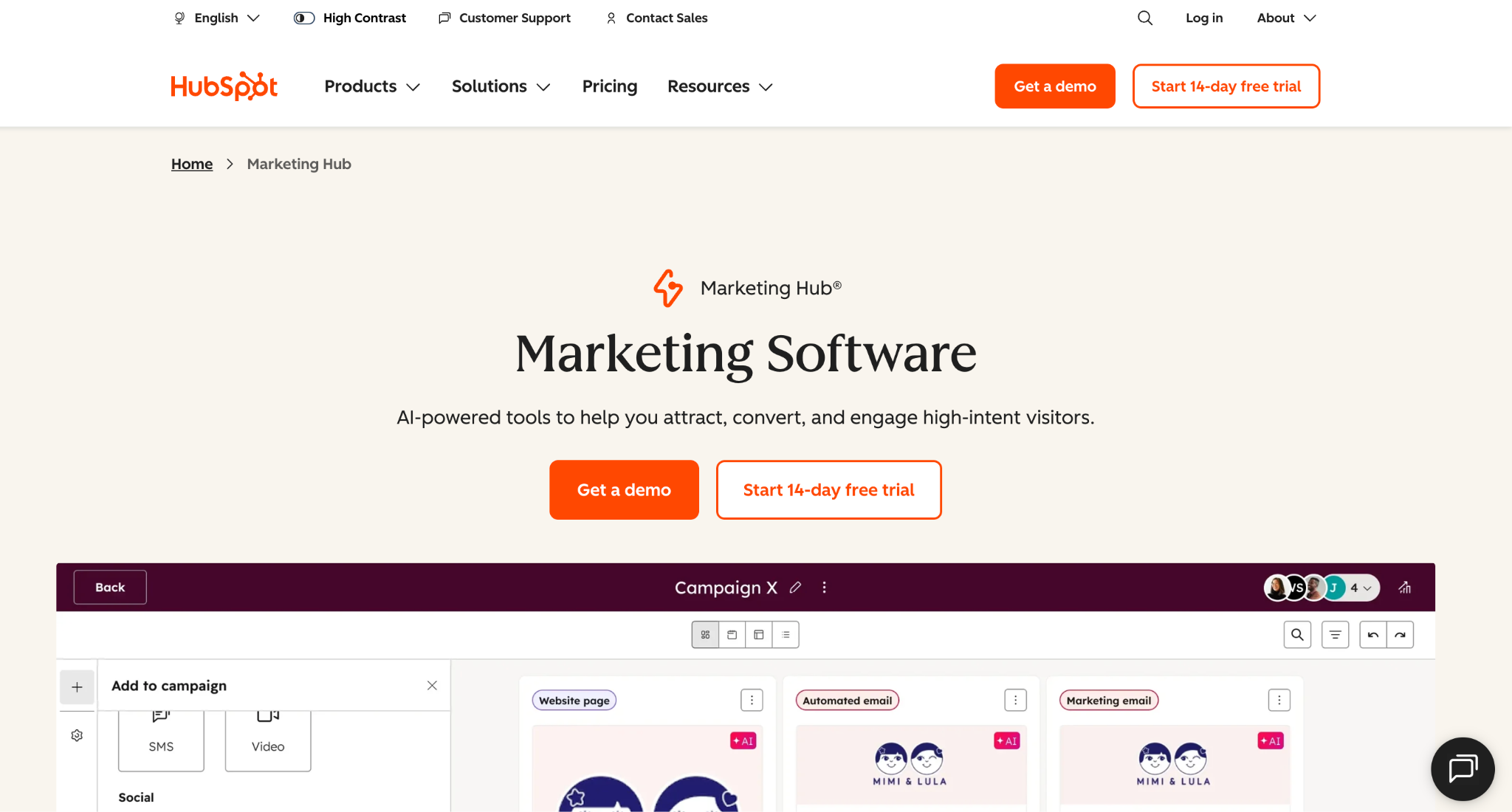
HubSpot Marketing Hub is an all-in-one marketing automation platform tightly integrated with its CRM, enabling end-to-end automation from lead capture to revenue attribution. It supports email campaigns, landing pages, forms, and web tracking while aligning marketing and sales data within a single system.
It provides a unified view of customer journeys, lead scoring, and attribution, suitable for B2B and product-led growth companies that want to track touchpoints across multiple channels. Automation workflows can trigger behavior such as page visits, email engagement, and form submissions, syncing directly with sales pipelines.
HubSpot is ideal for teams that want to scale from email to full CRM-driven marketing automation without constantly swapping vendors.
Key Features
- CRM-linked workflows – Multi-step journeys triggered by contact behavior.
- Lead scoring & segmentation – Route leads to sales or nurture streams.
- Email & content automation – Landing pages, emails, website personalization.
- Reporting & attribution – Track campaign performance and revenue impact.
Pros
- Integrated marketing + sales – Reduces data silos.
- Visual builder & templates – Easier complex automation setup.
- Scales from SMB to enterprise – Flexible tiered plans.
Cons
- Pricing grows quickly – Higher cost with more contacts/features.
- Workflow logic limits – Less flexible than specialized engines.
- Ecosystem commitment – Full value requires HubSpot suite adoption.
3. ActiveCampaign
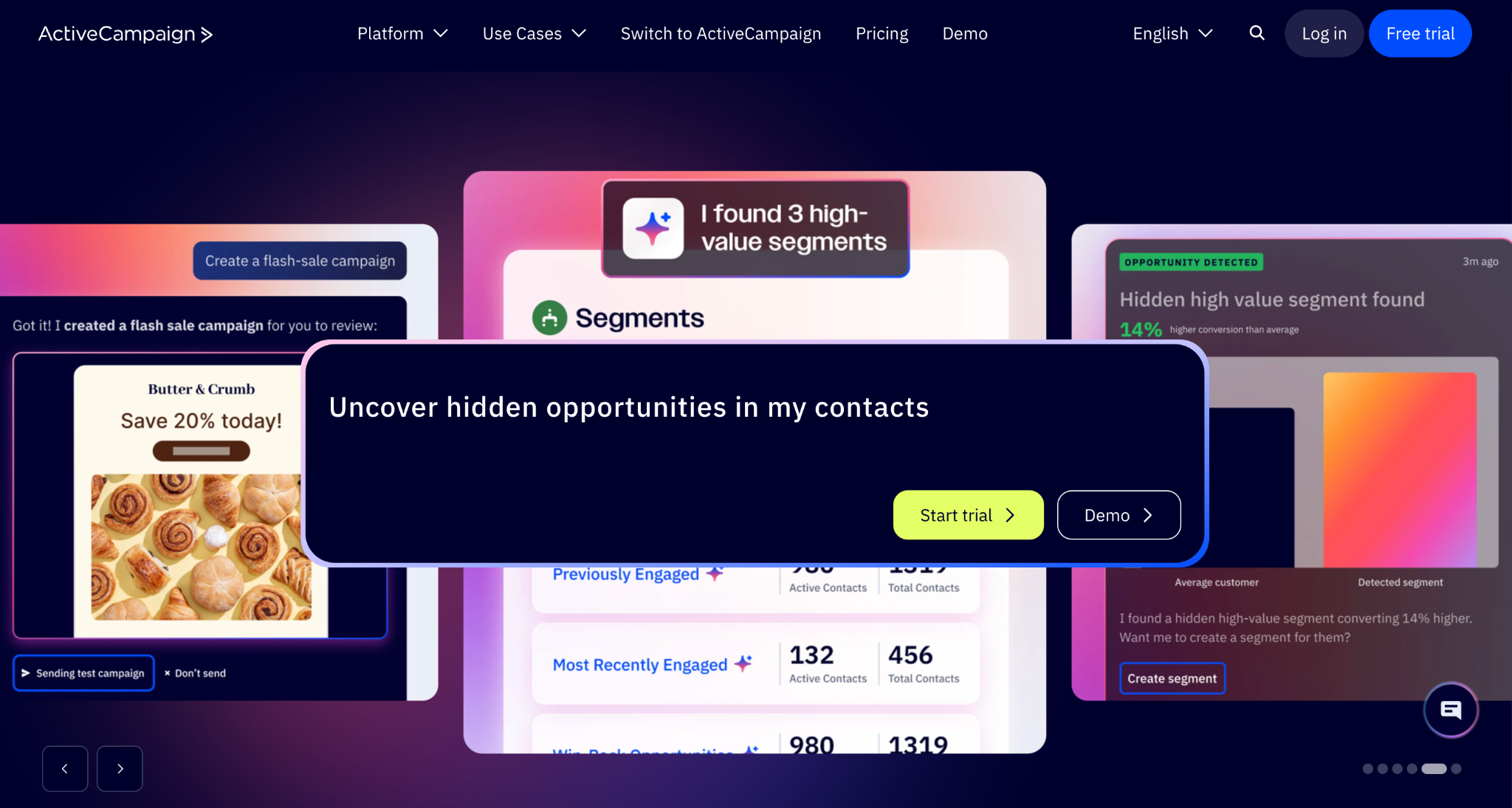
ActiveCampaign is a behavior-driven marketing automation platform with strong CRM and segmentation capabilities. It emphasizes visual workflows, conditional logic, and multi-channel engagement, giving brands fine-grained control over campaigns.
It excels in responding to specific user actions such as link clicks, page views, or purchase behavior with tailored follow-ups across email, SMS, and site messages. Its automation builder supports complex branching, delays, and conditions, suitable for product-led and mid-market SaaS businesses.
ActiveCampaign is best for marketers who prioritize precision targeting and advanced segmentation over all-in-one CRM features.
Key Features
- Visual workflow builder – Multi-step, conditional journeys via drag-and-drop.
- Behavior-based triggers – Email, site, and CRM event automation.
- Advanced segmentation – Dynamic lists using multiple attributes.
- Multi-channel messaging – Coordinate email, SMS, and site campaigns.
Pros
- Flexible automation logic – Handles complex, high-value journeys.
- Strong personalization – Improves campaign relevance.
- Marketing-focused value – Good for teams not needing full CRM.
Cons
- Steeper learning curve – Dense interface for beginners.
- Channel limits – Email/web-focused; other channels less strong.
- Pricing increases with scale – Higher volume lists/messages cost more.
4. Klaviyo
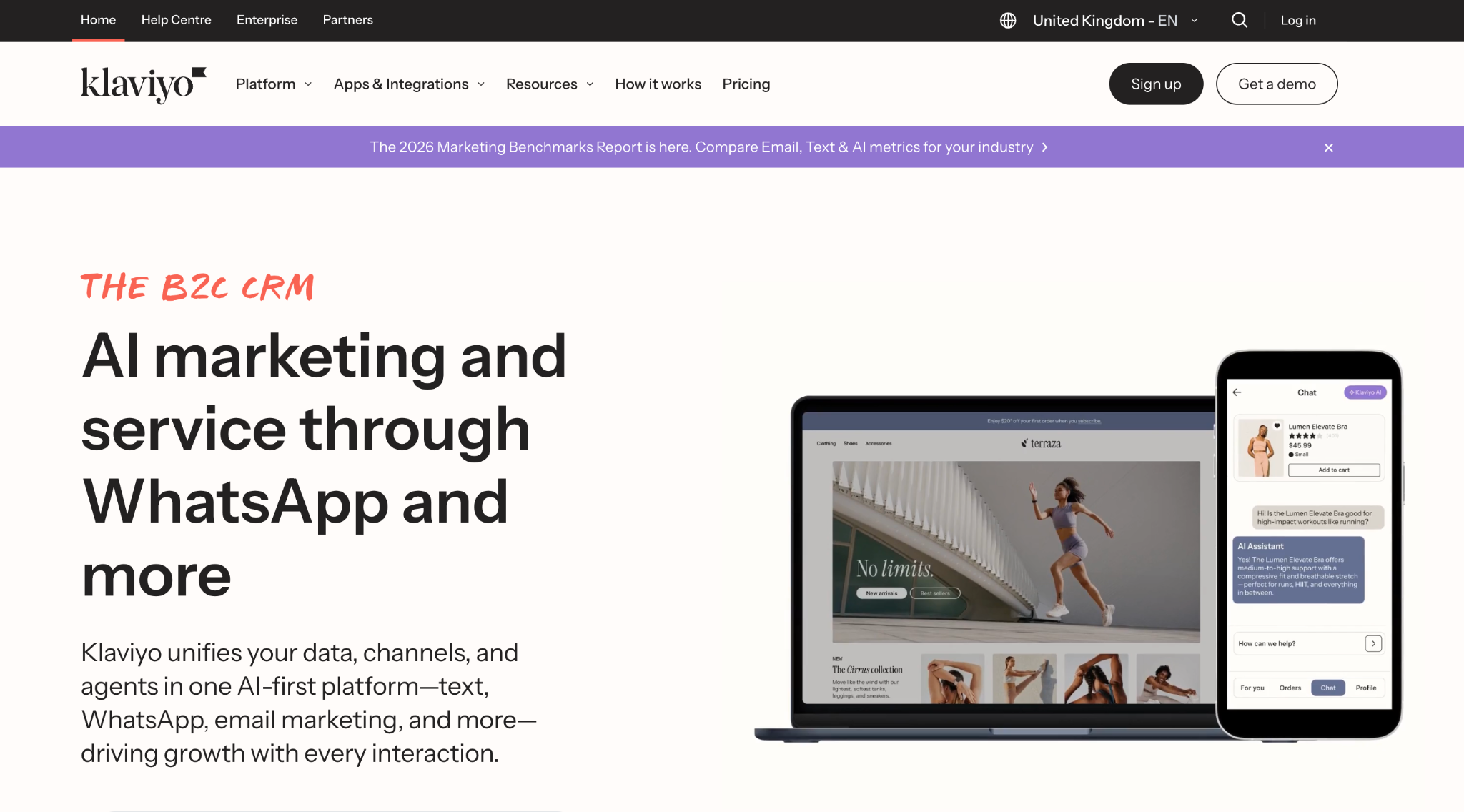
Klaviyo is a revenue-driven marketing automation platform for e-commerce brands, focusing on email and SMS campaigns tied to purchase behavior. It integrates with Shopify, WooCommerce, BigCommerce, and other carts, supporting triggers like browse abandonment, cart abandonment, and post-purchase flows.
Using real-time purchase data and predictive analytics, Klaviyo helps brands send highly targeted messages that drive conversions and repeat purchases. Templates include welcome series, win-back campaigns, and loyalty programs optimized for transactional environments.
Klaviyo is ideal for DTC and e-commerce-first brands seeking retention-focused automation.
Key Features
- Revenue-driven workflows – Abandoned cart, browsing, and post-purchase automation.
- Predictive analytics & segmentation – Target churn and optimize send times.
- Email & SMS integration – Multi-channel campaigns in one dashboard.
- Deep e-commerce integrations – Shopify, WooCommerce, 300+ third-party apps.
Pros
- E-commerce-specific automation – Revenue and retention focus.
- Beginner-friendly templates – Fast campaign launches.
- Balanced features & pricing – Fits growth-stage brands.
Cons
- Limited B2B use – Less suitable for non-e-commerce cases.
- Scaling costs – Pricing rises with contacts/sends.
- Advanced analytics limits – Less sophisticated than enterprise platforms.
5. Brevo (formerly Sendinblue)
Brevo is an affordable all-in-one marketing automation platform for SMBs, combining email, SMS, and a lightweight CRM in one interface. It supports automation workflows, welcome series, re-engagement campaigns, and built-in contact management.
The platform emphasizes deliverability and compliance, making it suitable for high-volume senders. It is ideal for small businesses that want cost-effective marketing automation without a full-stack CRM suite.
Key Features
- Email & SMS automation – Multi-step journeys across both channels.
- Built-in CRM – Track contacts, tags, and basic sales stages.
- Landing pages & forms – Capture leads and feed automations.
- Transactional + marketing emails – Send both from one platform.
Pros
- Strong SMB value – Generous free and low-tier plans.
- Light CRM reduces sprawl – Fewer tools needed for small teams.
- Deliverability & compliance – Reliable email performance.
Cons
- Limited enterprise features – Advanced reporting & attribution missing.
- Fewer integrations – Less flexibility for complex tech stacks.
Simpler automation logic – Less sophisticated than ActiveCampaign.
Launch Your WhatsApp Store & Automations With Flowcart
Looking for a complete, ready-to-deploy WhatsApp commerce infrastructure?
Flowcart transforms WhatsApp into your highest-converting sales channel with AI-generated cart recommendations that automatically compile product selections based on customer conversations, seamless in-chat checkout that eliminates external redirects and multi-touch abandoned cart recovery sequences that can recover 20-30% of lost sales.
The AI-powered platform delivers CRM-grade measurement and attribution while maintaining native connectivity with HubSpot and Zoho. Advanced features include intelligent product discovery where customers can ask questions using natural language and receive curated recommendations instantly, loyalty programme integration that tracks purchase history automatically and regional payment processing through Stripe, M-Pesa, Razorpay and other local providers.
Also, Flowcart’s ready-to-use automation blueprints provide proven revenue workflows that integrate directly with your existing Shopify, WooCommerce and CRM systems, offering viable Klaviyo alternatives for e-commerce automation.
Book a demo today and see how Flowcart powers revenue-first conversational WhatsApp commerce.
FAQ's
1.How Do Customers Reach a Business on WhatsApp?
Customers typically reach businesses through Click-to-WhatsApp ads on Facebook and Instagram, QR codes on packaging or in stores, wa.me links on websites or emails, and website chat widgets that open WhatsApp directly. These entry points allow platforms like Flowcart to capture campaign data and trigger personalized automated conversations.
2.What are Click-to-WhatsApp Ads (CTWAs)?
Click-to-WhatsApp Ads allow users to click an ad and instantly open a chat with a business on WhatsApp with a pre-filled message, making it easier for potential customers to ask questions, explore products, or start a purchase conversation.
3.How do QR codes help drive WhatsApp sales?
Businesses place QR codes on packaging, receipts, or storefronts so customers can scan and instantly start a WhatsApp chat or access specific product catalogues, turning offline interactions into digital conversations.
4.Can businesses track where WhatsApp leads come from?
Yes. Platforms like Flowcart capture referral and campaign data such as UTM parameters, ad source, and location, helping businesses measure campaign performance and personalize conversations.

.png)




%201.webp)



.png)