.png)
.png)

.png)
Key Takeaways
- WhatsApp can host a full storefront: catalog, guided flows, in-chat checkout, and post-purchase support, all within a single conversation.
- Choose the right setup early: Business App for quick launches, Business API via a BSP for automation and scale, on-premises for enterprise control.
- Compliance is non-negotiable: capture timestamped opt-ins, use approved templates, and follow local privacy laws (UAE/KSA, Kenya, South Africa, etc.).
- Build the core revenue flows first: catalog → browse → add-to-cart → checkout, plus abandoned-cart recovery and COD confirmations.
- Operational discipline matters: role-based access, consistent labels, SLAs, and weekly catalog maintenance keep the channel reliable.
- Start with measurable wins: Spinners & Spinners automated 295 price lists; Healthy U saw a 50% week-on-week sales lift after centralising; Electromart delivered 100+ WhatsApp orders in month one.
- Track the right metrics: catalog views, add-to-cart, checkout rate, AOV, conversion, repeat purchase rate, and message delivery/reply rates.
- Run small, controlled campaigns at launch: test templates, validate flows end-to-end, and scale after you prove recovery and conversion gains.
A WhatsApp shop solves a familiar ecommerce problem: people click your ads, browse for a moment, and disappear before checkout. Inside WhatsApp, the journey feels lighter. Customers see products, ask questions, and complete orders in the same chat they already use every day. Brands get faster replies and fewer drop-offs.
This guide walks you through setting up WhatsApp for e-commerce end-to-end, keeping everything running without manual follow-ups. Ideal for teams that want cleaner ROAS, smoother COD management, and a storefront that lives where their customers already are.
What is WhatsApp ecommerce?
WhatsApp ecommerce turns the app into a full shopping channel. Instead of sending customers to a website, brands bring the store inside the chat. Shoppers browse catalogs, view prices, add items to a cart, place orders, and complete payments without switching tabs or loading a slow mobile site. For teams, this creates a direct path from intent to purchase, reducing the friction that usually leads to drop-offs.
Put simply, a WhatsApp shop works as a conversational storefront. Messages replace page views, product cards replace listing pages, and quick replies stand in for live chat. The flow feels natural for customers, and brands get more visibility into buyer behavior.
WhatsApp Ecommerce Compliance and Approvals
Compliance is the guardrail that keeps your WhatsApp shop running without interruptions. Meta reviews every business, every template, and every proactive message. Falling out of line can lead to blocked templates or a restricted account, which is why teams need a simple view of how approvals work.
1. Platform policies
Meta categorizes every outbound message into marketing, utility, or authentication. Only pre-approved templates can be sent proactively, and marketing templates require explicit opt-in. If a message looks promotional but isn’t approved under the right category, it gets flagged.
2. User consent
Customers must opt in before you message them outside of a 24-hour window. Opt-ins can come from website forms, ad clicks, or conversations they start with you. You need a trackable record of that consent, stored with a timestamp.
3. Regional regulations
Each market follows its own privacy and data rules. In the Middle East, countries like the UAE and KSA enforce strict data-handling and customer-consent requirements. Across Africa, frameworks such as Kenya’s Data Protection Act and South Africa’s POPIA outline how customer information should be collected, stored, and retained. These laws shape how long data can be held, who can access it, and how it may be used in your WhatsApp operations.
4. Business verification
To access the WhatsApp Business API (and request the green tick), brands must complete Meta’s verification process. This includes proving legal business identity, matching submitted documents to the business profile, and confirming ownership through email or phone validation.
5. Prohibited content
WhatsApp blocks ads or promotions related to adult products, unregulated supplements, alcohol, tobacco, scams, impersonation, and harmful activities. Violations move through stages: template rejection, short-term restrictions, full account blocks, and, in severe cases, permanent disabling.
6. Security expectations
Brands are expected to protect customer data with encryption, access controls, and clear retention policies. Storing chat exports on personal devices or shared drives violates these rules and raises audit risks.
A compliant WhatsApp ecommerce setup covers these basics:
- Verified business account
- Approved templates for marketing and utility messages
- Clear opt-in and opt-out paths
- Documented consent logs
- Region-aligned privacy policies
- Secure data handling practices
When these pieces are in place, your shop can scale without fear of sudden restrictions or rejected campaigns, and your team can focus on the experience rather than policing approvals.
Also Read: Why WhatsApp is the Future of Conversational Commerce
Step-By-Step Guide: How to Set Up Your WhatsApp Ecommerce Shop
Quick roadmap: pick the right WhatsApp approach → set up the account and catalog → wire payments and automations → publish flows, segments, and campaigns → track metrics and scale with teams.
Step 1: Pick the right approach
Your setup choice shapes everything that follows. It affects how fast you launch, how much you can automate, and how well your team handles incoming volume. So, choose the option that matches message volume, technical capacity, and integration needs.
- WhatsApp Business App (beginner): Free, fast to launch, up to 500 catalog items, manual handling. Best for local shops and small teams (≈10–50 daily chats).
- WhatsApp Business API (cloud) via a BSP (recommended for growth): Supports automation, templates, payments, multi-agent inbox, analytics, and CRM integrations.
- On-premises API (enterprise): Complete control, heavy engineering, for very high volume and strict compliance needs.
Step 2: Set up the WhatsApp Business App
This route helps smaller teams quickly get a functional shop up and running. The focus is on presenting products cleanly and keeping conversations organized.
Download the WhatsApp Business App on Android or iOS, register a dedicated business number, and complete verification. Fill out your profile with a clear logo, a short description, your business category, address, hours, and a website link. Customers should understand who you are before they message you.
Next, create your catalog by adding high-quality square images, clear product names, short descriptions, prices, and SKUs. WhatsApp reviews each item, usually within a day or two. If your version supports collections, group products by category or theme to make browsing smoother.
Improve response time by creating quick replies for common questions related to shipping, returns, sizing, and payment methods. Additionally, use labels to categorize conversations to beat confusion. You can also enable greeting and away messages to set expectations when customers reach out outside business hours.
Android users can access basic analytics to monitor catalog views, clicks, and message activity. Apply for verification if available in your region to increase trust and credibility.
Step 3: Set up the WhatsApp Business API
This is the path for teams that want automation, templates, payments, and multi-agent workflows. The setup is more detailed, but it creates a storefront that runs at scale.
- Start by choosing a BSP.
- Compare pricing, integration support, catalog handling, flow builders, analytics, and payment options.
- Log in to Meta Business Manager and complete business verification using official documents once you select a partner.
- Create your WhatsApp Business Account, add a dedicated phone number, and verify it.
- Build your Commerce Catalog in Meta Commerce Manager, either manually, through CSV import, or with a direct feed from Shopify or WooCommerce.
After your catalog is ready, connect it to your WhatsApp account so customers see the shopping button inside your profile.
With the foundation in place, create message templates for marketing, utility, and transactional updates. Keep them concise and compliant, and submit them for review. It is also recommended to connect your payment gateway through your BSP and run test transactions to confirm that order data is captured correctly.
Additional steps include:
- Using your BSP’s visual builder to create guided journeys: browsing flows, cart creation, checkout forms, order tracking, feedback collection, or support routing.
- Adding automations for abandoned carts, COD confirmations, order updates, and re-engagement.
- Segmenting contacts by purchase history, behavior, or recency to send more focused broadcasts.
Analytics in the BSP dashboard help you track message delivery, catalog interactions, conversion rates, AOV, and repeat purchase patterns. Add team members with role-based access and route conversations with rules that fit your support model.
Step 4: Build the core ecommerce flows
Start with flows that directly influence sales and reduce operational load. A smooth browse → cart → checkout flow is the foundation. Customers should be able to select items, confirm quantities, and receive a payment link in minutes.
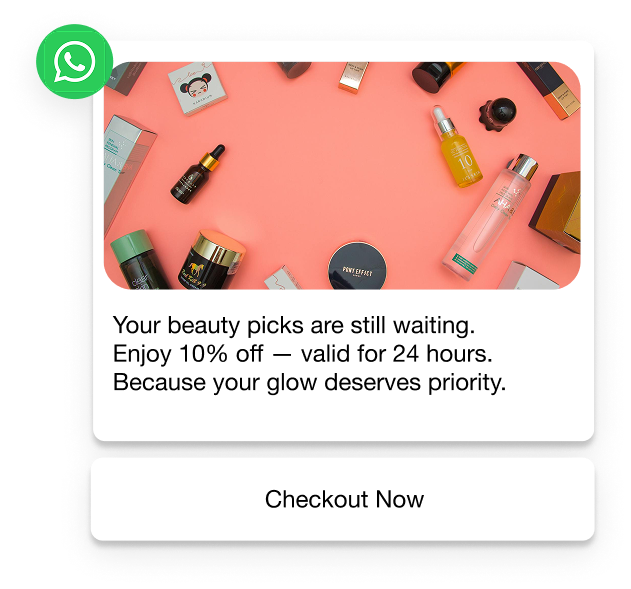
Add an abandoned-cart flow: a first reminder after 30 minutes, followed by a second nudge the next day. Include product images and a clear CTA. Order lifecycle messages keep customers informed without manual effort.
If your brand offers COD, build a confirmation journey that verifies intent before dispatch. This single flow significantly reduces return-to-origin losses. End with a support triage flow that sorts routine questions and routes complex issues to the right agent.
Step 5: Automate your messaging and test flows
Automation reduces load, but only when tested properly. Template messages should be structured, personalized with variables, and reviewed before approval. Every flow should be tested for invalid inputs, mid-chat drop-offs, payment failures, and edge cases.
📌Run small batches for proactive messaging to maintain sender quality and avoid rate-limit flags.
Step 6: Segment your audience and launch campaigns
Once your flows and templates are in place, start segmenting your audience so every message feels relevant. WhatsApp works best when campaigns reflect a customer’s intent, behaviour, or purchase history.
Begin by grouping customers based on how they interact with your shop. BSP dashboards make this easy: you can filter by activity, product interest, or recency and save these segments for targeted broadcasts.
Common segments include:
- Repeat buyers who respond well to loyalty drops
- High-AOV customers who prefer premium ranges
- Cart abandoners who need a clear nudge to convert
- Category-specific shoppers who browse similar products repeatedly
- Dormant customers who haven't engaged in weeks
Use approved templates to send broadcasts for new arrivals, restocks, limited-time offers, or seasonal promotions. Keep each message tight, visual where possible, and aligned with what that segment has shown interest in.
Step 7: Structure your team and daily operations
As conversations grow, a structured support workflow becomes essential. This keeps response times tight, avoids duplicate replies, and ensures nothing falls through the cracks.
Add team members to your BSP with role-based access so everyone works within clear boundaries. Use labels to route conversations so your team quickly understands what needs attention.
Define simple, predictable SLAs such as replying within an hour during operating hours and marking escalations when issues need a specialist. A shared inbox helps agents see who’s handling what, while internal notes prevent confusion during handoffs.
Smooth operations come from small habits: consistent labeling, clean routing rules, and clear reply patterns across the team.
Step 8: Optimize and refine your WhatsApp shop
Once your system is live, focus on refining it with data. Catalog performance, message insights, and conversion trends show you where friction exists and what to improve next.
Start by reviewing your product data. High views but low conversions could signal weak images, unclear descriptions, or pricing misalignment. Revisit templates that underperform by tightening wording, clarifying CTAs, or testing variations with different segments.
Use analytics to understand customer behaviour across the journey:
- Catalog views
- Add-to-cart actions
- Checkout completions
- Payment drop-offs
- Repeat purchase rate
- Message reply speed and patterns
Make updates weekly so your WhatsApp shop stays aligned with customer expectations, product availability, and campaign priorities.
Step 9: Run a pre-launch readiness check
Before you go live, run a quick system check to catch anything that could break the customer experience. Your shop is ready when:
- Your business profile is complete and verified
- The catalog is connected and all items are approved
- Payment integration works end-to-end
- Core flows (browse → cart → checkout) run without errors
- Cart recovery and COD confirmation flows are active
- Key templates are approved and available in the BSP
- Opt-in methods and consent logs are set up
- Segments are created for your first campaigns
- Team roles, labels, and SLAs are in place
- Analytics dashboards show clean, trackable data
Once everything checks out, your WhatsApp shop is ready to drive conversions from day one.
Top WhatsApp Ecommerce Use Cases
Most ecommerce wins fall into a few repeatable patterns: product discovery, cart recovery, COD management, and post-purchase support. Below are the core use cases that consistently drive revenue, along with real examples of how brands achieve them with Flowcart.
Use Case 1: Simplifying complex product discovery and price personalization
Instead of forcing shoppers to navigate long catalogs or complicated pricing tables, brands can turn WhatsApp into a guided journey that surfaces the right products and the right prices instantly. This speeds up decision-making and creates a seamless path from inquiry to order, especially for businesses managing both B2B and B2C buyers.
Example: How Spinners & Spinners streamlined pricing and ordering with Flowcart
Spinners & Spinners, a heritage textile manufacturer in East Africa, needed a faster way to manage 295 distinct price lists for wholesalers, retailers, and end consumers. Their previous setup involved manual quoting, inconsistent pricing, and disconnected sales channels, which slowed order processing.
Flowcart helped them consolidate everything into a single conversational funnel. Customer phone numbers were matched to Customer IDs in their ERP, enabling WhatsApp to identify the correct price list for each message. Buyers sent an RFQ via WhatsApp; the system pulled the correct prices, generated a quote, and sent it back instantly for confirmation and payment. Orders were processed without delays, and customers received accurate, personalised pricing without back-and-forth communication.
Impact:
- Automated management of 295 price lists
- Accurate, personalised quotes for every customer segment
- Faster order processing through ERP integration
- One unified channel for both B2B and B2C sales
In a category where complexity slows growth, Spinners & Spinners now runs discovery, pricing, ordering, and support through a single WhatsApp conversation, turning operational challenges into a scalable advantage.
Use Case 2: Centralizing multi-store communication and customer service
WhatsApp becomes far more powerful when everything runs through a single, unified channel. Centralizing communication not only improves customer engagement experience but also helps teams coordinate and build a predictable system for handling demand across locations.
Example: How Healthy U unified 8 stores and boosted repeat orders with Flowcart
Healthy U, a leading wellness retailer in East Africa, previously operated every outlet with a separate WhatsApp number. This kept store teams disconnected, slowed fulfillment, and left HQ without visibility into conversations or sales inquiries. Manual recording of orders added to the workload and created delays across all 30+ outlets.
Flowcart helped Healthy U shift to a unified WhatsApp setup. All customer interactions now come through one WhatsApp number, while Flowcart’s storefront connects conversations, orders, payments, and analytics into a single operating system. HQ can monitor every chat, identify training gaps, and track store-wise customer interactions.
Impact:
- Week-on-week sales increased by 50%
- Centralized oversight for HQ across all stores
- Faster, more consistent responses from store teams
- Over 50% of monthly orders now come from returning customers
Healthy U now runs end-to-end engagement within a single WhatsApp thread. With Flowcart, their entire retail network operates as a coordinated unit, giving customers a single, reliable point of contact while giving HQ complete visibility across the brand.
Use Case 3: Guiding customers from product search to checkout inside WhatsApp
Electronics buyers often compare models, filter by features, and ask repeated questions before deciding. WhatsApp excels in these scenarios because it turns a complex search process into a simple conversation. With the right flows and product matching, brands can help shoppers discover the best options and checkout without leaving the chat, shortening the buying cycle.
Example: How Electromart built a guided shopping assistant with Flowcart
Electromart, the retail arm of Somotex with operations across West and East Africa, wanted WhatsApp to become more than a support channel. Most chats stopped at basic questions, and customers had no structured way to browse products, compare options, or complete an order. The journey felt fragmented, and there was no clear path from discovery to purchase.
Flowcart helped Electromart build a smart shopping assistant inside WhatsApp. Shoppers can now search for products, browse categories, or ask for recommendations based on brand, budget, or features. The bot returns top-matching items with images, descriptions, prices, and key specs so customers can make informed choices right in chat. Once they’re ready, customers place an order through a seamless WhatsApp checkout with COD confirmation.
Impact:
- Over 100 WhatsApp orders per month from the very first month
- Higher engagement and longer chat sessions
- Smooth transition from search → comparison → checkout inside a single chat
Electromart now drives real sales through WhatsApp instead of handling surface-level queries. Guided discovery, AI-generated carts, and in-chat checkout work together to convert shoppers faster and give them a complete buying experience without switching channels.
Read complete Flowcart stories here
WhatsApp eCommerce: Best practices (what to do and what to avoid)
WhatsApp works when messages respect customers, flows reduce friction, and ops run predictably. Below are the most common mistakes teams make, each followed by a concrete fix you can apply immediately.
Mistake #1: Using a personal WhatsApp account for business
Personal accounts lack business features and put your channel at risk of suspension.
☑️How to fix it:
- Move to WhatsApp Business App for small teams; use the Business API through a BSP for scale.
- Migrate existing contacts and archive old chats before switching.
- Keep business and personal numbers separate.
Mistake #2: Messaging customers without explicit opt-in
Sending unsolicited promos leads to complaints, bans, and regulatory trouble.
☑️How to fix it:
- Capture explicit opt-in with a clear checkbox, ad click, QR code, or POS consent.
- Record timestamp, channel, and message type for every opt-in.
- Honor opt-outs immediately and keep an auditable log.
Mistake #3: Submitting the wrong template category
Using a marketing template for a transactional message (or vice versa) results in templates being rejected and raising flags.
☑️How to fix it:
- Match content to category: Marketing = promos; Utility = order updates; Authentication = OTPs.
- Add context and business name in the template.
- Place variables inside the sentence, not at the start or end.
Mistake #4: Sending messages too frequently (spam)
High frequency kills engagement and triggers platform capping or bans.
☑️How to fix it:
- Build a cadence plan: promotional 2–4/week, informational 1–2/week, transactional as needed.
- Segment by engagement: high-engagers receive more, low-engagers receive less.
- Monitor unsubscribe and complaint rates; reduce frequency if they spike.
Mistake #5: Using the wrong media or bad formatting
Low-quality images, unsupported file types, and long walls of text reduce engagement.
☑️How to fix it:
- Use JPEG/PNG images under 5MB and MP4 for short clips.
- Prefer bullets, line breaks, and buttons over long paragraphs.
- Include at least one image or short video in product messages.
Mistake #6: Neglecting compliance and privacy
Non-compliance risks fines, legal exposure, and permanent account suspension.
☑️How to fix it:
- Store consent records with timestamps.
- Publish a privacy policy and honor data deletion requests.
- Use only approved WhatsApp Business platforms and follow local regulations (GDPR, TRAI, CCPA as applicable).
Implementing these fixes stops most operational leaks and protects your sender reputation.
Additional Read: WhatsApp Marketing Mistakes to Avoid (And How to Fix Them)
Best Tools to Power WhatsApp Ecommerce
Picking the right platform changes how much you can automate, who in your team can run the inbox, and how smoothly the checkout and analytics tie back to your systems. Below is a compact comparison of popular WhatsApp ecommerce platforms to help you choose the right fit.
Flowcart sits toward the commerce-focused end of the spectrum: features are built around cart and checkout, recovery flows, and revenue metrics, while other platforms concentrate more on basic inboxing, choice-based bots, or enterprise-grade omnichannel routing.
Now we’ll understand what each core Flowcart capability delivers in practice.
Next Read: WhatsApp Chatbot for Business: How to Automate Support & Boost Sales
How to build your WhatsApp ecommerce system with Flowcart
Flowcart gives ecommerce teams a complete operating system for acquisition, conversion, and retention inside WhatsApp. Instead of stitching together multiple tools, you get one place to run ads, guide shoppers, build carts, trigger payments, recover revenue, and run loyalty flows all backed by a team that supports setup, workflows, and scaling.
1. Bring shoppers in with strong entry points
Flowcart helps you turn traffic into high-intent conversations. Here’s what you can use:
- Click-to-WhatsApp Ads: Customers land in a pre-loaded shopping flow instead of a blank chat.
- WhatsApp Flows: Build structured product journeys without code — perfect for guided discovery, FAQs, and service menus.
These touchpoints let you push shoppers directly into product selection or cart-building, reducing drop-offs from the first click.
2. Convert customers with in-chat shopping
Once someone enters the conversation, Flowcart turns browsing into buying. You can access:
- In-Chat Checkout: Customers add items and pay without switching apps.
- AI-Generated Carts: Flowcart builds personalized carts based on customer requests (price range, brand, size, use case).
- Abandoned Cart Recovery: Automated nudges bring shoppers back with context (cart items, price, stock).
- WhatsApp Webview: When a step needs more space, such as address capture, delivery preferences, subscription selection, or payment confirmation, Flowcart opens a secure Webview inside WhatsApp. Customers get a smoother, app-like experience while staying in the same conversation.
This workflow means every interaction from “What do you have in stock?” to “Place order” happens inside one chat thread.
3. Retain customers with segmented messaging
You can move beyond one-size-fits-all broadcasts and send targeted, behavior-aware communication. Choose these features from Flowcart’s stack to run successful campaigns:
- AI-Powered Segmentation: Segment by purchase history, recency, product interest, or conversation signals.
- Subscriptions: Let customers opt into recurring orders for consumables, refills, or memberships directly inside WhatsApp. They can confirm frequency, pause deliveries, or resume plans through simple chat actions.
- Smart Broadcasts: Send tailored campaigns directly to segmented customer types.
- Loyalty Program: Reward repeat customers with points, in-chat redemption, and exclusive perks.
These tools make WhatsApp a recurring revenue engine instead of a one-off sales channel.
4. What the Flowcart Team does for you
You don’t have to figure out the workflows alone because the Flowcart Team sets up your system, configures templates, optimizes flows, and provides ongoing support.
Team involvement includes:
- Setting up catalogs, smart product finders, and checkout flows
- Creating compliant templates and opt-in funnels
- Building abandoned cart journeys and COD confirmation flows
- Structuring segments for repeat purchases and retargeting
- Monitoring delivery rates, message quality, and performance
- Training your team on inbox management, lead automation, and campaign planning
This gives your brand a plug-and-play WhatsApp commerce setup that works from Day 1 without any technical overhead. If you want a walkthrough tailored to your shop, catalog size, and current stack, book a demo with the Flowcart team to see the workflows in action.
FAQs
What are the key features of WhatsApp ecommerce?
WhatsApp ecommerce includes catalogs, flows, in-chat checkout, order notifications, abandoned-cart recovery, segmentation, and automated customer journeys. Brands can guide shoppers from product discovery to payment in one thread. It also supports team inboxing, analytics, and loyalty programs for long-term retention.
WhatsApp vs. email vs. SMS for ecommerce: which to choose?
WhatsApp delivers higher open and response rates because it feels conversational and immediate. Email is better for long-form content and low-frequency communication, while SMS works for simple alerts but lacks richness. WhatsApp sits in the middle, its interactive, visual, and capable of handling the full purchase journey.
How does WhatsApp ecommerce work?
Businesses set up a catalog and flows, connect a payment method, and use approved templates for transactional or promotional messaging. Shoppers browse, ask questions, receive recommendations, and complete checkout inside the chat. Behind the scenes, automation handles routing, updates, and recovery.
How much does it cost to set up WhatsApp Business for ecommerce?
The WhatsApp Business App is free and suitable for small teams. The WhatsApp Business API is delivered through solution providers, with monthly platform fees plus WhatsApp conversation charges. Total cost depends on message volume, automation needs, and integrations, typically ranging from a low monthly SaaS fee to a custom enterprise pricing plan.
How do I securely integrate payments within WhatsApp chat?
Payments are processed through approved gateways such as Razorpay, PayStack, Stripe, or M-Pesa via your BSP’s integrations. Customers get encrypted, PCI-compliant payment links or in-chat checkout pages. The transaction is processed by the gateway, not stored by WhatsApp, keeping financial data secure.

.png)





%201.webp)



.png)